


















Lesson 26 of 46 · Gears
Chapter 5 review: gears
Review the gears chapter with a one-page picture, a recap table of every formula, a pair-selection search and ten mixed check questions.
You have now been through the whole gear design chain: define the tooth, find the force, check the stress, and pick the right family. This review ties the lessons together so that you can see them as one routine rather than a list of formulas, and then tests you with questions that mix the topics.
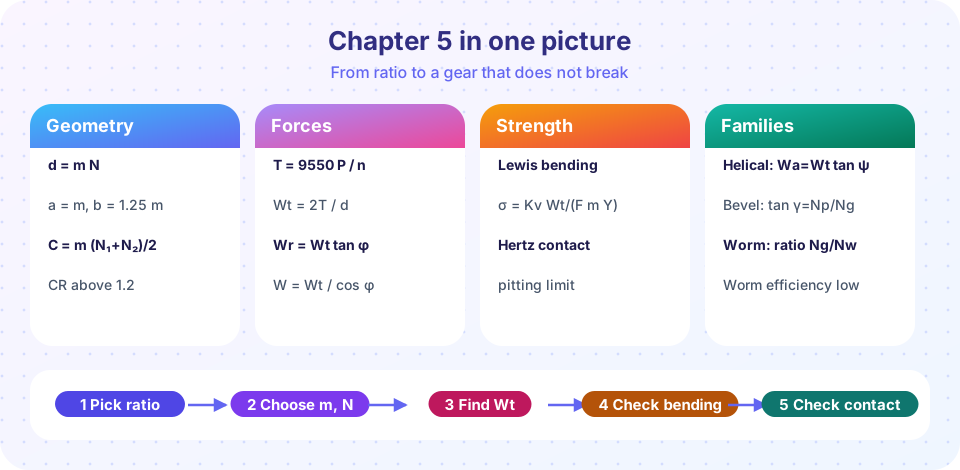
The chapter in a table
| Topic | Key relations | Remember |
|---|---|---|
| Geometry | d = m N, C = m (N1 + N2) / 2, da = m (N + 2), v = π d n / 60 |
Same module and pressure angle to mesh |
| Tooth shape | Involute, base circle db = d cos φ, N_min = 2 / sin² φ ≈ 17 |
Constant ratio, line of action |
| Contact ratio | CR = [√(ra1² − rb1²) + √(ra2² − rb2²) − C sin φ] / (π m cos φ) |
Want at least 1.2, better 1.4 |
| Trains | ratio = product of stage ratios | Idlers reverse direction only |
| Forces | T = 9550 P / n, Wt = 2T / d, Wr = Wt tan φ, W = Wt / cos φ |
Radial load goes to the bearings |
| Bending | σ = Ka Kv Wt / (F m Y) |
Pinion has the smaller Y |
| Contact | σH = 189.8 √[(Wt / (F cos φ))(1/ρ1 + 1/ρ2)], ρ = d sin φ / 2 |
Not dependent on module |
| Helical | d = mn N / cos ψ, Wa = Wt tan ψ |
Needs a thrust bearing |
| Bevel | tan γp = Np / Ng, Wr = Wt tan φ cos γ, Wa = Wt tan φ sin γ |
Force at the mean radius |
| Worm | ratio = Ng / Nw, tan λ = L / (π dw), η = (cos φn − μ tan λ) / (cos φn + μ / tan λ) |
Low efficiency, heat, self-locking |
What you should be able to do now
- Look at a power and a speed and produce a first gear pair: ratio, tooth counts, module, diameters and center distance.
- Compute the tooth force and its components, and pass them on to the shaft and bearing calculations in the next chapters.
- Decide whether bending or contact limits the design, and know which variable to change in each case.
- Explain why a gearbox of helical gears needs thrust bearings, and why a worm drive gets hot.
A worked mixed problem
A 5.5 kW motor at 960 rpm drives a pinion with 18 teeth and module 3 mm, meshing with a gear of 54 teeth. The face width is 30 mm. Here is how the chapter's tools combine, step by step.
- Geometry.
d1 = 3 × 18 = 54 mm,d2 = 162 mm,C = 108 mm, ratio54/18 = 3, output speed960/3 = 320 rpm. Eighteen teeth is just above the undercutting limit of 17, so the pinion is acceptable. - Load.
T = 9550 × 5.5 / 960 = 54.7 N·m, soWt = 2 × 54.7 / 0.054 = 2026 NandWr = 2026 × tan 20° = 738 N. The output torque is about54.7 × 3 × 0.98 = 161 N·m. - Speed.
v = π × 0.054 × 960 / 60 = 2.71 m/s, soKv = (6.1 + 2.71) / 6.1 = 1.44. - Bending. With
Y ≈ 0.309for 18 teeth,σ = 1.44 × 2026 / (30 × 3 × 0.309) = 105 MPa. Against an allowable of 200 MPa that gives a safety factor of about 1.9. - Next. The contact check, the shaft loads (
WtandWrabove) and the bearings follow, exactly as in the projects chapter.
The whole calculation takes five lines, and each line uses one lesson of the chapter. If you can reproduce it without looking, you have understood the chapter.
The most common errors
Four mistakes cause most wrong answers in gear problems. The first is mixing the pitch diameter with the tip diameter, which makes the center distance wrong by one module. The second is forgetting that the pinion, not the gear, governs the bending check. The third is using millimeters for the pitch diameter in Wt = 2T/d and getting a force that is a thousand times too small. The fourth is applying the Lewis equation to a helical or bevel gear without adjusting for the helix angle or the cone angle. If an answer looks odd, check these four first.
Try it
The first TryIt is a small design search. It looks through standard modules, tooth counts and face widths for a 7.5 kW, 1450 rpm drive with a ratio of 4, and keeps only combinations with a bending safety factor of at least 1.25 against 200 MPa, a contact safety factor of at least 1.25 against 900 MPa and a contact ratio of at least 1.4. Then it lists the most compact ones. The allowable stresses are assumed for the exercise; real values come from the material and heat treatment.
Press Run (or Ctrl + Enter) to see the result here.
Program input · what you'd type while the program runs
Type the answers before you press Run, one per line. Each time the program reads a line (with input()), it gets the next line from this box.
The second TryIt is a quick drill. Each question is generated from a fixed set of numbers, and the answers print below. Try to compute them yourself first, then compare.
Press Run (or Ctrl + Enter) to see the result here.
Program input · what you'd type while the program runs
Type the answers before you press Run, one per line. Each time the program reads a line (with input()), it gets the next line from this box.
Check your understanding
Quick check · 10 questions
of 10 answered You scored / 10 · perfect!
-
1. A pair of gears with module 5 mm has 20 and 50 teeth. What is the center distance?
C = m (N1 + N2) / 2 = 5 × 70 / 2 = 175 mm. -
2. Why does the involute profile matter?
The involute gives a straight line of action through the pitch point, so the velocity ratio is constant. -
3. A 4 kW drive runs at 800 rpm. What is the torque?
T = 9550 × 4 / 800 = 47.75 N·m. -
4. Which stress is independent of the module at a given pitch diameter and face width?
Contact stress depends on force, face width and the radii of curvature. Bending stress depends strongly on the module. -
5. For which gear pair is an axial thrust bearing definitely required?
Helical gears produce an axial force Wa = Wt tan ψ. Ideal spur gears produce none. -
6. A 24-tooth pinion with a Lewis Y of 0.337 meets a 96-tooth gear with Y = 0.44 at the same force. Which tooth is weaker in bending?
Stress is inversely proportional to Y, so the pinion with the smaller Y has the higher stress. -
7. A worm has lead 20 mm and pitch diameter 40 mm. What is tan of the lead angle?
tan λ = L / (π dw) = 20 / (π × 40) = 0.159, so λ ≈ 9.0°. -
8. With 20 degree gears, what is the lowest pinion tooth count that avoids undercutting in the standard full-depth system?
N_min = 2 / sin² 20° = 17.1. -
9. A compound train has stage ratios of 4 and 3 and the input turns at 1800 rpm. The output speed is:
Total ratio 12, so 1800 / 12 = 150 rpm. -
10. Why is a worm drive with a small lead angle often warm to the touch?
At small lead angles the efficiency is low, and the lost power becomes heat in the mesh.
Summary
- Geometry (
d = m N,C,v, contact ratio) comes first; force and stress checks use these numbers. T = 9550 P / n,Wt = 2T / d,Wr = Wt tan φgive the load that goes to shafts and bearings.- Bending (module and form factor) and contact (diameter and face width) are separate checks; both must pass.
- Helical gears add thrust, bevel gears turn the axis, worm gears give big ratios but waste power.
Track your progress
Create a free account to tick off lessons and pick up where you left off on any device.
of Machine Design lessons completed