


















Lesson 39 of 47 · Writing About Literature
Thesis and Argument
Learn how to turn a puzzle in a text into a strong literary thesis: tests for a good claim, common weak theses and how to fix them, with examples from Shelley, Shakespeare and Frankenstein.
A thesis is the engine of a literary essay. Every paragraph either supports it, complicates it or builds toward it. When a thesis is weak, an essay drifts: it summarizes, lists techniques, and ends with a sentence that could close any essay on any book. When a thesis is strong, the essay almost writes itself, because each paragraph has a job.
This lesson shows you how to find a thesis, test it, and sharpen it. You will see what weak theses look like, why they fail, and how small changes can turn them into arguments worth reading.
What you will learn
- The difference between a topic, a question, a theme and a thesis.
- Three tests a strong thesis passes.
- Five common kinds of weak thesis, with repairs.
- How to use a counter-reading to make a thesis stronger.
Key terms
- Topic: the general subject, such as ambition in Macbeth.
- Question: a puzzle you want to answer, such as how the play shows ambition's cost.
- Thesis: your arguable answer to the question.
- Counter-reading: a plausible different interpretation that an essay anticipates and answers.
- "So what?": the test of whether the argument matters beyond one small detail.
From topic to thesis
Imagine you are writing about Macbeth. Your topic is ambition. That is too broad to argue. Narrow it into a question by asking how or why: How does the play make ambition feel like a kind of dressing-up? Then answer your own question with a thesis:
Through images of ill-fitting clothing, Macbeth suggests that Macbeth's kingship is something he wears and not something he is, so the murder never makes him truly king.
Notice what this sentence does. It makes a claim (kingship as costume), names a method (clothing images), and implies a significance (the murder fails to deliver what he wanted). A reader can disagree, and the essay can prove it. Early in the play Macbeth asks why he is being dressed in "borrowed robes", and later in the play a nobleman says his title hangs loose about him like a giant's robe on a dwarfish thief. These are the kind of specific details that make the thesis checkable.
Three tests for a strong thesis
- Could a reasonable reader disagree? If everyone would agree, you have a fact, not an argument. "Macbeth is ambitious" fails this test.
- Can you prove it from the text? A thesis must rest on details you can quote. "Shakespeare believed ambition is wrong" fails because you cannot prove what he believed. "The play shows ambition destroying Macbeth's sleep and his marriage" can be proven.
- Does it answer a question and matter? A thesis should explain how or why, and it should survive the "so what?" question. If your claim changes how we understand the play, it passes.
Two extra checks: a good thesis is specific (it names particular features of the text) and focused (one main idea, not five).
Five common weak theses
| Weak type | Example | Problem | Repair |
|---|---|---|---|
| Announcement | "In this essay I will discuss imagery in Ozymandias." | Says what you will do, not what you claim | State the claim: what does the imagery do? |
| Summary | "The poem is about a ruined statue in a desert." | Describes, does not argue | Ask what the description achieves |
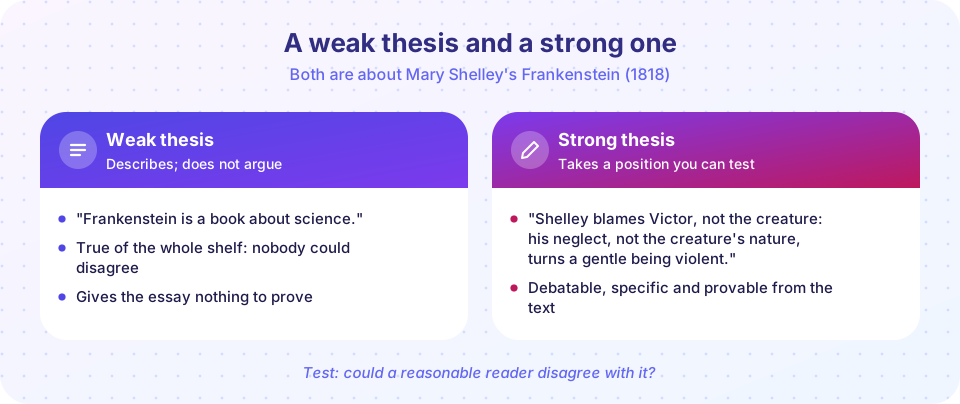
| Fact | "Frankenstein was published in 1818." | Nobody can disagree | Move to interpretation |
| Moral judgment | "Victor is a bad person." | Opinion without analysis | Explain how the text invites the judgment |
| Too broad | "Shelley shows the nature of humanity." | Cannot be proven in one essay | Choose a particular feature and effect |
Worked repair
Start with a typical weak thesis:
Ozymandias is about how power does not last.
It is a theme statement. It is true, but almost every reader would say it, and it does not show how the poem works. Ask: how does the poem make this idea? One striking feature is that the poem is a story within a story. The speaker meets a traveller, who describes a statue, whose sculptor read the king's expression, and the king's own words are carved on the base. A stronger thesis:
By passing the king's boast through three layers of voices, a traveller, a sculptor and the poem's speaker, Shelley suggests that power survives only as a story told by others, and that the sculptor's art outlasts the king's commands.
This thesis names a method (nested voices), makes an argument (power as story; art outlasting boast), and invites proof. The closing lines about the "lone and level sands" support it.
Making a thesis more complex
Sometimes the best thesis admits a complication. A useful form is: Although [a plausible alternative], [text] does [X] by [method], which shows [significance].
For Frankenstein:
Although the creature commits murder, Shelley guides the reader to blame Victor, because the creature's violence follows only after the neglect and rejection he suffers.
The "although" clause names a counter-reading (the creature is a monster) and then answers it. Essays with complex theses tend to be more interesting, and they prepare you for the counter-argument section in a body paragraph.
Answering prompts
Teachers often supply a prompt: "To what extent does Shelley sympathize with the creature?" "How does the poet use imagery to convey loss?" "Compare the treatment of a double life in two novels." Always answer the question as asked. Use its key words in your thesis. If the prompt says "to what extent", your thesis should say how far the claim holds and where it stops ("largely" or "only partly"). If it says "compare", the thesis must name a point of comparison and a conclusion about the two, not describe them separately.
Testing and revising your thesis
Write a first thesis early, and treat it as provisional. As you gather evidence, ask: Does the evidence support it? Are there passages that contradict it? Contradictions are gifts. They show you where the argument needs to be more precise. Experienced writers often change the thesis after the first draft, because writing reveals what they actually think. The final thesis should match the essay you actually wrote, and the introduction should be revised to say so.
A quick checklist:
- It is a full sentence, not a topic or a question.
- A reasonable reader could disagree.
- It names specific features of the text.
- It explains how or why, not just what.
- It matters: a reader would learn something.
- I can prove it using short quotations.
"A thesis must be a great discovery." It must be arguable and supported, not world-shattering.
"A thesis cannot change." Revising it as you learn is part of good writing.
"A thesis with 'because' or 'by' is too long." Often the connector is what makes it an argument.
Try it
Check your understanding
Quick check · 5 questions
of 5 answered You scored / 5 · perfect!
-
1. Which of these is a thesis rather than a topic?
Only the second makes a debatable claim, names a method and implies significance. -
2. Which test asks whether a claim passes the 'so what?' question?
A strong thesis changes how we understand the text, not just describes a detail. -
3. Why is 'Frankenstein was published in 1818' a weak thesis?
A thesis must be arguable; facts are evidence or background, not arguments. -
4. What does an 'although' clause in a thesis usually do?
It acknowledges a plausible alternative before arguing for your reading. -
5. When your evidence contradicts your thesis, what should you do?
Contradictions show where the argument needs to be more precise.
Summary
- A thesis is an arguable answer to a question about how or why a text works.
- Test it: Can someone disagree? Can I prove it from the text? Does it matter?
- Weak types include announcements, summaries, facts, moral judgments and over-broad claims.
- Complex theses acknowledge counter-readings, and a thesis can change as you learn from your evidence.
Next: Evidence and Quotation
Track your progress
Create a free account to tick off lessons and pick up where you left off on any device.
of Introduction to Literature lessons completed