


















Lesson 29 of 47 · Literary Movements
Romanticism and Realism
Compare Romanticism and Realism: Wordsworth, Keats, Mary Shelley and Blake against George Eliot, Flaubert and Tolstoy, with historical context and practice passages.
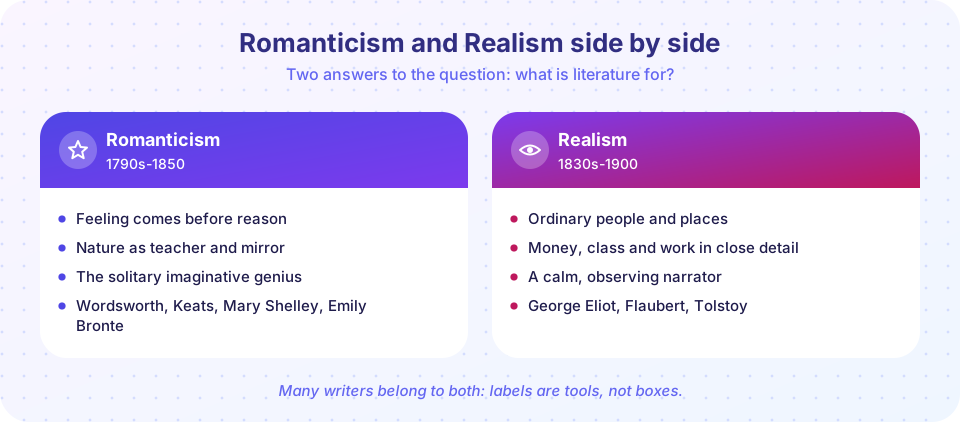
Two movements dominate the nineteenth century in European and American literature, and they pull in nearly opposite directions. Romanticism trusts feeling, nature and the individual imagination. Realism trusts careful observation of ordinary social life. One looks at a storm and asks what it means for the soul; the other looks at the landlord's receipt and asks who pays the rent.
Understanding both, and how they overlap, gives you a strong base for everything that follows. Later movements are often best understood as answers to these two.
What you will learn
- The historical background and main features of Romanticism.
- The aims and techniques of Realism and its offshoot, Naturalism.
- How to tell the two apart in a short passage, and where they blur.
- Why labels like these are tools for questions, not boxes.
Key terms
- The sublime: an experience of awe and fear before something vast, such as a mountain or storm.
- Lyric: a short poem expressing personal feeling.
- Realism: a style that aims to show ordinary life and society with accurate detail.
- Naturalism: an extreme form of Realism that treats people as shaped by heredity and environment.
- Free indirect discourse: narration that slips into a character's thoughts without quotation marks.
Romanticism
Background
Romanticism arose in the late eighteenth century, in Germany, Britain and France, and flourished until the middle of the nineteenth. Its background includes the French Revolution (1789), which seemed to promise a new world, the Industrial Revolution, which was changing landscapes and cities, and an Enlightenment faith in reason that Romantic writers thought was too narrow.
Features
Romantic writers valued:
- Feeling and imagination over cold reason. Wordsworth, in the Preface to the second edition of Lyrical Ballads (1800), called good poetry "the spontaneous overflow of powerful feelings", though he added that it is shaped by calm reflection afterward.
- Nature as a teacher, a mirror of the soul and a source of the sublime. The daffodils in Wordsworth's "I wandered lonely as a cloud" and the storm in Coleridge's poems are not scenery but states of mind.
- The individual: the lonely genius, the outcast, the rebel. Lord Byron's heroes and Mary Shelley's Victor Frankenstein are different versions of this figure.
- The past, the folk and the strange: medieval tales, ballads, ghosts and Gothic castles, from Horace Walpole's The Castle of Otranto (1764) onward.
- Poetry as vision: William Blake's Songs of Innocence and of Experience (1794) combined verse and his own engravings to challenge conventional morality.
Key British figures include Blake, Wordsworth, Coleridge, Byron, Percy Shelley and Keats. John Keats, in a letter, praised "negative capability", the ability to remain in uncertainty without grasping after fact. Mary Shelley's Frankenstein (1818) mixes Gothic horror with questions about science and responsibility. Emily Brontë's Wuthering Heights (1847) carries Romantic passion into the novel.
Romanticism was international. Goethe's The Sorrows of Young Werther (1774) set off a wave of sentimental feeling in Germany. Pushkin's Eugene Onegin is a Russian landmark. In the United States, Emerson, Poe, Hawthorne, Melville and Whitman, the "American Renaissance", took up themes of nature, the individual and darkness.
Realism
Background
Realism emerged in the 1830s and 40s, especially in France and Britain, and became dominant by mid-century. It was fed by a growing middle-class reading public, magazines and serialized novels, and by the sense that the world was being transformed by industry and science. The task of the novelist, many believed, was to describe society as it really was.
Features
Realist writers aimed for:
- Ordinary people and settings: clerks, farmers, wives, landlords, not just kings and heroes.
- Detail: the price of bread, the furniture of a parlor, the sound of a street. Money, class, work and marriage drive plot.
- A balanced, observing narrator, often with irony, who explains how society works. In Madame Bovary (1857), Gustave Flaubert follows Emma Bovary's boredom and debts with close, unsentimental attention. The novel was prosecuted for offending public morals; Flaubert was acquitted.
- Moral and psychological complexity. George Eliot (the pen name of Mary Ann Evans) in Middlemarch (1871 to 1872) shows a town of interlinked lives, where small choices have large consequences. Leo Tolstoy's Anna Karenina (1878 in book form) and Fyodor Dostoevsky's Crime and Punishment (1866) dig into the minds of their characters.
- Everyday speech: Mark Twain's Adventures of Huckleberry Finn (1884) uses regional dialect, a move toward realism in language itself.
Naturalism, associated with Émile Zola in France (Germinal, 1885) and Thomas Hardy in England (Tess of the d'Urbervilles, 1891), pushes further. It portrays people as shaped by heredity, environment and economic forces, often with a pessimistic cast.
A technique often credited to this tradition is free indirect discourse: the narrator slides into a character's thoughts without quotation marks. For example, "She would never be so foolish again" could be the narrator's report or Emma's resolve. It lets the reader hear a character's mind and judge it at once.
Where they overlap
The two movements are not clean opposites. Dickens mixes social observation with fantasy and sentiment. The Brontës combine Romantic intensity with a detailed provincial setting. The great Russian novelists often pair careful social description with spiritual crisis. Even Wordsworth wrote about rural poverty, and Eliot admired his poems. A better way to see the difference is as a matter of emphasis: what a writer treats as the most interesting reality, feeling or society.
"Romantic means love stories." In literary history, Romantic refers to a period and a set of values (imagination, nature, the individual), not romance as such.
"Realism means everything in the book is true." Realism is a set of techniques that create the effect of reality. Realist novels are still invented, selective and shaped.
"Romantics hated science." Many Romantics were curious about science; Mary Shelley, for example, drew on the scientific debates of her day.
Reading tip: ask what counts as real
When you read a Romantic poem, ask what the landscape is for: is it a place, or a mirror of the speaker's mind? When you read a Realist novel, ask what the detail is for: is the price of a coat there to build a world, to show a character's pride, or to make a point about class? In both cases the choices are deliberate, and noticing them is the first step of analysis. A good habit is to note one detail in each passage that you would not expect, and ask what it adds.
Try it
Press Run (or Ctrl + Enter) to see the result here.
Program input · what you'd type while the program runs
Type the answers before you press Run, one per line. Each time the program reads a line (with input()), it gets the next line from this box.
Check your understanding
Quick check · 5 questions
of 5 answered You scored / 5 · perfect!
-
1. Which pair of values is most associated with Romanticism?
Romantic writers valued feeling, imagination, nature and the individual over narrow rationalism. -
2. What is the sublime?
The sublime describes the mixed awe and terror of encountering mountains, storms or other overwhelming nature. -
3. Which novel is a major example of Realism?
George Eliot's Middlemarch (1871 to 1872) is a landmark of Realism, showing a town's interlinked lives in close social detail. -
4. What does free indirect discourse do?
It blends the narrator's voice with a character's mind, which suits Realism's interest in psychology. -
5. Which statement about the two movements is most accurate?
Many writers mix Romantic and Realist features, so the contrast is a matter of emphasis.
Summary
- Romanticism (about 1790s to 1850) values feeling, nature, imagination and the individual, in the age of revolution and industry.
- Realism (about 1830s to 1900) aims at ordinary life, social detail, money and class, with a balanced narrator.
- Naturalism extends Realism with a view of people as shaped by heredity and environment.
- The movements overlap in many writers, so treat labels as questions about emphasis.
Track your progress
Create a free account to tick off lessons and pick up where you left off on any device.
of Introduction to Literature lessons completed