


















Lesson 34 of 47 · Theory and Criticism
Text and Reader: Formalism, Structuralism and Reader-Response
Learn where meaning lives: the New Critics' close reading, structuralist patterns in Saussure and Propp, and reader-response ideas from Rosenblatt, Iser and Fish.
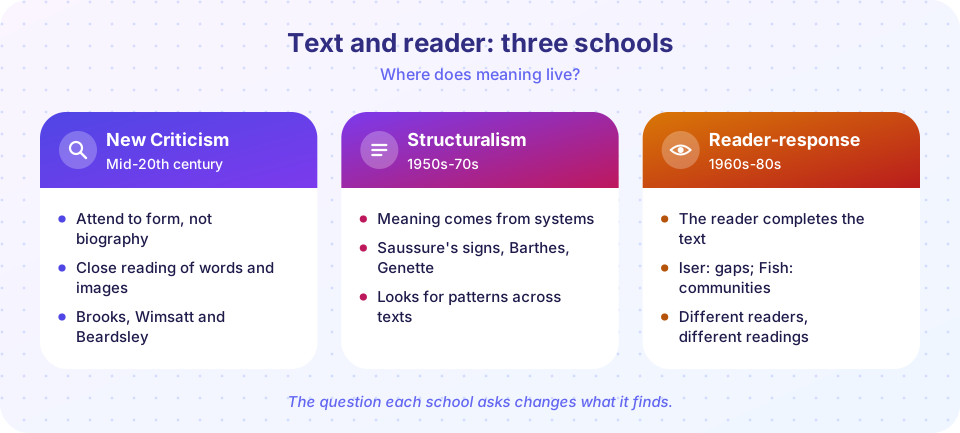
Where does a poem's meaning come from? One answer says: from the words, the way they are arranged. A second says: from the system of conventions that readers and writers share. A third says: from the person reading, who brings experience and expectations. These three answers define the schools in this lesson, and each has left a mark on how literature is taught today.
You will meet them in historical order. Formalism and New Criticism dominated the first half of the twentieth century. Structuralism followed, borrowing ideas from linguistics. Reader-response grew in reaction to both, and put the reader at the center.
What you will learn
- The aims and methods of Russian Formalism and New Criticism.
- Core structuralist ideas: the sign, binary oppositions and narrative patterns.
- The main reader-response and reception theories, and their critics.
- When each lens is most useful, and where each falls short.
Key terms
- Close reading: careful attention to the words, images, sound and structure of a text.
- Defamiliarization: a technique that makes the familiar seem strange so that we really see it.
- Signifier and signified: Saussure's terms for a sign's form (the word) and the concept it points to.
- Binary opposition: a pair of contrasting terms, such as nature and culture.
- Implied reader: the kind of reader a text seems to expect.
Formalism and New Criticism
Russian Formalism
In the 1910s and 1920s, a group of Russian scholars, including Viktor Shklovsky and Roman Jakobson, argued that literary study should be a science of literary devices. Shklovsky's essay "Art as Technique" (1917) introduced defamiliarization (ostranenie): art takes the automatic, habitual ways we see things and makes them strange, so that perception becomes slow and noticeable again. Think of a narrator who describes a theatre performance as though he were a visitor from another planet: ordinary actions suddenly look odd and interesting. Vladimir Propp's Morphology of the Folktale (1928) analyzed a hundred Russian fairy tales and found that they share a small set of repeated "functions", such as a villain's attack and a hero's departure, in a fixed order.
New Criticism
In the English-speaking world, a similar impulse produced New Criticism in the 1920s to the 1950s. I. A. Richards, in Practical Criticism (1929), gave Cambridge students poems with authors' names removed and recorded their reactions. Many students misread, and Richards concluded that careful reading was a skill that had to be taught. American critics such as Cleanth Brooks, W. K. Wimsatt and Monroe Beardsley developed a method of close reading that shaped how literature has been taught ever since.
Their key ideas included:
- The text as a unified object. A good poem is an organic whole in which tension, irony and paradox are resolved. Brooks, in The Well Wrought Urn (1947), spoke of the "heresy of paraphrase": a poem's meaning cannot be separated from its form.
- The intentional fallacy (Wimsatt and Beardsley, 1946): the author's intention is neither available nor desirable as a standard of judgment. The text is public, and we can only argue from it.
- The affective fallacy (1949): judging a poem by its emotional effect on the reader confuses what the poem is with what it does.
The strengths of this approach are real: attention to detail, a shared method and a habit of evidence. The weaknesses are real too. By ignoring history, authors and politics, it can make poems seem to float outside the world. Later critics attacked this narrowness, but almost every one of them still uses close reading.
Structuralism
Structuralism draws on Ferdinand de Saussure's Course in General Linguistics (published after his death, in 1916). Saussure argued that a sign has two parts: the signifier (the sound or written form) and the signified (the concept). The link between them is arbitrary, and meaning comes from differences within a system: "cat" means what it does because it is not "bat" or "cap".
Structuralists extended this thinking beyond language. The anthropologist Claude Lévi-Strauss analyzed myths as systems built on binary oppositions such as raw and cooked or nature and culture. In literary studies, structuralists asked how narratives are built. Gérard Genette developed a vocabulary for time and voice in narrative (order, duration, frequency, narrator levels). Roland Barthes, in works like S/Z (1970), divided a story into five "codes" that readers use to make sense of it. Propp's functions fit here too.
A structuralist critic might ask: what are the oppositions at work in a text (home and away, wild and tame)? How does the story follow a familiar pattern? What would change if one element were replaced? The method is excellent for showing how conventions work and for comparing many texts. It tends to be less interested in what makes one particular text special, and in the experience of reading it.
Reader-response and reception
By the 1960s, some critics argued that a text is incomplete until somebody reads it. Several versions of this idea appeared:
- Louise Rosenblatt (Literature as Exploration, 1938, and The Reader, the Text, the Poem, 1978) described reading as a "transaction" between reader and text. She distinguished efferent reading, which seeks information to take away, from aesthetic reading, which attends to experience in the moment.
- Wolfgang Iser (The Act of Reading, 1976) argued that texts contain gaps that readers fill, guided by an implied reader the text seems to address. Think of how a mystery leaves clues but not conclusions.
- Hans Robert Jauss developed reception theory, which asks how works are received over time. Readers bring a "horizon of expectations", and a work's meaning changes as that horizon shifts.
- Stanley Fish (Is There a Text in This Class?, 1980) said that meaning is produced by interpretive communities: groups of readers who share strategies. A class of lawyers and a class of poets read the same text differently because they have learned to read in different ways.
Roland Barthes's essay "The Death of the Author" (1967) pushed in the same direction, ending with the claim that the birth of the reader must be paid for by the death of the author.
The obvious worry is relativism: if the reader makes meaning, can any reading be right? Reader-response critics answer in different ways. Iser says the text constrains readers through its gaps. Fish says communities constrain interpretation. Most teachers use a middle rule: readings should be grounded in the text, while acknowledging that readers differ.
"New Critics said biography is useless." They said authorial intention is not a standard of judgment. Many of them used history and biography carefully.
"Reader-response means any reading is as good as any other." Most reader-response critics argue that readings must be defended with evidence and with reference to a community's standards.
"Structuralism ignores meaning." It shifts attention from single meanings to systems that make meaning possible.
Try it
Press Run (or Ctrl + Enter) to see the result here.
Program input · what you'd type while the program runs
Type the answers before you press Run, one per line. Each time the program reads a line (with input()), it gets the next line from this box.
Check your understanding
Quick check · 5 questions
of 5 answered You scored / 5 · perfect!
-
1. What does defamiliarization (Shklovsky) aim to do?
Art makes the automatic seem strange, which slows perception and renews attention. -
2. What is the intentional fallacy?
Wimsatt and Beardsley argued that the text, not the author's intention, is the proper object of criticism. -
3. In Saussure's theory, what links a signifier and a signified?
The link is arbitrary, and meaning arises from differences in the system. -
4. Which critic spoke of 'interpretive communities'?
Fish argued that groups of readers who share strategies produce meaning. -
5. What is the main worry about reader-response criticism?
If readers make meaning, critics ask how to tell better readings from worse. Different theorists answer differently.
Summary
- Formalism and New Criticism treat the text as an object and teach close reading, but risk ignoring history and authors.
- Structuralism applies Saussure's ideas of the sign and difference to myths and narratives, revealing patterns and binary oppositions.
- Reader-response theories (Rosenblatt, Iser, Jauss, Fish) argue that meaning is completed by readers and reading communities.
- Each lens is best for certain questions, and each has well-known blind spots.
Track your progress
Create a free account to tick off lessons and pick up where you left off on any device.
of Introduction to Literature lessons completed