


















Lesson 32 of 47 · Literary Movements
Chapter Review: Literary Movements
Recap Chapter 6: Romanticism, Realism, Modernism, Postmodernism and postcolonial writing, with a one-page summary, a comparison table, a sorting game and a ten-question quiz.
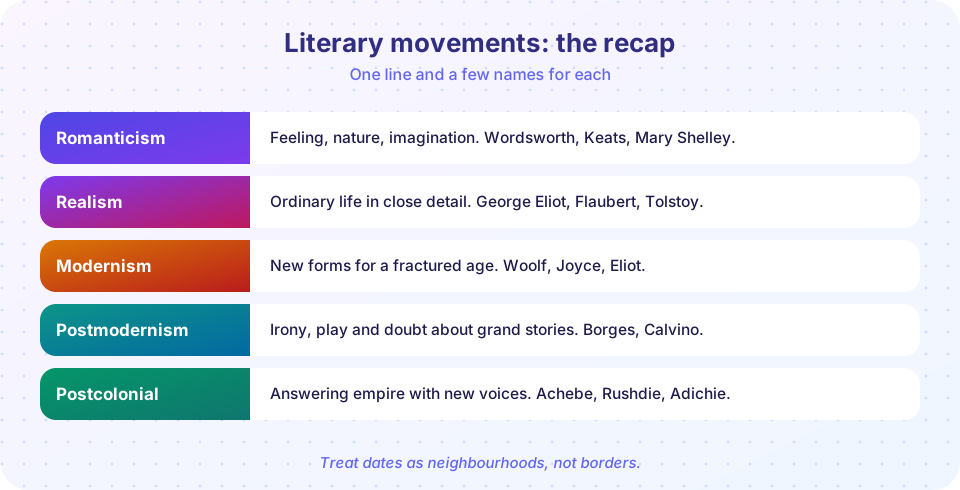
You have walked through two centuries of writing and across several continents. The goal of this review is not to make you memorize dates but to give you a map you can carry into any reading: for each movement, a few questions, a few names, and a sense of what it was reacting to.
What you will learn
- A one-line summary and example writers for each movement.
- How movements react to each other.
- How well you can place a writer or technique in context.
The chapter in a table
| Movement | Rough dates | Core idea | Techniques | Key works |
|---|---|---|---|---|
| Romanticism | 1790s to 1850 | Feeling, nature, imagination | Lyric, sublime, Gothic, the outcast hero | Lyrical Ballads, Frankenstein, Keats's odes |
| Realism | 1830s to 1900 | Ordinary life in social detail | Omniscient narrator, free indirect discourse, close detail | Madame Bovary, Middlemarch, Anna Karenina |
| Modernism | c. 1900 to 1945 | New forms for a fractured age | Stream of consciousness, collage, multiple viewpoints | Ulysses, Mrs Dalloway, The Waste Land |
| Postmodernism | c. 1945 onward | Play, irony, doubt about grand stories | Metafiction, pastiche, intertextuality | Gravity's Rainbow, If on a winter's night a traveler |
| Postcolonial | 1950s onward (and earlier roots) | Answering empire, recovering voices | Hybrid forms, code-switching, retelling | Things Fall Apart, Wide Sargasso Sea, Midnight's Children |
How the movements answer each other
- Romanticism answers the Enlightenment's emphasis on reason with feeling and imagination.
- Realism answers Romanticism's fantasy with observation of ordinary life and social causes.
- Modernism answers Realism's confident order with fragments and inner experience.
- Postmodernism answers Modernism's seriousness with irony, play and doubt.
- Postcolonial writing answers the empires that produced many of these literatures, and asks who has been writing, and who has been written about.
Using movements in your own writing
Movement labels are most useful in an essay when they serve a claim, not when they decorate an introduction. Compare two weak and strong uses:
- Weak: "This novel is a good example of Realism."
- Stronger: "By following the debts and rent of an ordinary household in close detail, the novel presents money as the force that shapes every private choice, a Realist concern with society that Romantic writers often set aside."
The second version names a feature of the text, links it to a movement's aims, and makes a comparison. It also leaves room for the text to be more than one thing.
Two study habits help. First, build a personal timeline: write the dates of a dozen works you know on one line and label the movement each seems to belong to, then circle the works that do not fit neatly. The misfits are usually the most interesting. Second, when you read a new work, ask what it is reacting against. A writer who stops using a long, tidy plot or a calm narrator is telling you something about the style they reject.
Common misconceptions
"A writer belongs to exactly one movement." Many writers cross boundaries. Dickens mixes Realist detail with Romantic sentiment, and Beckett sits between Modernism and Postmodernism.
"Movements are universal." The labels come mainly from European and North American history. Other traditions have their own periods and turning points.
Try it
Check your understanding
Quick check · 10 questions
of 10 answered You scored / 10 · perfect!
-
1. Which movement is most associated with the sublime and the lonely imaginative genius?
The sublime, nature and the solitary imaginative figure are central to Romanticism. -
2. Which technique is typical of Realist novels?
Realists such as Flaubert and Eliot used free indirect discourse and detailed description of ordinary life. -
3. Which writer is most associated with stream of consciousness?
Woolf, along with Joyce, is a leading modernist user of stream of consciousness. -
4. What did Lyotard mean by incredulity toward metanarratives?
It is his short description of postmodern doubt about grand organizing stories. -
5. Which work gives a voice to the first Mrs Rochester of Jane Eyre?
Jean Rhys's Wide Sargasso Sea (1966) imagines Bertha Mason's Caribbean past. -
6. Why is it risky to treat movement labels as boxes?
Labels are tools. Writers often mix features, and the boundaries are blurry. -
7. Which pair of terms best describes Achebe's concern in Things Fall Apart?
The novel shows a complex Igbo society and its disruption by missionaries and colonial government. -
8. Which text is best known as a fragmented modernist poem?
Eliot's The Waste Land (1922) is built from fragments, voices and allusions. -
9. What do postcolonial writers often do with language?
Some, like Achebe, adapt English; others, like Ngũgĩ, choose African languages. -
10. Which reaction chain is correct?
Each movement partly defines itself against the one before it.
Summary
- Five movements, five questions: feeling and nature; ordinary life; broken forms; play and doubt; voices answering empire.
- Movements react to each other, overlap, and are shaped by history.
- Treat labels as tools for asking better questions of a text.
Track your progress
Create a free account to tick off lessons and pick up where you left off on any device.
of Introduction to Literature lessons completed