


















Lesson 17 of 47 · Fiction and Narrative
Fiction: an overview
A clear overview of fiction and narrative: the difference between story and plot, the four building blocks, a short history of the novel and the short story, and how to read prose fiction.
Humans tell stories. We tell them at the dinner table, in the playground and around a fire, and we have done so for as long as we have had language. Fiction is the art of story made on purpose: invented people, events and places, shaped into a narrative that holds attention and, with luck, tells us something true about being alive. This chapter shows you how fiction works from the inside. Four building blocks, plot, character, point of view and setting, carry almost every story you have ever loved.
What you will learn
- The difference between story and plot.
- The four building blocks of fiction.
- A short history of the novel and the short story.
- What readers should notice in the opening of a story.
- How the lessons in this chapter fit together.
Key terms
Narrative is an account of connected events; fiction is narrative about invented people and events.
Story is the sequence of events in time order; plot is how the events are arranged and connected by cause.
Narrator is the voice that tells the story.
Novel, novella and short story are fiction forms sorted by length.
Realism is the aim to portray ordinary life truthfully; fantasy and science fiction invent worlds that differ from ours.
Story and plot
The novelist E. M. Forster gave a famous distinction in Aspects of the Novel (1927). "The king died and then the queen died" is a story: events in time order. "The king died, and then the queen died of grief" is a plot: the events are linked by cause. A plot is not just what happens, but why one thing leads to another, and how the writer arranges the information. Plots can start in the middle, jump back in time or hold back a crucial fact. The next lessons explore this in detail, beginning with plot and structure.
The four building blocks
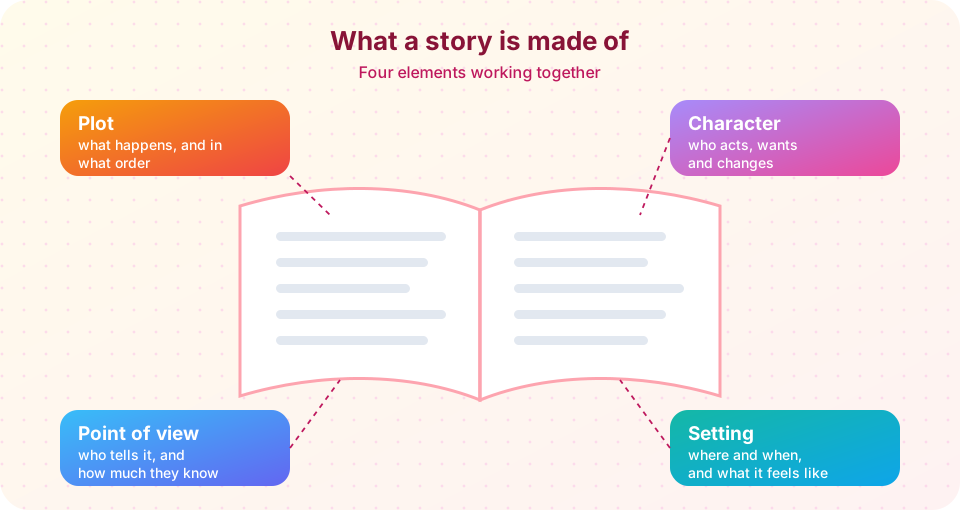
- Plot is the arrangement of events and the tension that drives readers forward.
- Character is who acts, wants and changes. Strong fiction usually grows from a person we care about. See character.
- Point of view is who tells the story and how much they know or reveal. See point of view.
- Setting is where and when the story happens, and the atmosphere that surrounds it. See setting and atmosphere.
These four interlock. A change in one changes the others. Tell the same events from a different narrator and they become another story. Move a plot to a different time and the characters must act differently. When you analyze a story, you are asking how the four elements work together to produce its effect and meaning.
Plot
Character
Point of view
Setting
A short history of fiction
Stories are ancient: Egyptian tales, Sanskrit collections such as the Panchatantra, and the stories of One Thousand and One Nights all circulated long before printing. The modern novel is usually traced to early seventeenth-century Spain, where Miguel de Cervantes published Don Quixote (1605 and 1615), the story of a man who reads too many chivalric romances. In England, writers such as Daniel Defoe (Robinson Crusoe, 1719) and Samuel Richardson (Pamela, 1740) helped make the novel a popular form, and in the nineteenth century it became the dominant literary genre, with Jane Austen, Charles Dickens, the Brontë sisters, George Eliot, Leo Tolstoy, Fyodor Dostoevsky and Gustave Flaubert among its masters.
The short story came into its own in the nineteenth century, in magazines. In an 1842 review of Nathaniel Hawthorne's tales, Edgar Allan Poe argued that a short story, read in one sitting, should aim for a single "unity of effect," with every word contributing. Anton Chekhov in Russia and Guy de Maupassant in France added new subtlety, and many twentieth-century writers, from Katherine Mansfield to Jorge Luis Borges, kept reinventing the form. Today fiction is written and read in every language, and stories appear as novels, short stories, serials, graphic novels, audio and interactive games.
Openings: a worked example
A story's first lines do a great deal of work. They introduce a voice, a situation and a promise. Compare three famous openings, all in the public domain.
Moby-Dick (1851), Herman Melville: "Call me Ishmael. Some years ago—never mind how long precisely—having little or no money in my purse, and nothing particular to interest me on shore, I thought I would sail about a little and see the watery part of the world."
Great Expectations (1861), Charles Dickens: "My father's family name being Pirrip, and my Christian name Philip, my infant tongue could make of both names nothing longer or more explicit than Pip."
Pride and Prejudice (1813), Jane Austen: "It is a truth universally acknowledged, that a single man in possession of a good fortune, must be in want of a wife."
What each tells you. Melville's narrator speaks to us directly in the first person, with a casual, confiding tone ("call me Ishmael" invites us to use the name without claiming it is his real one). Dickens's narrator is also "I," but an adult recalling his childhood, with gentle humor: the point of view looks back. Austen's narrator uses no "I" at all; the voice is general, authoritative and ironic, a third-person narrator who stands above the characters. In three sentences, the point of view, tone and character have already been set. Notice, too, what is missing: none of them begins with explosions. They begin with a voice.
How to read fiction
- Read once for the story. Follow events and feelings.
- Reread for the four elements. Trace the plot's turning points, the character's wants, the narrator's perspective and the setting's mood.
- Notice patterns. Repeated images, parallel scenes and echoing phrases (see symbol, motif and theme).
- Ask what changes. At the end, what is different for the character, the world or the reader's view?
- Ask about omission. What does the narrator leave out, and why?
Common misconceptions
"Fiction is lies." Fiction does not claim to report fact. It invents situations in order to explore feelings and ideas that can be true to life.
"The narrator is the author." The narrator is a voice the author creates, sometimes unreliable.
"A good story needs lots of action." Many great stories are quiet. Tension can come from a secret, a choice or a silence.
Try it
Generate a story seed, then measure whose voice an opening uses.
Press Run (or Ctrl + Enter) to see the console output here.
No output.
Check your understanding
Quick check · 5 questions
of 5 answered You scored / 5 · perfect!
-
1. In Forster's distinction, what turns a story into a plot?
'The king died and then the queen died of grief' links the events by cause, making it a plot. -
2. Which is NOT one of the four building blocks in this chapter?
The four blocks are plot, character, point of view and setting. -
3. Don Quixote (1605) is often cited as the start of
Cervantes's book is widely regarded as the first modern novel. -
4. What did Poe say a short story should aim for?
Poe argued that every element should contribute to one overall effect. -
5. Austen's opening of Pride and Prejudice uses
The narrator speaks in a general, authoritative voice without saying 'I'.
Summary
- Fiction is invented narrative; a story is events in time order, a plot links them by cause.
- Four building blocks, plot, character, point of view and setting, interlock in every story.
- The novel grew from early modern Spain and England; the short story flourished in the nineteenth century.
- Openings introduce a voice, a situation and a promise.
- Read once for story, again for the four elements, patterns and change.
Next: Plot and structure
Track your progress
Create a free account to tick off lessons and pick up where you left off on any device.
of Introduction to Literature lessons completed