


















Lesson 20 of 47 · Fiction and Narrative
Point of view: who tells the story?
Understand first, second and third person narration, limited and omniscient narrators, free indirect discourse and unreliable narrators, with a same-scene comparison and examples from Twain and Fitzgerald.
Every story has a teller, and the teller's position changes everything. A bank robbery told by the robber is a thriller; told by the teller behind the glass it is a nightmare; told by an all-seeing voice that knows the guard is secretly in on it, it becomes a puzzle. Point of view (sometimes called narrative perspective) is the answer to two questions: who is telling the story, and how much do they know? In this lesson you will meet the standard options and learn to ask what each one gains and what it hides.
What you will learn
- The three persons of narration and their effects.
- The difference between limited and omniscient third person.
- Free indirect discourse and stream of consciousness.
- Reliable, unreliable and naive narrators.
- How to describe and analyze a narrator's choices.
Key terms
Point of view is the perspective from which a story is told.
First person uses "I" or "we"; second person addresses "you"; third person uses "he," "she," "they."
Limited narration stays with one character's knowledge; omniscient narration knows everything.
Free indirect discourse blends a narrator's voice with a character's thoughts without quotation marks.
Unreliable narrator is a teller whose account cannot be fully trusted.
First person
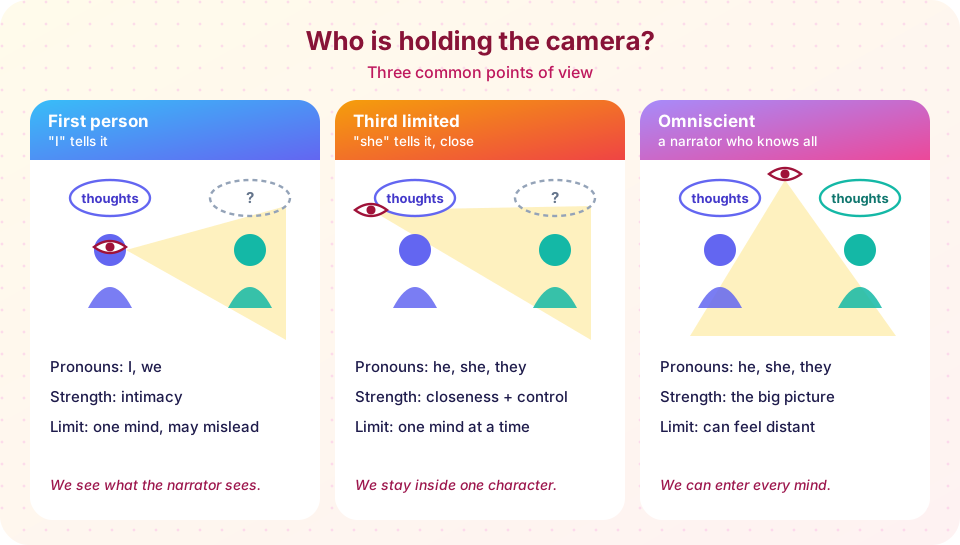
In first person the narrator is a character who says "I." This creates intimacy and voice: we feel we are listening to a real person. But it also limits what we can know to what the narrator sees, remembers and chooses to tell. First-person narrators come in several types.
- Protagonist narrators tell their own story, such as Pip in Dickens's Great Expectations or Jane Eyre, whose famous line "Reader, I married him" speaks directly to us.
- Witness narrators tell someone else's story from the side. In F. Scott Fitzgerald's The Great Gatsby, Nick Carraway watches and reports on Gatsby. Nick says he was "within and without, simultaneously enchanted and repelled by the inexhaustible variety of life," which is also a statement about the position of a witness narrator.
- Retrospective narrators look back on the past from an older age, so there are really two selves: the experiencing "I" and the telling "I." Dickens uses this in Great Expectations, where the older Pip comments on his younger self.
A strong first-person voice carries a lot of character. Mark Twain's Huck Finn begins, "You don't know about me without you have read a book by the name of The Adventures of Tom Sawyer; but that ain't no matter." The dialect, the comic casualness and the speaker's confidence all come through a single sentence.
Second person
Second person addresses the reader as "you": "You open the door and step into the dark." It is rare in novels, though it appears in some experimental fiction and in interactive stories and role-playing games. It can create immediacy or a feeling of being implicated, but over a long text it can feel strange or demanding.
Third person
In third person, the narrator stands outside the story and uses "he," "she" and "they." There are several versions.
Third-person limited. The narrator follows one character closely and knows only what that character knows and feels. We see the world through them, in the narrator's own words. This creates closeness without a spoken "I."
Third-person omniscient. The narrator knows everything: every character's thoughts, the past, the future, things nobody present could know. Jane Austen and George Eliot used it with great wit, and Tolstoy's War and Peace ranges over a whole society. The omniscient voice can comment on events, as Austen's does in her famous openings, and can compare minds. The cost is that it can feel distant, or as if the narrator is a character of their own.
Third-person objective (or dramatic). The narrator reports only what could be seen and heard, like a camera, and never enters anyone's mind. We must infer thoughts from behavior. Ernest Hemingway's short story "Hills Like White Elephants" (1927) is the classic example: two people talk at a railway station, and the narrator tells us nothing about what either is thinking.
Free indirect discourse and stream of consciousness
Free indirect discourse is a technique that slips a character's thoughts into the narrator's voice, without quotation marks or "she thought." Here is an invented example: "Ana looked at the board. Forty minutes! He could at least have called." The exclamation and the complaint belong to Ana, but they appear in the narrator's flow. Jane Austen was one of the first English novelists to use it extensively, and the French novelist Gustave Flaubert made it famous. It lets a narrator be close to a character and still keep some distance, so that a gap, even a small irony, can open.
Stream of consciousness goes further, trying to reproduce the unedited flow of a mind, with its jumps and associations. Virginia Woolf's Mrs Dalloway (1925) moves smoothly from one mind to another, and James Joyce's Ulysses (1922) ends in an almost unpunctuated rush of thought.
Reliable, unreliable and naive narrators
A reliable narrator gives an account we can trust. An unreliable narrator gives an account that is distorted by bias, madness, self-interest, limited knowledge or deliberate lies. You met one in Poe's "The Tell-Tale Heart" (see tone and irony). Reading an unreliable narrator means reading between the lines: noticing the gap between what is said and what the facts suggest.
A naive narrator is sincere but lacks understanding. Huck Finn is a famous example. He believes that helping a runaway enslaved man, Jim, to freedom is a sin that will send him to hell, yet his actions show a moral instinct stronger than the lessons he was taught. The reader sees more than Huck does, and that gap between the narrator's understanding and the reader's is dramatic irony (see tone and irony). Mark Twain's novel depends on the gap.
The same scene, three ways
The best way to feel the differences is to rewrite one scene. Here is an invented scene at a station.
First person: "I checked the board again. Leo was forty minutes late, and I was already composing the speech I would give him."
Third-person limited: "Ana checked the board again. Leo was forty minutes late, and she was already composing the speech she would give him."
Omniscient: "Ana checked the board again, composing a speech. Across the platform, Leo, who had missed the train on purpose, wished he had the courage to walk up and apologize. Neither of them noticed the porter, who had seen them both before."
Notice what the omniscient version can do: it reveals a secret (Leo missed the train on purpose), creates dramatic irony (the reader knows what Ana does not) and widens the world (the porter). It loses the intimate feel of Ana's own voice.
How to analyze point of view
- Identify the person (first, second, third) and the tense (past or present).
- Decide how much the narrator knows: one mind, many minds, everything.
- Ask how close the narrator stays to the characters.
- Look for gaps between what the narrator says and what the evidence shows.
- Ask why the writer chose it. What would be lost or gained with another point of view?
Common misconceptions
"The narrator is the author." A narrator is a voice the author creates. Even a narrator who sounds like the author may be a persona.
"First person is always more honest." First-person narrators can lie, mislead or misunderstand.
"Omniscient narrators have no personality." Many have strong, opinionated voices, like Austen's or Dickens's.
Try it
Switch between the three versions of the scene, then count pronouns to see the pattern.
Press Run (or Ctrl + Enter) to see the result here.
Program input · what you'd type while the program runs
Type the answers before you press Run, one per line. Each time the program reads a line (with input()), it gets the next line from this box.
Check your understanding
Quick check · 5 questions
of 5 answered You scored / 5 · perfect!
-
1. Which narrator knows only what one character knows and feels, but speaks as 'she' or 'he'?
Limited narration stays close to one character's knowledge. -
2. Nick Carraway in The Great Gatsby is an example of
Nick tells Gatsby's story from the side. -
3. What is free indirect discourse?
It lets a character's thoughts color the narration. -
4. Why is Huck Finn called a naive narrator?
His sincere misunderstanding creates dramatic irony. -
5. Hemingway's 'Hills Like White Elephants' is told in which mode?
The narrator reports only what can be seen and heard.
Summary
- Point of view answers who tells the story and how much they know.
- First person is intimate but limited; third limited stays with one mind; omniscient knows everything; objective reports only outward behavior.
- Free indirect discourse and stream of consciousness blend or flow character thought.
- Unreliable and naive narrators create gaps the reader must read between.
- Rewrite a scene from another point of view to see what each choice gains and hides.
Next: Setting and atmosphere
Track your progress
Create a free account to tick off lessons and pick up where you left off on any device.
of Introduction to Literature lessons completed