


















Lesson 22 of 47 · Fiction and Narrative
Chapter 4 review: fiction and narrative
Review plot, character, point of view and setting by analyzing Kate Chopin's The Story of an Hour, then test yourself with flashcards, a story-elements checklist and a ten-question quiz.
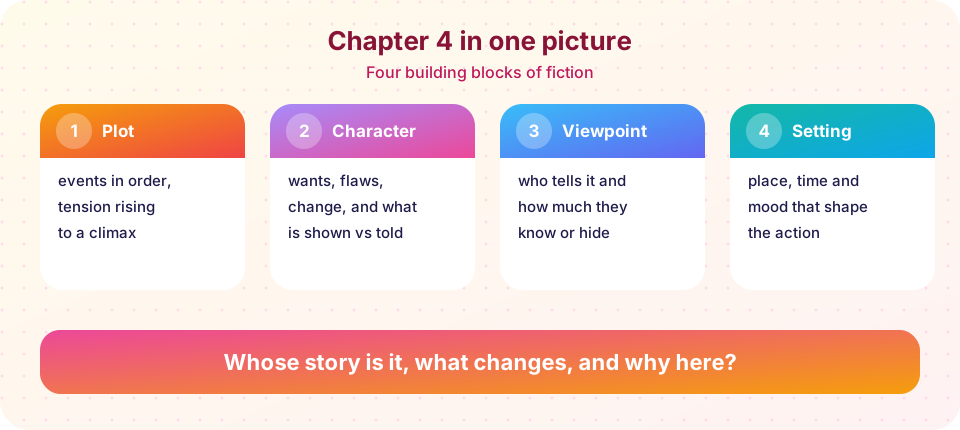
You have now met the four building blocks of fiction: plot, character, point of view and setting. A skilled reader keeps all four in view at once, because in a good story they depend on each other. This review shows them working together in one short story, gives you a checklist you can reuse on any text, and ends with flashcards and a ten-question quiz.
What you will learn
- A summary of the chapter's four lessons.
- How to analyze one story with all four elements.
- A reusable checklist for fiction analysis.
- The key terms you should know.
Key terms
Plot is the arrangement of events linked by cause; climax is its turning point.
Protagonist is the central character; dynamic characters change.
Point of view is the perspective of the narrator; limited and omniscient describe how much the narrator knows.
Setting is place, time and social world; atmosphere is the mood they create.
Irony is a gap between appearance and reality.
The chapter at a glance
| Element | Lesson | Question to ask |
|---|---|---|
| Overview | Fiction: an overview | What are the four building blocks, and how do they interlock? |
| Plot | Plot and structure | What is the conflict, and how is tension arranged? |
| Character | Character and characterization | What does the character want, and how do they change? |
| Point of view | Point of view | Who tells it, and what do they know or hide? |
| Setting | Setting and atmosphere | Where and when, and what does the place do? |
A worked analysis: "The Story of an Hour"
Kate Chopin published "The Story of an Hour" in 1894. It is a very short story, about a thousand words, and it is in the public domain, so you can read it in full in a library or online. Here is the outline, followed by the four-element analysis.
What happens. Louise Mallard has heart trouble, so her sister Josephine and her husband's friend Richards break the news carefully: her husband, Brently Mallard, has been killed in a railroad accident. Louise weeps at once, then goes alone to her room. Sitting in an armchair facing an open window, she sees spring: treetops, the smell of rain, a patch of blue sky. Slowly she realizes that, although she will mourn a husband who loved her, she now has years of life that belong to her alone. She whispers "free" to herself. Then she joins her sister downstairs, and the front door opens: Brently, alive and unaware of the accident, walks in. The story ends: "When the doctors came they said she had died of heart disease—of joy that kills."
Plot. The exposition is a single sentence about Louise's heart condition, which is also a hint of the ending. The inciting incident is the news. The rising action is Louise's reaction in her room, and the climax is her recognition of freedom. The falling action is brief: her return downstairs and the husband's arrival. The resolution is a single ironic sentence. Notice how compressed the arc is: the story takes place in about an hour, as the title promises, and the pyramid is steep.
Character. Louise is the protagonist, and she is a dynamic character whose inner change happens in minutes. She is round: she feels grief and relief together, and she is surprised by her own response. Chopin uses indirect characterization: we learn about Louise from her reactions (the stormy weeping, then the quiet in her room) and from the narrator's reading of her thoughts. Brently, Josephine and the doctors are flat, minor figures who matter mostly by how they respond.
Point of view. The story is told in third-person limited, close to Louise, so we feel her thoughts as she forms them. The narrator moves slightly outward at the end to report what the doctors say. That shift is crucial: the doctors' conclusion, "joy that kills," is dramatic irony, because the reader knows what Louise really felt and the doctors do not.
Setting. The setting is mostly a room with a window, in a late-nineteenth-century household where marriage limited a woman's independence. The window and the outdoors, with spring, birdsong and the sky, suggest life and possibility. The social setting matters: a woman of that time and class had few options outside marriage. The place is small but the weather outside is huge, and the contrast carries the story's meaning.
Theme (one reading). Chopin explores the cost of marriage to a woman's sense of self, and the possibility that the sorrow society expects hides a different feeling. Notice how the evidence comes from plot, character, point of view and setting together.
A reusable checklist
When you analyze any story, run through these questions.
- Conflict. What does the protagonist want, and what stands in the way?
- Structure. Where are the inciting incident, the climax and the resolution? Is the order of events straightforward?
- Character. Is the protagonist round or flat, static or dynamic? What do their choices reveal?
- Point of view. Who tells the story, and how much do they know? Is there any irony in the gap?
- Setting. Where and when, and what mood does it create? Does it symbolize anything?
- Pattern. What images, words or situations repeat?
- Theme. What claim about life does the story seem to make, and what is the best evidence?
Practice: apply the checklist yourself
Now try the checklist on a story you know. A fairy tale is a good choice because the plots are short and the elements are easy to see. Take "Cinderella," for example. A quick sketch might read like this. The conflict is external (the cruel stepfamily) and internal (hope against resignation). The structure has a clear inciting incident in the invitation to the ball and a climax at midnight when the spell breaks. The protagonist is a static, flat figure of goodness in many versions, which is a reminder that flat characters can still carry a story; what changes is her situation, not her nature. The point of view is a third-person narrator who knows the heroine's feelings and the fairy godmother's magic, which makes it omniscient. The setting is a household and a palace, a contrast of work and splendor, with the symbolic objects of cinders, a pumpkin and a glass slipper. A theme one might propose is that kindness is eventually recognized, though a more critical reader might notice that the story also rewards beauty and marriage, and ask what values the tale teaches.
Notice how fast you can generate an analysis when you have a checklist, and how many questions the checklist raises. Pick a story you read recently, copy the seven questions into your reading journal and answer each in a sentence. Then choose the one answer you are least sure of and find a passage that settles it. This habit of testing a claim against the text is exactly what you will use in the chapters on drama, literary movements and essay writing.
Common misconceptions
"The ending is the meaning." The ending matters, but the meaning grows from the whole story: its conflict, character, voice and setting.
"If I know the plot, I have understood the story." Plot is only one of four elements.
"A surprise ending means a good story." A good ending feels both unexpected and inevitable, as if the story has been preparing it all along.
Try it
Review the key terms with flashcards, then use the checklist tool on Chopin's story.
Press Run (or Ctrl + Enter) to see the console output here.
No output.
Check your understanding
Quick check · 10 questions
of 10 answered You scored / 10 · perfect!
-
1. Which sentence shows the difference between story and plot?
Plot links events by cause; story is only sequence. -
2. In 'The Story of an Hour,' the doctors' conclusion creates
The reader knows Louise's real feelings, which the doctors misread. -
3. Which point of view does Chopin's story mainly use?
The narrator stays close to Louise's thoughts. -
4. What is the inciting incident in the story?
The news upsets the balance and begins the sequence of events. -
5. Why is the open window significant?
The setting symbolizes opening possibility for Louise. -
6. What does 'dynamic' mean for a character?
Dynamic characters undergo a meaningful change. -
7. A foil is
Foils, by contrast, help show qualities in another character. -
8. Which is the best way to build atmosphere?
Sensory detail makes mood felt rather than announced. -
9. What does an unreliable narrator require from the reader?
Readers must notice where the narration and the evidence disagree. -
10. Which question links all four elements?
Whose story (point of view and character), what changes (plot) and why here (setting) connect the elements.
Summary
- Plot, character, point of view and setting interlock in every story.
- Analyze a story by tracing conflict, structure, character, point of view, setting, patterns and theme.
- Chopin's "The Story of an Hour" shows a steep plot, a dynamic protagonist, a limited narrator with an ironic shift and a setting that carries meaning.
- Use the checklist to keep analysis complete, and always support claims with evidence.
Next: continue to the rest of the course on the Introduction to Literature track page, beginning with the chapter on drama.
Track your progress
Create a free account to tick off lessons and pick up where you left off on any device.
of Introduction to Literature lessons completed