


















Lesson 11 of 47 · Reading Closely
Chapter 2 review: reading closely
Review the five lenses of close reading with a full worked analysis of Robert Frost's Stopping by Woods, flashcards, a claim-evidence-explanation builder and a ten-question quiz.
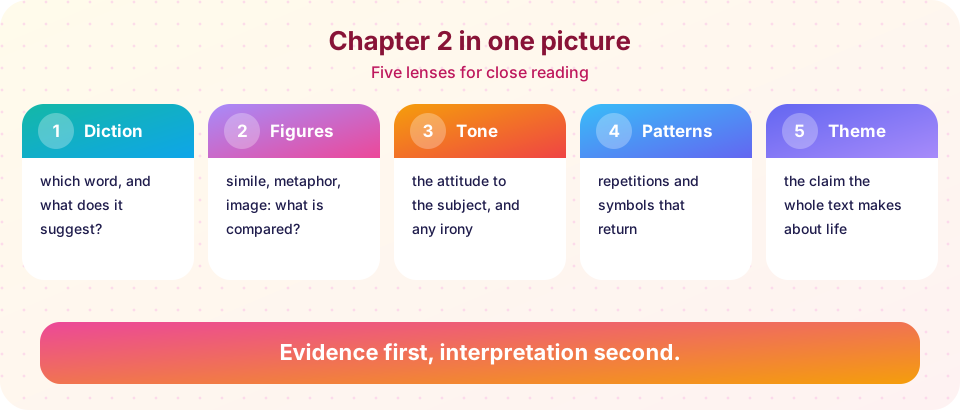
Chapter 2 gave you five lenses: diction, figures, tone, patterns (motif and symbol) and theme. Each one asks a different question about the same text, and the real skill is switching between them smoothly. This review pulls the lenses together in one extended example, so you can see how a reader moves from a detail to an argument. Then you can test yourself with flashcards, practice shaping a paragraph and take the chapter quiz.
What you will learn
- The key ideas of every lesson in Chapter 2.
- How to use all five lenses on one poem.
- How to turn notes into a tight claim-evidence-explanation paragraph.
- Which terms you should be able to define from memory.
Key terms
Diction is word choice. Connotation is a word's associations.
Figurative language includes simile, metaphor and personification. Imagery appeals to the senses.
Tone is the speaker's attitude. Irony is a gap between levels of meaning.
Motif is a recurring element. Symbol is a thing that stands for more than itself.
Theme is the central claim a work makes about its subject.
The chapter at a glance
| Lens | The question | Tools from the chapter |
|---|---|---|
| Diction | Why this word? | denotation, connotation, register, substitution test |
| Figures and imagery | What is compared, and what do we sense? | simile, metaphor, personification, tenor and vehicle |
| Tone and irony | What is the attitude, and is there a gap? | speaker versus author, verbal, situational and dramatic irony |
| Patterns | What returns and gains weight? | motif, symbol, tracking change |
| Theme | What does the work say about its subject? | theme as a full-sentence claim |
And behind all five lenses sits the four-step method from the overview: observe, question, interpret, support.
A full worked analysis: Robert Frost
Robert Frost published "Stopping by Woods on a Snowy Evening" in 1923, so the poem is in the public domain. Here are the first and last stanzas.
Whose woods these are I think I know.
His house is in the village though;
He will not see me stopping here
To watch his woods fill up with snow.

The woods are lovely, dark and deep,
But I have promises to keep,
And miles to go before I sleep,
And miles to go before I sleep.
First read, for the experience. The poem feels calm, quiet and a little hypnotic. Then the ending shifts: the repeated last line seems to carry more weight than a simple traveler's remark.
Lens 1, diction. The speaker calls the woods "lovely, dark and deep." "Lovely" attracts; "dark" and "deep" are ambiguous, since they can describe a forest or something more threatening. the speaker uses plain, short words, mostly of one syllable, which gives the poem a hush. A substitution test shows the effect: "pretty, gloomy and thick" would lose the mystery and the music. Note also the gentle word "stopping" in the opening: he is not arriving or camping, only pausing.
Lens 2, figures and imagery. The imagery is mostly of sight and hush: snow, dark, woods. The phrase "fill up with snow" quietly personifies the woods as a vessel being filled. In the middle stanzas Frost adds a horse that "must think it queer" to stop, and the "sweep / Of easy wind and downy flake." Those images make a world of softness and rest.
Lens 3, tone. The speaker is calm, reflective and slightly hesitant. There is a gentle secrecy in "He will not see me stopping here." The tone stays steady, and the pull toward rest is delivered without drama. That steadiness makes the last stanza feel quietly resolute.
Lens 4, patterns. The poem's main structural pattern is the repetition of the final line, "And miles to go before I sleep." The first time the line is literal: the traveler has a long way to go. The second time it echoes, and "sleep" begins to suggest something more than going to bed. The poem's rhyme scheme is also a pattern: each stanza rhymes AABA, and the unrhymed third line of each stanza becomes the first rhyme of the next, until the last stanza rhymes all four lines. The form seems to move toward a conclusion, as if the poem were pulling itself forward.
Lens 5, theme and argument. Now you can propose a claim, hedged: "Frost's poem suggests a tension between the pull of rest and the weight of obligation: the speaker is tempted by the peace of the woods but chooses the promises that keep him moving." Evidence: the alluring diction ("lovely, dark and deep"), the contrast "But I have promises to keep," and the repeated final line that turns a journey into something larger. Some readers hear "sleep" as death; the text allows that reading, but does not force it. A careful essay would say so and explain why the reading is possible without claiming it is the only one.
Notice what happened: each lens produced a handful of observations, and the argument grew from a pattern across the lenses. That is what the four-step method looks like on the page.
From notes to a paragraph: claim, evidence, explanation
When you write about a text, a simple paragraph structure keeps you honest.
- Claim: a one-sentence point.
- Evidence: a short, accurate quotation, introduced smoothly.
- Explanation: what the quotation shows and how it supports the claim, naming a device if relevant.
- Link: a closing sentence connecting back to the larger argument.
A sample: "Frost makes the woods attractive but ambiguous. The speaker calls them 'lovely, dark and deep,' pairing a word of beauty with two words that can also suggest danger or depth. This mixture explains why the speaker lingers, and it prepares the reader for the choice he makes in the final stanza." You will practice this in Chapter 8.
Common mistakes in close reading
Even careful readers fall into a few traps. Learning to recognize them will save you hours.
- Listing devices without interpreting them. "The poem uses alliteration, a simile and imagery" is a list, not an argument. Always say what the device does and why it matters.
- Summarizing instead of analyzing. If every sentence of your notes begins with "then," you are retelling. Ask "how" and "why" instead of "what happened."
- Quoting too much. A whole stanza as evidence usually means you have not decided which words matter. Cut the quotation to the phrase you will actually discuss.
- Ignoring the context of a word. A word's meaning depends on its sentence, its speaker and its period. Check how it is used before you decide what it suggests.
- Forcing a single reading. If the text supports two meanings, say so. Acknowledging ambiguity is a sign of a careful reader, not a weak one.
- Reading your own experience into the text and stopping there. Your reaction is a starting point. Move from "this reminds me of..." to "the text does this, which produces that effect."
A good habit is to reread your own paragraph and mark every claim. Beside each claim, write the evidence that supports it. If there is nothing beside it, either find the evidence or remove the claim.
Common misconceptions
"I have to use every lens on every text." Use the lens that the text invites. In a short poem, diction and pattern may carry most of the meaning; in a satire, tone and irony.
"A reading is right if the poem seems to say it." A reading is strong if specific evidence supports it and a thoughtful reader could follow your steps.
"The repeated line must mean death." It can; the text allows it. But a good reading shows how, and admits that other readings exist.
Try it
Test your memory with flashcards, then build and check an evidence paragraph.
Press Run (or Ctrl + Enter) to see the console output here.
No output.
Check your understanding
Quick check · 10 questions
of 10 answered You scored / 10 · perfect!
-
1. Which pair correctly matches a lens to its question?
Diction asks about word choice; tone asks about attitude. -
2. In Frost's poem, the repeated last line is an example of
The second occurrence echoes the first and begins to suggest more than a literal journey. -
3. Which sentence is best as a theme statement?
A theme is a full-sentence claim about the subject. -
4. What does the substitution test do?
Comparing the writer's word with a substitute reveals sound, connotation and rhythm. -
5. Calling hope 'the thing with feathers' without 'like' or 'as' is a
A direct statement that one thing is another is a metaphor. -
6. Tone differs from mood because tone is
Tone belongs to the speaker; mood is the reader's feeling. -
7. Which situation is dramatic irony?
The audience has knowledge the character lacks. -
8. What makes a motif different from a single image?
Recurrence and development turn a detail into a pattern. -
9. Which is the strongest evidence paragraph step?
Evidence needs explanation; naming a device or quoting alone is not analysis. -
10. Why should interpretations be hedged with words like 'suggests'?
Interpretations are claims that can be defended but not proved like a math result.
Summary
- Five lenses (diction, figures, tone, patterns, theme) ask different questions of the same text.
- Close reading follows four steps: observe, question, interpret, support.
- A strong argument grows from a pattern across lenses, not from a single detail.
- Write paragraphs as claim, evidence, explanation and link.
- Hedge interpretations and admit alternative readings when the text allows them.
Next: Poetry: an overview
Track your progress
Create a free account to tick off lessons and pick up where you left off on any device.
of Introduction to Literature lessons completed