


















Lesson 15 of 47 · Poetry
Free verse and the power of the line
Understand free verse and how poets create rhythm without strict meter: line breaks, white space, repetition and image, with Whitman, Pound, Williams and Eliot.
If a poem has no rhyme scheme and no regular meter, what keeps it a poem rather than a paragraph chopped into pieces? The answer is the heart of modern poetry: the line. In free verse, the poet gives up the fixed patterns of earlier forms and instead builds rhythm, emphasis and shape through line breaks, repetition, sound and image. Free verse is not "anything goes." It is a different set of tools, and in good hands it is as carefully made as any sonnet.
What you will learn
- What free verse is and how it arose.
- How line breaks create pause, emphasis and double meanings.
- Other tools: repetition, parallelism, white space and punctuation.
- The Imagist movement and its rules.
- How to read a free verse poem and say what its form does.
Key terms
Free verse is poetry without a regular meter or rhyme scheme.
Line break is the point where one line ends and the next begins.
End-stopped lines pause at the end; enjambed lines run on.
Cadence is the natural rise and fall of rhythm in language, without strict meter.
Imagism is an early twentieth-century movement that valued direct, precise images and economy of words.
Where free verse comes from
For centuries, most English poetry used meter and often rhyme. In the nineteenth century poets began to break away. The American poet Walt Whitman, in Leaves of Grass (first published in 1855 and revised many times), wrote long, flowing lines with no rhyme and no regular meter. He built his music from repetition and parallel phrases, a technique he shared with the Hebrew Psalms in the King James Bible. His book opens with lines that sound like a proclamation:
I celebrate myself, and sing myself,
And what I assume you shall assume,
For every atom belonging to me as good belongs to you.
Notice the pattern: "I celebrate myself, and sing myself" balances two parts. The next line repeats "assume." The third promises a connection between "me" and "you." The rhythm comes from the speaker's rising confidence, not from a drumbeat of stress.
In France, poets called the new style vers libre, "free verse," in the late nineteenth century. Early in the twentieth century, English-language poets such as Ezra Pound, T. S. Eliot and William Carlos Williams made free verse the dominant mode of modern poetry.
Imagism
Around 1912 and 1913, Pound and a group of poets launched Imagism. They set three principles: treat the subject directly, use no word that does not help the presentation, and compose in the rhythm of the musical phrase rather than the metronome. The movement valued the clear, concrete image. Pound's two-line poem "In a Station of the Metro" (1913) is its best-known example:
The apparition of these faces in the crowd;
Petals on a wet, black bough.
There is no verb in the second line, and the poem has no explanation. The reader supplies the link: faces in a dark underground crowd appear like petals against a wet bough. The poem works by placing two images side by side and letting meaning spark between them.
Line breaks do the work of meter
In free verse the line break takes over many of meter's jobs. Here is what a break can do.
- Create a pause. Where the line ends, the eye and the voice stop, even if only for a moment.
- Give emphasis. The last word of a line gets weight, and the first word of the next line does too. Putting a single word alone on a line makes it enormous.
- Make a double meaning. A line may read one way when it ends and another once the next line arrives. Imagine "He was the last to leave / the room" versus "He was the last to leave the room": the break lets you hold "leave" in a larger sense for a second.
- Control speed. Many short lines slow a reader down. Long lines, like Whitman's, sweep.
- Draw a shape. The poem's silhouette on the page, long or short, left-aligned or indented, is part of its effect.
A worked example: Williams
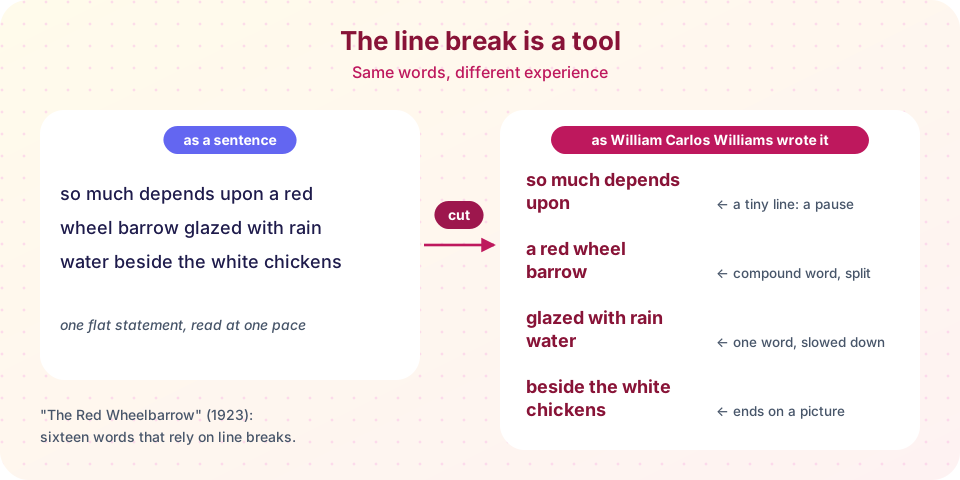
William Carlos Williams published "The Red Wheelbarrow" in 1923. Its whole text is a single sentence of sixteen words broken into eight short lines:
so much depends
upon

a red wheel
barrow

glazed with rain
water

beside the white
chickens
Read as a plain sentence, it is a statement: "so much depends upon a red wheelbarrow glazed with rainwater beside the white chickens." Now notice what the breaks do.
- The first line announces something important, but we do not yet know what. "upon" stands alone in line two, a tiny pause that delays the object.
- "wheel / barrow" splits one word into two, so that you look first at the wheel, then at the barrow, as if you were studying the object piece by piece.
- "rain / water" does the same, letting the word "rain" glisten for a moment before "water" arrives.
- The poem ends on "chickens," a small, living, ordinary thing, as if the whole weight of "so much depends" settled on a farmyard detail.
The poem makes you pay attention. It has no meter and no rhyme, yet its rhythm is clear: every stanza has a longer line followed by a one-word line, a pattern of three words then one. The poem creates a form of its own.
Other free-verse tools
- Repetition and parallelism. Whitman's lists and Allen Ginsberg's long chants use repeating openings (called anaphora) to build force.
- White space. Blank space between stanzas, or inside lines, becomes silence on the page.
- Punctuation. Whether a poet uses periods, commas, dashes or none at all changes the speed and the sense of closure.
- Sound. Free verse still uses alliteration, assonance and consonance.
- Imagery. Images carry much of the weight, as in Imagism.
- Fragments and juxtaposition. T. S. Eliot's The Waste Land (1922) opens with "April is the cruellest month, breeding / Lilacs out of the dead land." and then moves among voices and scenes with sudden jumps. The reader builds connections.
Free verse versus prose
A prose poem has no line breaks but is still poetry, thanks to compression, rhythm and imagery. So what separates free verse from chopped-up prose? The test: if you changed the line breaks at random, would the poem lose something? In good free verse, yes. The breaks have been chosen, and they shape the sense, the pace and the emphasis.
How to read a free-verse poem
- Read it aloud, following the breaks. Where do you naturally pause?
- Note the line lengths. Which are shortest and longest? Why?
- Find the one-word or very short lines. They are usually emphatic.
- Look for repetition in words, structure or images.
- Ask what would change if two lines were joined, or a break moved.
- Say what the shape does: hush, rush, hesitation, accumulation.
Common misconceptions
"Free verse is easier to write than rhymed verse." It removes one set of rules and demands careful control of rhythm and breaks. Robert Frost joked that writing free verse is like playing tennis with the net down, but that remark shows his own preference, not a fact about the form.
"Free verse has no rhythm." It has plenty, based on cadence, repetition and breaks.
"Short lines mean a simple poem." Short lines may mean the poet wants you to read slowly and notice each word.
Try it
Draw the ragged edge of a poem, then compare line lengths across four texts.
Press Run (or Ctrl + Enter) to see the result here.
Program input · what you'd type while the program runs
Type the answers before you press Run, one per line. Each time the program reads a line (with input()), it gets the next line from this box.
Check your understanding
Quick check · 5 questions
of 5 answered You scored / 5 · perfect!
-
1. What is free verse?
Free verse avoids fixed meter and rhyme but still uses line, sound and image deliberately. -
2. Which is NOT one of the Imagist principles listed?
Imagists rejected padding and fixed meter; they did not require rhyming couplets. -
3. Why does a one-word line stand out?
A single word on a line is isolated by white space, which gives it weight. -
4. In 'The Red Wheelbarrow,' what does splitting 'wheel / barrow' do?
The break slows the reader and draws attention to the wheel first, then the barrow. -
5. A good test of whether line breaks matter in a free-verse poem is to
If changing the breaks changes the effect, the breaks are doing work.
Summary
- Free verse drops fixed meter and rhyme but builds rhythm through line breaks, repetition, white space and image.
- Whitman, the Imagists, Williams and Eliot made free verse central to modern poetry.
- A line break can pause, emphasize, create double meanings and control speed.
- A good test: change the breaks and see what is lost.
- Read aloud, notice short lines, look for repetition and say what the shape does.
Next: Chapter 3 review
Track your progress
Create a free account to tick off lessons and pick up where you left off on any device.
of Introduction to Literature lessons completed