


















Lesson 12 of 47 · Poetry
Poetry: an overview
A friendly overview of poetry: what it is, its building blocks (line, stanza, speaker, sound, image, form), poetry around the world, and a method for reading a poem.
Poetry is the oldest literary art and the one many people find most intimidating. A poem looks short, so you expect it to be simple, and then it turns out to be as dense as a page of a novel. The good news is that poems follow patterns you can learn to hear and see. Once you know the tools, a poem stops being a riddle and becomes a piece of music for the mind. This lesson maps those tools. The next three lessons will examine sound and meter, forms, and free verse in detail.
What you will learn
- What makes poetry different from prose.
- The building blocks: speaker, line, stanza, sound, image and form.
- Three modes of poems: lyric, narrative and dramatic.
- Poetry from different times and cultures.
- A method for reading a poem you have not seen before.
Key terms
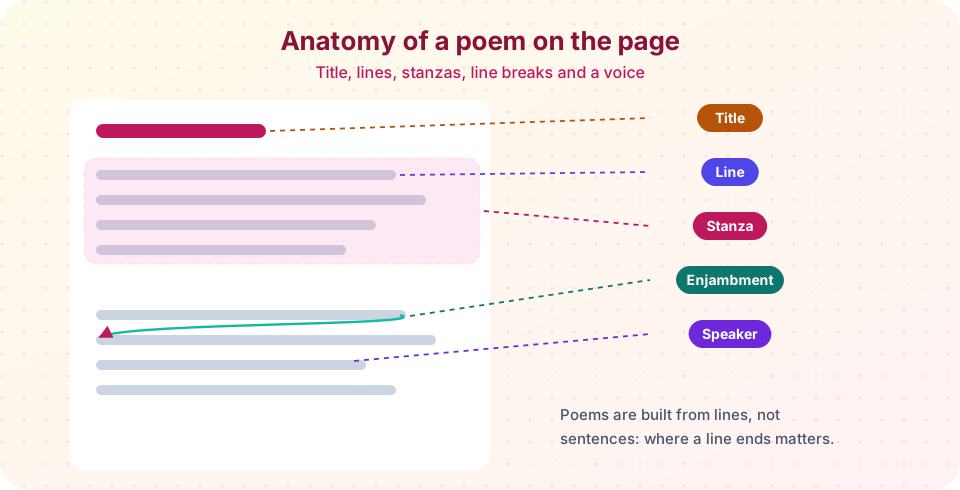
Line is a single row of words in a poem; stanza is a group of lines, like a paragraph.
Speaker is the voice that speaks the poem, who may not be the poet.
Enjambment is when a sentence or phrase continues over the end of a line without a pause.
Lyric poems express a speaker's thoughts and feelings; narrative poems tell a story.
Imagery is sensory language; meter is the pattern of stressed and unstressed syllables.
What is a poem?
The most visible difference between poetry and prose is the line. Prose runs to the edge of the page and breaks wherever the margin falls. In a poem the poet decides where each line ends. That choice is a tool. It controls where you pause, which word gets emphasis and what shape the poem makes on the page.
But poetry is more than a shape. It is a way of using language with particular intensity: compressing meaning, using sound on purpose, and depending on images and comparisons more than on explanation. The poet Samuel Taylor Coleridge is often quoted as defining poetry as "the best words in the best order," a phrase that captures the idea that every word is chosen and placed. Some poems tell a story, some capture a single moment, some argue, some simply delight in sound.
The building blocks
The speaker. The first question for any poem is "who is talking, and to whom?" The speaker may be the poet, a character, an object, even an animal. The speaker has a situation: a time, a place, a reason for speaking.
The line. Lines can be long or short, end-stopped (pausing at a punctuation mark) or enjambed. In the opening of William Wordsworth's "I Wandered Lonely as a Cloud" (1807), the sentence "I saw a crowd, / A host, of golden daffodils" spills over the line break. The poet first gives the surprising word "crowd," then adds "host," and lets "daffodils" land on a line of its own. The break is part of the pleasure.
The stanza. A stanza groups lines, often with a repeated pattern of rhyme and length. Stanzas have names according to the number of lines: couplet (2), tercet (3), quatrain (4), sestet (6), octave (8).
Sound. Rhyme, rhythm and repeated sounds give poems their musical quality. See sound and meter.
Imagery and figures. Poems rely heavily on metaphor, simile and sensory images, often with little explanation. See figurative language.
Form. A poem may follow an inherited pattern such as a sonnet or a haiku, or it may invent its own shape. See poetic forms and free verse.
Who speaks?
How it looks
How it sounds
What it holds
Three modes of poetry
Following the ancient distinction you met in genres and forms, poems tend to fall into three modes.
- Lyric poetry expresses one voice's thought or feeling. The word comes from the lyre, the instrument that accompanied the poems of ancient Greece. Sonnets, odes and most modern poems are lyric.
- Narrative poetry tells a story: epics such as the Iliad and ballads such as the traditional "Sir Patrick Spens."
- Dramatic poetry features a speaker addressing a listener, revealing character through speech. Robert Browning's "My Last Duchess" (1842) is a famous dramatic monologue.
Poetry around the world
Poetry exists in every culture. Sappho of Lesbos wrote short songs of love and longing in Greek around 600 BCE, of which only fragments survive. In China, the poets Li Bai and Du Fu of the eighth century wrote verses on friendship, travel and war that are still memorized. In the Persian tradition, Hafez of the fourteenth century wrote lyric poems called ghazals. In Japan, Matsuo Bashō (1644 to 1694) made the haiku one of the great short forms. Across Africa, praise poems and epics have been performed aloud for centuries. In nineteenth-century America, Walt Whitman and Emily Dickinson created two radically different voices, one expansive and public, the other compact and private. Reading poems in translation means reading a version by a translator, who has to decide what to keep: the meaning, the sound or the shape.
A method for reading a poem
A poem can feel opaque on first contact. This routine breaks it down.
- Read it aloud, twice. Do not try to understand everything yet. Notice the sound and the pace.
- Ask who and where. Who is the speaker? What is the situation?
- Paraphrase. Put each sentence in plain words. Follow the grammar across line breaks.
- Hunt for patterns. Look for repeated words, images and sounds.
- Find the shift. Many poems turn somewhere: a change in tone, subject or direction. Mark where.
- Consider the form. Why this length, this stanza shape, this rhyme or lack of it?
- Make a claim. State in a sentence what the poem seems to say or do, and support it.
A short example
Here is the opening of William Blake's "The Tyger," from Songs of Experience (1794).
Tyger Tyger, burning bright,
In the forests of the night;
What immortal hand or eye,
Could frame thy fearful symmetry?
The speaker addresses a tiger, a figure of apostrophe. The repeated "Tyger Tyger" opens like a chant. Rhyme joins "bright" and "night," and "eye" and "symmetry" (an imperfect rhyme today, though the sounds may have been closer in Blake's time). The fire and darkness of the first two lines contrast. The question in lines three and four asks who could make such a creature. The poem's central tension is already visible: the tiger is both beautiful ("bright," "symmetry") and terrifying ("fearful"). A reader could state a claim: the poem wonders what kind of maker could create both beauty and terror.
Common misconceptions
"Poems must rhyme." Many do, many do not. Rhyme is a tool, not a rule.
"A poem has a single hidden meaning." Poems usually support several readings, but they have to be backed up by the text.
"The speaker is always the poet." Poets often speak through characters and masks.
Try it
Explore how line breaks change one sentence, then count the parts of a poem in code.
Press Run (or Ctrl + Enter) to see the console output here.
No output.
Check your understanding
Quick check · 5 questions
of 5 answered You scored / 5 · perfect!
-
1. What is the first question to ask about a poem's voice?
Identifying the speaker and situation anchors the rest of your reading. -
2. Enjambment is when
The sense runs on over the line break. -
3. A group of four lines is called a
A quatrain has four lines; a couplet two; a tercet three; an octave eight. -
4. Which mode of poetry tells a story?
Narrative poems, such as epics and ballads, tell stories. -
5. Why does the lesson suggest reading a poem aloud twice?
Sound is a main part of how a poem works.
Summary
- A poem is built from speaker, line, stanza, sound, imagery and form.
- Line breaks are deliberate: enjambment and end-stopping both shape the reading.
- Poems are lyric, narrative or dramatic, and exist in every culture.
- Read aloud, find the speaker, paraphrase, hunt for patterns and locate the shift.
- Support any claim about a poem with specific lines.
Next: Sound, rhythm and meter
Track your progress
Create a free account to tick off lessons and pick up where you left off on any device.
of Introduction to Literature lessons completed