


















Lesson 38 of 47 · Writing About Literature
Writing About Literature: From Reading to Argument
Chapter 8 overview: what a literary essay is, the five passes from reading to revision, and a planner that turns a question and a thesis into an outline you can draft from.
Reading literature gives you impressions. Writing about it makes you turn those impressions into an argument: a claim about the text, backed with evidence, that another reader could test. This is the skill that most exams, courses and critical articles reward, and it is also a very good way to find out what you really think.
Many students find the move from "I liked it" to "here is what it does" the hardest part of the course. This chapter breaks it into steps. You will learn how to form a thesis, use quotations well, organize an essay and revise it. Each lesson uses short examples from public-domain texts so you can see techniques at work without any hidden background.
What you will learn
- What makes a literary essay different from a summary or a review.
- The five passes of the writing process and a sensible time split.
- How the lessons in this chapter fit together.
- How to turn a question into an outline.
Key terms
- Literary analysis: an argument about how a text works and what it means, supported with evidence.
- Thesis: the main claim of an essay, which the rest of the essay proves.
- Evidence: details from the text, usually quotations, that support a claim.
- Analysis: explanation of how the evidence supports the claim.
- Revision: re-seeing and reshaping a draft, not just correcting errors.
What a literary essay is
A literary essay is not a summary, which retells what happens. It is not a review, which says whether you liked a work. It is not a biography or a list of devices ("the poem uses a metaphor and a simile"). It is an argument that answers a question about how a text creates its effects or what it means, and it uses specific evidence to convince a thoughtful reader.
A good essay has a few reliable features. It starts from a question, makes a debatable thesis, builds paragraphs around claims, supports each claim with short quotations, and explains the quotation instead of leaving it to speak for itself. It uses present tense for events in the work ("Victor abandons his creature"), because literary works are treated as always happening. And it ends by saying why the argument matters.
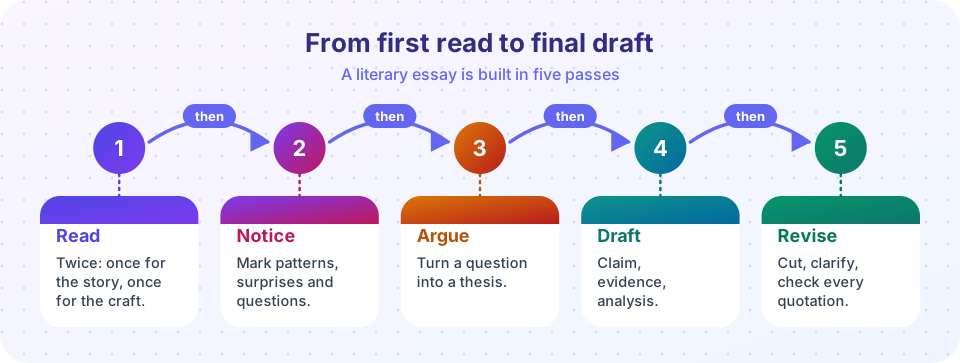
The five passes
- Read
- Notice
- Argue
- Draft
- Revise
Read. Read once for the story and once for the craft. Pencil in the margin: questions, repeated words, passages you love or hate.
Notice. Collect patterns and puzzles. A pattern might be a repeated image (windows, water, clocks); a puzzle might be a character's odd decision or a sudden change of tone. The best essays often start with a puzzle.
Argue. Turn the pattern or puzzle into a question and then into a thesis. This is the most important step, covered in the next lesson.
Draft. Build paragraphs around claims, with evidence and analysis. Do not worry about polish yet.
Revise. Re-read the draft as a stranger would. Does the argument move forward? Are the quotations earning their place? This pass has its own lesson.
What this chapter covers
- Thesis and Argument: from questions to debatable claims.
- Evidence and Quotation: choosing, introducing, formatting and explaining quotations.
- Structure and Revision: outlines, paragraphs, introductions, conclusions and revision methods.
- Chapter Review.
The chapter assumes you have already done close reading from Chapter 2. If that feels shaky, go back to it: strong writing grows from strong noticing.
Spend your time wisely. Many students rush the first two passes and then rewrite the last paragraph for hours. A sound rule of thumb is to give roughly a quarter of your time to reading, a fifth to planning, a quarter to drafting and a fifth or more to revising.
Common misconceptions
"A good essay summarizes the plot at length." Readers who know the book do not need the plot. They need your argument.
"Writers discover their thesis only at the end, so I should begin writing without one." You may refine your thesis as you write, but you need a working thesis to guide the draft.
"Using big words makes the essay smarter." Clarity wins. Choose the plain word unless a technical term is more precise.
Try it
Press Run (or Ctrl + Enter) to see the result here.
Program input · what you'd type while the program runs
Type the answers before you press Run, one per line. Each time the program reads a line (with input()), it gets the next line from this box.
Check your understanding
Quick check · 4 questions
of 4 answered You scored / 4 · perfect!
-
1. What distinguishes a literary essay from a summary?
A literary essay argues a claim about how a text works or what it means. -
2. Which tense is normally used to describe events in a literary work?
The literary present treats the work as always happening: 'Victor abandons his creature.' -
3. Where do the best essays often start?
A puzzle or pattern leads to a question, which leads to a thesis. -
4. What does the analysis in an essay do?
Analysis connects evidence to the claim and shows how the words create the effect.
Summary
- A literary essay is an argument about a text, supported by evidence and explained through analysis.
- The process has five passes: read, notice, argue, draft and revise.
- Starting from a puzzle or pattern leads to a question and then a thesis.
- Plan time for revision; it is where an essay becomes an argument.
Next: Thesis and Argument
Track your progress
Create a free account to tick off lessons and pick up where you left off on any device.
of Introduction to Literature lessons completed