


















Lesson 26 of 47 · Drama
Modern Drama: Realism, Epic Theatre and the Absurd
How modern theatre moved from realism in Ibsen and Chekhov to Brecht's epic theatre, Beckett's absurd, and the American and Black theatre traditions of Miller, Hansberry and Wilson.
Around 1880 something changed in the theatre. Playwrights began to put ordinary rooms on stage: a living room with a lamp, a table and a door that actually closed. Characters began to talk like real people, about money, marriage and shame. Within a generation other writers rebelled against that realism and invented new ways to break the stage's spell. The result is a century of drama with an astonishing range, from kitchen-sink naturalism to plays in which almost nothing happens on a bare stage.
This lesson follows the main lines of that history. You will see why realism felt revolutionary, how Chekhov changed the rhythm of a play, why Brecht wanted audiences to think rather than weep, and how later playwrights from several countries made the stage speak for communities who were not on it before.
What you will learn
- What realism changed in the theatre and what the "fourth wall" is.
- How Chekhov uses subtext, and how Brecht and Beckett break the spell.
- How American and Black theatre traditions rework the idea of tragedy.
- How to read a modern play by asking what it expects from its audience.
Key terms
- Realism: a style that shows ordinary people, believable speech and everyday settings.
- Fourth wall: the imaginary wall between the stage and the audience in a realistic box-set room.
- Subtext: what characters mean or feel beneath what they actually say.
- Epic theatre: Brecht's approach, which reminds the audience they are watching a play so they can think critically.
- Theatre of the Absurd: plays that present life as without clear meaning, often with illogical or repetitive action.
Realism: Ibsen and the drama of the ordinary
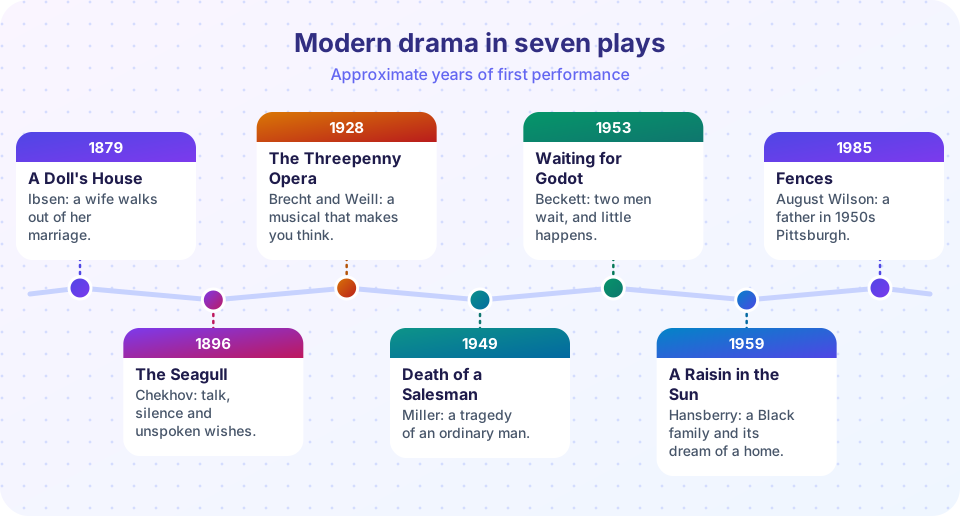
The Norwegian dramatist Henrik Ibsen (1828 to 1906) is often called the father of modern drama. His plays, such as A Doll's House (1879), Ghosts (1881) and Hedda Gabler (1890), are set in contemporary middle-class homes and use ordinary speech. They build slowly to a moment when a hidden truth, a debt, a disease or a lie, explodes the surface calm.
In A Doll's House, Nora spends the play pretending to be her husband's pet and then, in the last scene, leaves him and the house to find out who she is. The sound of the door closing was said to shock audiences across Europe, and the ending was controversial enough that some productions in Ibsen's time were given alternative endings. The play is a perfect example of the problem play, which takes a social issue, here the legal and economic position of married women, and places it inside a family drama.
Realism relied on the box set: a room with three walls and an invisible fourth wall facing the audience. Actors behaved as if no one were watching. The stage became a window into a private world, and the audience became eavesdroppers.
Chekhov: what is not said
The Russian writer Anton Chekhov (1860 to 1904) pushed realism in a different direction. In The Seagull (1896), Uncle Vanya, Three Sisters (1901) and The Cherry Orchard (1904), very little seems to happen. People talk about the weather, the estate, a missing book, while their lives quietly fail. The drama is in subtext: a character says "It is cold in here" and means "I am lonely".
The Seagull failed badly at its first performance in St Petersburg in 1896. It was revived in 1898 by the newly founded Moscow Art Theatre under Konstantin Stanislavski, whose acting approach, often called "the system", trained actors to find the inner life of a character. The collaboration launched both Chekhov's reputation and a new style of ensemble acting. Chekhov called The Cherry Orchard a comedy; directors still argue about whether he meant it as farce or as a gentler, sadder kind of humor.
A famous piece of advice attributed to Chekhov is that a gun shown on the wall in the first act should be fired in a later one. It is a useful tip for reading any play: ask what each object, line and detail is for.
Brecht: thinking in the theatre
Bertolt Brecht (1898 to 1956) believed realism lulled the audience into passive feeling. He developed epic theatre, which tells a story in a loose, narrated series of scenes and keeps reminding us that we are watching a performance. Actors may step out of character, speak to the audience, or sing songs that comment on the action. Signs and projections announce what is about to happen. Lights are left visible.
His aim was the Verfremdungseffekt, usually translated "alienation effect" or "distancing effect". By making the familiar look strange, the audience can ask why things are the way they are, and whether they could change. His plays include The Threepenny Opera (1928, with the composer Kurt Weill) and Mother Courage and Her Children (written in 1939 and first performed in 1941). In the latter, a canteen woman follows the armies of a long war, trying to profit from it while it consumes her children. Brecht wanted the audience to see her as a person making fatal choices, not as a saint, so he did not want them to cry and go home. After 1949 he led the Berliner Ensemble in East Berlin.
Beckett and the Absurd
After the Second World War, a group of playwrights, including the Irish writer Samuel Beckett (1906 to 1989), the Romanian-French writer Eugene Ionesco and the British writer Harold Pinter, wrote plays that dropped the familiar logic of plot and psychology. The critic Martin Esslin gave their work the name Theatre of the Absurd in 1961.
Beckett's Waiting for Godot (premiered in Paris in 1953) shows two tramps, Vladimir and Estragon, waiting by a tree for someone who never arrives. A second act echoes the first. The language is plain and funny, the stage almost empty, and the play has been read as being about religion, war, friendship, boredom, and the very act of going on. Beckett himself resisted any single explanation. For a student, the key point is the form: the play turns the usual promise of drama, that something will happen, upside down, and makes the audience feel what waiting is like.
American theatre: tragedy and the common man
In the United States, Arthur Miller (1915 to 2005) argued in an essay of 1949 that ordinary people could be tragic heroes. His Death of a Salesman (1949) follows Willy Loman, a traveling salesman whose belief in being "well liked" collapses as he ages and his sons disappoint him. The set shows the Lomans' house in skeleton form, and the action moves freely between present scenes and Willy's memories. Miller's The Crucible (1953) uses the Salem witch trials to comment on the political panic of his own time. Tennessee Williams wrote A Streetcar Named Desire (1947), a lyrical, violent study of desire and fading illusion.
Many voices on the stage
Twentieth-century drama also widened the question of whose stories get told.
- Lorraine Hansberry (1930 to 1965) wrote A Raisin in the Sun (1959), about a Black family in Chicago deciding how to spend an insurance payout. Its title comes from a poem by Langston Hughes, and it is often described as the first play by a Black woman produced on Broadway.
- August Wilson (1945 to 2005) wrote a cycle of ten plays, each set in a different decade of the twentieth century, mostly in Pittsburgh's Hill District. Fences (1985) follows a father, a former baseball player, in the 1950s.
- Wole Soyinka (born 1934), of Nigeria, won the Nobel Prize in 1986. His Death and the King's Horseman (1975) draws on Yoruba ritual and the clash of colonial and local authority.
- Caryl Churchill (born 1938) wrote Top Girls (1982), which breaks time and realism by gathering historical and fictional women at a dinner party.
"Modern drama is just realism." In fact, realism is one branch. Epic, absurd, expressionist and ritual theatre all reject it in different ways.
"Nothing happens in Waiting for Godot, so it has no meaning." Something does happen: people talk, wait, hope, fail. The play's meaning lies in how it makes waiting feel.
Try it
Check your understanding
Quick check · 5 questions
of 5 answered You scored / 5 · perfect!
-
1. What does the term fourth wall describe?
In a box-set realistic play, the audience looks in through an invisible fourth wall as if watching a real room. -
2. What is subtext in a Chekhov play?
Chekhov's characters often speak about trivial things while the real emotion lies beneath the words. -
3. What was Brecht's main aim with the alienation (distancing) effect?
By reminding the audience it is watching a play, epic theatre encourages judgment rather than complete emotional immersion. -
4. Which play is usually linked to the Theatre of the Absurd?
Beckett's Waiting for Godot is a central example, along with plays by Ionesco and Pinter. -
5. What is distinctive about August Wilson's cycle of plays?
Wilson wrote ten plays, one for each decade of the twentieth century, mostly set in Pittsburgh.
Summary
- Ibsen's realism put ordinary rooms and urgent social problems on stage, behind an invisible fourth wall.
- Chekhov made subtext central, so the drama lies beneath the conversation.
- Brecht's epic theatre and Beckett's absurd theatre broke the illusion in different ways: one to provoke thought, one to dramatize meaninglessness and waiting.
- American and Black theatre traditions, with Miller, Williams, Hansberry and Wilson, widened tragedy and put new communities at the centre.
- Postcolonial and feminist dramatists such as Soyinka and Churchill extended the stage again.
Next: Chapter Review: Drama
Track your progress
Create a free account to tick off lessons and pick up where you left off on any device.
of Introduction to Literature lessons completed