


















Lesson 30 of 47 · Literary Movements
Modernism and Postmodernism
How Modernism broke old forms after the First World War, how Postmodernism played with them and doubted grand stories, with Woolf, Joyce, Eliot, Borges, Calvino and Rushdie.
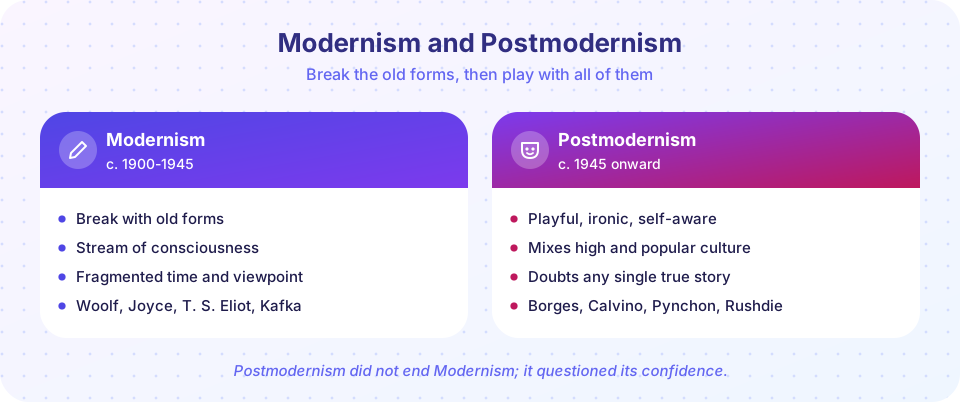
By the early twentieth century, many writers felt that the old forms no longer fit the world. Cities had grown enormous and anonymous, machines and mass media had changed daily life, Freud and others had suggested that the mind was stranger than anyone thought, and the First World War (1914 to 1918) shattered faith in progress. Modernism was the literary response: a burst of experiment in poetry, fiction and drama that tried to find new forms for new experience.
Postmodernism, which grew after the Second World War, took the experiment further and added doubt. If modernists tried to find new ways to tell the truth, many postmodernists asked whether any single story could tell it. This lesson explains both movements, their techniques and the major debates about them.
What you will learn
- The historical shocks behind Modernism and its main techniques.
- How Postmodernism differs: irony, metafiction and doubt about grand narratives.
- Examples from Woolf, Joyce, Eliot, Borges, Calvino, Pynchon and Rushdie.
- Why scholars still argue about where one ends and the other begins.
Key terms
- Stream of consciousness: a technique that tries to reproduce the flow of a character's thoughts and sensations.
- Fragmentation: a broken, collage-like structure, often with sudden jumps in time or voice.
- Metafiction: fiction that openly draws attention to being fiction.
- Intertextuality: the way a text echoes, quotes or answers other texts.
- Pastiche: a work that imitates the styles of others, often playfully.
Modernism (about 1900 to 1945)
The pressure of the age
Modernist writers lived through huge change. Cities like London, Paris and New York became centers of artists and exiles. Einstein's relativity (1905 and 1915) and Freud's psychology unsettled ideas about time and the self. Photography, film and the telephone changed perception. And the war made inherited confidence in civilization look empty. The poet Ezra Pound's famous slogan, "Make it new", sums up the mood.
Techniques
Modernists tried to capture inner experience and a fractured world:
- Stream of consciousness. The term comes from the psychologist William James (1890). In Mrs Dalloway (1925), Virginia Woolf moves between characters' thoughts as one London day unfolds. In her essay "Modern Fiction" (1919), she urged novelists to attend to the ordinary mind on an ordinary day, with its flickers and impressions, rather than to a tidy plot. James Joyce's Ulysses (1922) follows a single day in Dublin, mapped loosely onto Homer's Odyssey, with styles that change from chapter to chapter.
- Fragmentation and collage. T. S. Eliot's poem The Waste Land (1922) is built from voices, quotations and scenes, ending with the line "These fragments I have shored against my ruins". The reader has to join the pieces.
- Multiple viewpoints. William Faulkner's The Sound and the Fury (1929) tells one family's story through four narrators, beginning with the mind of a man with an intellectual disability, whose sense of time is not linear.
- Compression and restraint. Ernest Hemingway's "iceberg" approach leaves most of the meaning below the surface of plain sentences. Imagist poets, such as H.D., aimed at a single hard image.
- Estrangement. Franz Kafka's The Metamorphosis (1915) opens with a man waking as a giant insect and treats it with flat realism, making alienation concrete.
Modernism was international: Proust in France, Rilke in Germany, Akhmatova and Mandelstam in Russia, Pessoa in Portugal, and the Harlem Renaissance in the United States, with poets like Langston Hughes and novelists like Zora Neale Hurston (Their Eyes Were Watching God, 1937) blending African American speech and modern form.
Modernist writers were often elitist or difficult, and some held political views that now disturb readers. Critics have also pointed out that the canon of "high modernism" long underrepresented women and writers of color. Recent scholarship has widened the picture.
Postmodernism (about 1945 onward)
The shift
After 1945, mass media, consumer culture, and the experience of the Holocaust and the atomic bomb deepened doubt. The philosopher Jean-François Lyotard, in The Postmodern Condition (1979), described postmodernism as "incredulity toward metanarratives", suspicion of the grand stories (progress, reason, revolution) that once organized society. Writers responded with irony, play and self-awareness.
Techniques
- Metafiction. Texts draw attention to their own making. In Italo Calvino's If on a winter's night a traveler (1979), the reader is a character who keeps trying to start a novel and is interrupted. John Barth's "Lost in the Funhouse" (1968) is a story that comments on its own construction.
- Intertextuality and pastiche. Jorge Luis Borges, in stories like "The Garden of Forking Paths" (1941), builds labyrinths of imaginary books and libraries. Jean Rhys's Wide Sargasso Sea (1966) rewrites Jane Eyre from another point of view.
- Mixing high and popular culture. Thomas Pynchon's Gravity's Rainbow (1973) combines physics, comic songs, conspiracy and slapstick.
- Unreliable and shifting narrators, and fractured history. Salman Rushdie's Midnight's Children (1981) tells India's independence through a narrator who may be misremembering. Kurt Vonnegut's Slaughterhouse-Five (1969) treats the bombing of Dresden through a narrator who has "come unstuck in time".
- Magical realism. Gabriel García Márquez's One Hundred Years of Solitude (1967) treats the marvelous as ordinary, a style that also belongs to Latin American literary history.
Debates
Is postmodernism a break or a continuation of Modernism? Some critics, such as Fredric Jameson, have linked it to "late capitalism" and a flattening of depth. Others see it as a liberating questioning of authority that gave space to voices once excluded. And some argue the label is too wide to be useful. The best response is to study particular texts, not slogans.
"Modernism means modern, as in recent." In literary history it names a specific early twentieth-century movement, not everything contemporary.
"Postmodern writing has no meaning." It usually questions single or authoritative meanings, but many postmodern works are intensely concerned with history, politics and ethics.
"Modernism and Postmodernism are separate camps." Many writers, Beckett among them, belong to both stories.
How to read difficult experimental texts
Experimental writing can be frustrating at first. A few habits help. Do not expect to understand everything on a first pass: modernist and postmodern works often reward rereading, and many were meant to unsettle. Read for pattern before plot: which images or phrases return? Read aloud, because rhythm and repetition carry meaning in stream-of-consciousness prose. Ask why this form? Why does the author fragment time, change narrators or interrupt the story? Often the form is the argument: a broken structure for a broken world, or a self-aware story to remind you that every story is made.
Try it
Press Run (or Ctrl + Enter) to see the result here.
Program input · what you'd type while the program runs
Type the answers before you press Run, one per line. Each time the program reads a line (with input()), it gets the next line from this box.
Check your understanding
Quick check · 5 questions
of 5 answered You scored / 5 · perfect!
-
1. Which technique tries to reproduce the flow of a character's thoughts?
Stream of consciousness follows the unbroken flow of thoughts and sensations, as in Woolf and Joyce. -
2. Which work is built from fragments and quotations and ends with the line about fragments shored against ruins?
T. S. Eliot's The Waste Land (1922) is a landmark of fragmentation. -
3. What did Lyotard mean by 'incredulity toward metanarratives'?
Lyotard used it to describe postmodern doubt about grand organizing stories like progress or revolution. -
4. Calvino's If on a winter's night a traveler is best described as:
The novel makes the reader a character and keeps interrupting its own story. -
5. Which statement about Modernism is accurate?
Modernism spread across many countries and responded to a rapidly changing world.
Summary
- Modernism (about 1900 to 1945) answered urbanization, new psychology and the First World War with fragmentation, stream of consciousness and compression.
- Postmodernism (from about 1945) adds irony, metafiction, intertextuality and suspicion of grand narratives.
- Examples include Woolf, Joyce, Eliot, Kafka and Faulkner; Borges, Calvino, Pynchon, Vonnegut and Rushdie.
- Scholars disagree about where the line falls and what each movement means.
Track your progress
Create a free account to tick off lessons and pick up where you left off on any device.
of Introduction to Literature lessons completed