


















Lesson 47 of 47 · Projects and Practice
Further Study: Where to Go Next
Next steps after this course: reading plans by theme, books about reading and criticism, how to join a conversation, related tutorials on this site and ways to keep growing as a reader.
You have reached the end of the course, but not of literature. An introduction gives you tools. Practice, reading breadth and conversation turn them into skill. This final lesson suggests ways to keep going: what to read, how to deepen your study of theory and writing, how to connect literature to other subjects, and how to build habits that last.
Everything here is a suggestion, not a requirement. The best plan is the one that you will actually follow, so choose a small number of steps that excite you.
What you will learn
- How to build a reading plan that stretches you without overwhelming you.
- Which books can deepen your understanding of reading, theory and writing.
- How literature connects to other subjects, and which tutorials on this site continue the journey.
- Habits that keep your skills sharp.
Key terms
- Primary source: the literary work itself.
- Secondary source: writing about the work, such as criticism.
- Anthology: a collection of texts, often for study.
- Reading group: people who read a text and discuss it together.
Read widely
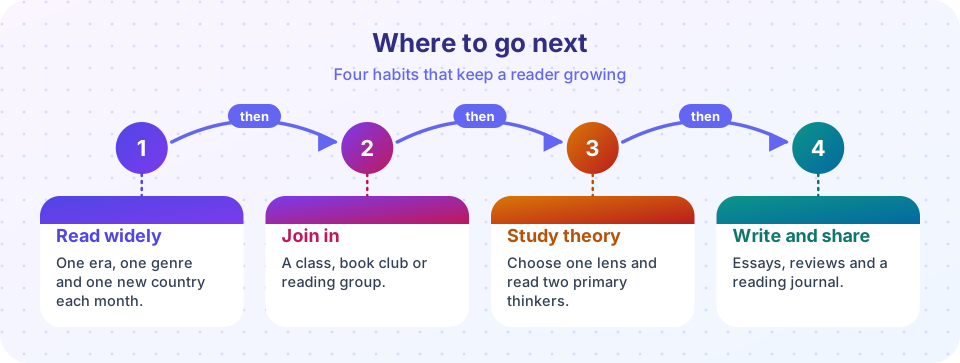
The fastest way to improve as a reader is to read many kinds of texts. A useful principle is breadth with depth: read across periods, genres and countries, and reread a few favorites slowly.
Some ideas for a one-year plan:
- One genre a month. Spend a month on short stories, then poems, then a play, then a novel, then a book of essays.
- One period at a time. Pair a movement with its best-known works: for example, read a Romantic poet, a Realist novel and a Modernist short story in the same season and notice what changes.
- One new voice at a time. If most of your reading has been from one country or language, add one writer from another place each month, in translation if needed.
- One reread. Pick a book you read years ago and read it again with this course in mind.
A sample starter list, by interest (all are widely available):
- Drama: Oedipus the King, Hamlet, A Doll's House, Death of a Salesman, A Raisin in the Sun, Waiting for Godot.
- Short fiction: Chekhov's "The Lady with the Dog", Joyce's "The Dead", Borges's "The Garden of Forking Paths", Gilman's "The Yellow Wallpaper", Melville's "Bartleby, the Scrivener".
- Poetry: Blake's Songs of Innocence and of Experience, Dickinson's poems, Whitman's Leaves of Grass, Langston Hughes's poems, Eliot's The Waste Land.
- Novels: Frankenstein, Jane Eyre, Middlemarch, Mrs Dalloway, Things Fall Apart, Beloved.
- World and postcolonial writing: Wide Sargasso Sea, Season of Migration to the North, Midnight's Children, One Hundred Years of Solitude, Half of a Yellow Sun.
You do not have to like everything. Disliking a book and being able to say precisely why is a perfectly good literary skill.
Join a conversation
Reading becomes richer when it is shared. A class, a book club, an online reading group or even a friend who reads the same book will show you readings you would never have found alone. When you disagree, you have to find evidence, which is exactly the skill of criticism.
If you want to talk but cannot find a group, start one with two or three people and a rule: everyone brings one passage and one question. The conversation will take care of itself. Reading aloud in the group is also a good habit: it brings out rhythm and tone.
Deepen your study of theory and criticism
Chapter 7 gave you a map. To go further, choose one lens and read two primary thinkers, not only summaries. Some accessible guides to start:
- Terry Eagleton, Literary Theory: An Introduction (1983) and How to Read Literature (2013).
- Jonathan Culler, Literary Theory: A Very Short Introduction.
- Peter Barry, Beginning Theory.
- Thomas C. Foster, How to Read Literature Like a Professor, a lively guide to common patterns.
- Virginia Woolf's essay "How Should One Read a Book?" and Francine Prose's Reading Like a Writer, for the craft side.
- E. M. Forster, Aspects of the Novel (1927), and Wayne Booth, The Rhetoric of Fiction (1961), on how stories are built and who tells them.
- An anthology such as The Norton Anthology of Theory and Criticism for primary essays.
Read the original essays for the thinkers you met here: Woolf's A Room of One's Own, Barthes's "The Death of the Author", Achebe's "An Image of Africa", Said's Orientalism, Shklovsky's "Art as Technique". They are often shorter and clearer than their reputations suggest.
Write and share
Writing is how reading becomes yours. Keep a reading journal with a short entry for each text: one quotation, one question, one reaction. Write a review or a short essay each month and ask someone to read it and tell you where they got lost. If you are in school or university, ask for feedback on structure and argument, not just grammar.
You might also try creative writing. Writing a poem in a form you have studied, a scene in the style of a movement, or a retelling from another point of view (as Jean Rhys did with Jane Eyre) teaches you how choices produce effects.
How literature connects to other subjects
Literature is entangled with almost everything else:
- History and politics: texts are shaped by their times and shape them in turn. See World History.
- Language and linguistics: how words work, change and mean. See Linguistics.
- Philosophy: questions of truth, interpretation, ethics and the self. See Introduction to Philosophy.
- Art: the visual arts share periods, styles and debates with literature. See Art History.
- Religion and myth: many literary works are in conversation with sacred texts and traditions. See Religious Studies.
- Psychology: minds, memory and emotion. See Introduction to Psychology.
- Writing skills: see English Writing and Composition and English Grammar.
- Study skills: see Study Skills and Exam Technique for note-taking and revision strategies.
Habits that last
- Read a little every day, even ten pages.
- Reread what you love.
- Notice your own reactions and ask what in the text caused them.
- Be curious about what you do not like.
- Share what you find.
Literature is not a set of facts to memorize. It is a long conversation among readers and writers, and you are now part of it.
"I have to read the classics first." Start where your curiosity is. Skills transfer, and you can reach the classics from any direction.
"Only experts can write criticism." Careful readers with evidence can. Everyone starts as a beginner.
Try it
Press Run (or Ctrl + Enter) to see the result here.
Program input · what you'd type while the program runs
Type the answers before you press Run, one per line. Each time the program reads a line (with input()), it gets the next line from this box.
Check your understanding
Quick check · 4 questions
of 4 answered You scored / 4 · perfect!
-
1. What does 'breadth with depth' mean for a reader?
Variety widens your range, and slow rereading builds depth. -
2. What is a good rule for a new reading group?
A passage and a question keep the talk grounded in the text and open to different views. -
3. Which is a primary source in literary study?
Primary sources are the literary works; criticism is secondary. -
4. How can you deepen your theory study after this course?
Going to the source shows you the thinkers' own arguments.
Summary
- Read widely and reread; plan a modest, enjoyable list.
- Join a conversation, because disagreement sharpens evidence-based reading.
- Deepen theory by choosing one lens and reading original essays and accessible guides.
- Write and share: a reading journal, short essays and creative experiments.
- Literature connects to history, language, philosophy, art, religion and psychology, and this site has tutorials for several of them.
You have finished the course. Return to the course home page any time to review a chapter.
Track your progress
Create a free account to tick off lessons and pick up where you left off on any device.
of Introduction to Literature lessons completed