


















Lesson 27 of 47 · Drama
Chapter Review: Drama
A one-page recap of Chapter 5: Greek tragedy, Shakespeare's stage and modern drama, with a comparison table, flashcards and a ten-question quiz.
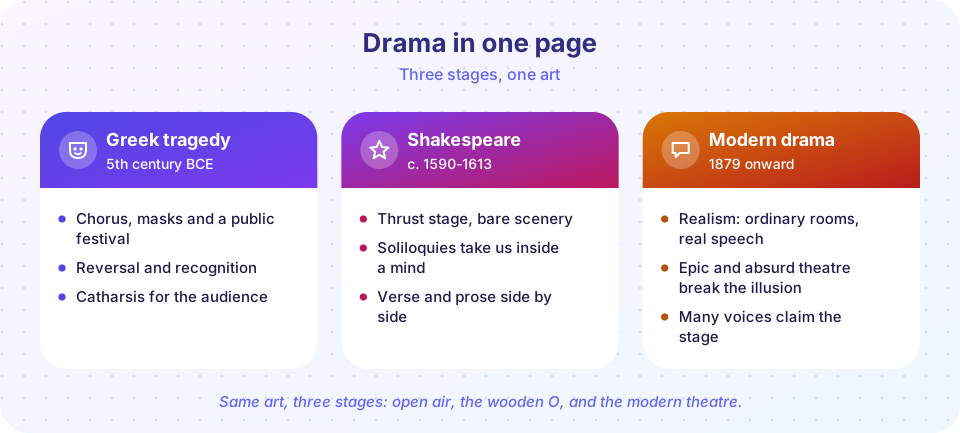
You have now seen drama at three great moments: the open-air festival in Athens, the wooden playhouse in London, and the modern theatre that kept reinventing itself. This review gathers the chapter into one picture, one table and one quiz. Use it to check what you can explain in your own words before you move on to literary movements.
What you will learn
- A compact comparison of Greek tragedy, Shakespearean drama and modern drama.
- The key terms of the chapter in one place.
- How well you remember the three lessons.
The chapter in a table
| Greek tragedy | Shakespeare | Modern drama | |
|---|---|---|---|
| Period | 5th century BCE | c. 1590 to 1613 | 1879 onward |
| Place | Open-air theatre at a festival | Open-air playhouse (the Globe) and indoor Blackfriars | Proscenium and studio theatres worldwide |
| Performers | Masked male actors and a chorus | Adult men and boys | Women and men, many kinds of actor training |
| Language | Verse and song | Blank verse, prose and songs | Mostly prose, much of it close to everyday speech |
| Scenery | Minimal; the skene | Minimal; words do the work | Realistic box sets, or deliberately bare or stylized |
| Key idea | Reversal, recognition, catharsis | Soliloquy and language as scenery | Realism, subtext, epic and absurd |
| Names to know | Aeschylus, Sophocles, Euripides, Aristotle | Shakespeare | Ibsen, Chekhov, Brecht, Beckett, Miller, Hansberry, Wilson |
Key ideas to remember
- Drama is unfinished on the page. Performance completes it, and different performances reveal different meanings.
- Aristotle's six parts of tragedy (plot, character, thought, diction, song, spectacle) put plot first. Hamartia, peripeteia, anagnorisis and catharsis name stages of a tragic action and its effect.
- Dramatic irony gives the audience knowledge the characters lack. Oedipus the King is the model.
- Language is scenery in Shakespeare. Lines tell us place, time and mood, and soliloquy admits us to a mind.
- Verse and prose carry social and emotional signals in Shakespeare. Blank verse is unrhymed iambic pentameter.
- Realism hides the stage behind a fourth wall; epic theatre and the absurd deliberately expose or empty it.
- Subtext is the meaning beneath what characters say, especially in Chekhov.
- Modern drama broadens whose stories appear on stage: Hansberry, Wilson, Soyinka and Churchill, among many others.
Using drama terms in an essay
A term is only useful if it explains something specific. Instead of writing "the play uses dramatic irony", say what the audience knows, what the character does not, and what that gap makes us feel. Instead of "Shakespeare uses a soliloquy", say what thought the soliloquy reveals that no other scene could. When you quote a play, name the speaker and, where it matters, the situation on stage: who is listening, who is not, and what is happening in the space around the speech. And when you write about a script, remember to use the present tense and to imagine the performance: a stage direction or a silence is evidence just as much as a line of dialogue.
Common misconceptions
"Tragedy always means a flawed hero who deserves his fall." Aristotle's term can mean error, and many tragedies show people overwhelmed by conflicting claims or by forces beyond them.
"Shakespeare is the end of the story." Drama before and after him is just as inventive, and the later reaction to realism shows how much theatre keeps rethinking its own conventions.
Try it
Check your understanding
Quick check · 10 questions
of 10 answered You scored / 10 · perfect!
-
1. Which of Aristotle's six parts of tragedy comes first in importance?
Aristotle calls plot the most important element because tragedy imitates action. -
2. In Oedipus the King, what is the main source of dramatic irony?
The myth was familiar, so the audience hears Oedipus's confident promises with a second meaning. -
3. What did the groundlings do at the Globe?
The groundlings were the standing audience in the open yard. -
4. Which line is the main verse form of Shakespeare's plays?
Blank verse is unrhymed iambic pentameter, which is close to natural speech rhythm. -
5. Why does Shakespeare's language often act as scenery?
With minimal scenery, speeches told the audience where and when the action took place. -
6. Ibsen's A Doll's House (1879) is a good example of which type of play?
It is set in a contemporary middle-class home and dramatizes a social issue, the position of married women. -
7. What is subtext?
Subtext is the feeling or intention below the surface of the words, a hallmark of Chekhov. -
8. What did Brecht want the alienation effect to achieve?
By distancing the audience, Brecht encouraged judgment and political awareness. -
9. Which pair is correctly matched?
Hansberry wrote A Raisin in the Sun (1959). Miller wrote Death of a Salesman, Beckett Waiting for Godot, and August Wilson Fences. -
10. Which statement about hamartia is best supported by Aristotle's wording?
The Greek word covers errors of judgment, which is why many scholars avoid the phrase 'fatal flaw'.
Summary
- Greek tragedy, Shakespearean drama and modern drama solved the same problem, making a shared event from words and bodies, in three different ways.
- Key tools: dramatic irony, soliloquy, language as scenery, realism and its opposites.
- Plays are best read with an eye to performance: ask what the actors, space and audience add.
Track your progress
Create a free account to tick off lessons and pick up where you left off on any device.
of Introduction to Literature lessons completed