


















Lesson 44 of 47 · Projects and Practice
Comparative Project: Two Novels, One Question
A guided comparative-essay project on Shelley's Frankenstein and Stevenson's Jekyll and Hyde: choosing a question, building a grid, drafting a thesis and organizing point by point.
Comparison is one of the most common tasks in literature courses, and one of the most often done badly. The usual mistake is to write two summaries stuck together, with a sentence at the end saying "both are similar and different". A good comparison does something else: it uses two texts to answer a question that neither could answer so well alone.
In this project you will plan a comparative essay on two public-domain novels, Mary Shelley's Frankenstein (1818) and Robert Louis Stevenson's The Strange Case of Dr Jekyll and Mr Hyde (1886). You will choose a question, build a comparison grid, draft a thesis and design an outline. You can then adapt the method to any pair of texts.
What you will learn
- How to choose a question that gives a comparison a point.
- How to build and use a comparison grid.
- The difference between block and point-by-point structures, and why the second is usually stronger.
- How to write a comparative thesis and a paragraph that weighs both texts.
Key terms
- Point of comparison: the shared feature or question that lets two texts be compared fairly.
- Block structure: discussing all of text A, then all of text B.
- Point-by-point structure: discussing one point at a time, alternating between texts.
- Contrast: a difference that is significant, not merely a variation.
- Synthesis: an insight that emerges only from seeing both texts together.
Step 1: choose a question
A comparison needs a question that both texts speak to. Ask where the texts touch: a shared theme, a technique, a situation. For our pair, some possible questions are:
- Where is the monster located: in the individual or in how society treats him?
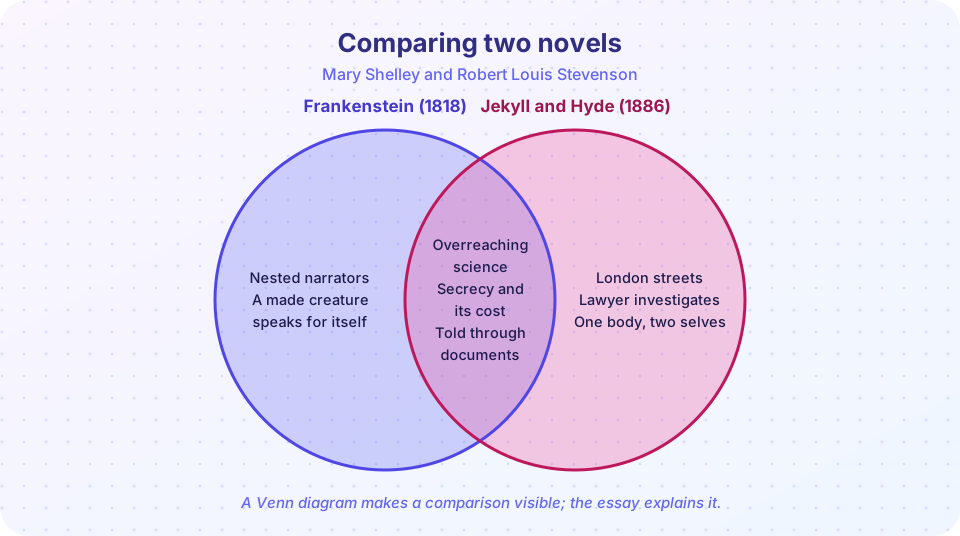
- How does each novel use multiple narrators or documents to build its story?
- What does each suggest about the limits of science?
- How does the setting, an Arctic and Alpine landscape versus nineteenth-century London, shape the horror?
A good question has an answer that is arguable and that differs between the texts in a meaningful way. We will take the first: Where is the monster?
Step 2: build a comparison grid
A grid lists criteria in rows and the two texts in columns. It prevents you from comparing apples with oranges, and it shows you where the interesting similarities and differences lie.
| Criterion | Frankenstein | Jekyll and Hyde |
|---|---|---|
| Who tells the story | Nested narrators: the explorer Walton, Victor, and the creature | The lawyer Utterson's investigation, then letters from Lanyon and Jekyll |
| Setting | Geneva, Ingolstadt, the Arctic | London |
| Source of the horror | A being created and then abandoned by his maker | A scientist's experiment that splits his own self |
| Role of science | Pushes beyond human limits | Does the same, as private experiment |
| Ending | The creature vows to end his life in the Arctic | Jekyll's statement ends and he is found dead |
Next, mark the cells: similarities, differences, and the ones that interest you. Here, both novels are told through multiple documents and both end in death. But the source of the horror is the most important difference: in one novel the monstrous is made by neglect, in the other it is released from within.
Step 3: find evidence
For each point, find a short, precise quotation. The creature says of himself, "I was benevolent and good; misery made me a fiend." The line puts the cause outside him, in suffering. In Jekyll's final statement, the doctor concludes that "man is not truly one, but truly two." The line puts the cause inside: a divided human nature. These two quotations are almost a mini-argument on their own, which is what a good comparison needs.
Keep notes on how each text creates its effect, not only what happens. In Frankenstein, the creature's eloquent narration invites sympathy; in Jekyll and Hyde, much of the story is told from outside, by observers who cannot see what Jekyll hides, which creates suspense and a sense of the unknown. That difference in narration supports the difference in where the monstrous is located.
Step 4: write the thesis
A comparative thesis states a conclusion about both texts, usually with an "although" or "whereas" structure:
Although both novels show scientists who create a frightening double, Shelley locates monstrosity in society's treatment of the made creature ("misery made me a fiend"), whereas Stevenson locates it in the divided self ("man is not truly one, but truly two"), so one novel indicts neglect and the other fears the secret life within.
Check the thesis against the tests from the previous chapter: it is arguable, specific, based on evidence and significant. It also names a point of comparison and a difference that matters.
Step 5: choose a structure
Block structure (all of A, then all of B) is easy to write but tends to produce two separate essays. Point-by-point structure is stronger: each body paragraph or section makes one point and draws on both texts.
An outline for our essay:
- Introduction: both novels feature a creator and a monster; thesis as above.
- Point 1: cause of the horror. The creature's neglect versus Jekyll's chosen experiment, with the two quotations.
- Point 2: narration. The creature's voice versus a story told from outside, and how each shapes sympathy.
- Point 3: setting and society. A natural landscape of isolation versus the respectable city, and who is responsible.
- Counter-reading: Victor is also a "double" of his creature, and Jekyll's society pushes him toward secrecy. Respond: these show how each novel complicates its own answer, but the emphasis still differs.
- Conclusion: what the contrast reveals about two different fears, social neglect and inner division.
A sample comparative paragraph
The two novels give opposite answers to the question of where monstrosity begins. Shelley's creature insists, "I was benevolent and good; misery made me a fiend", and the novel supports him by showing each kindness he offers met with violence before he turns to violence himself. Stevenson reverses the direction. Jekyll's discovery that "man is not truly one, but truly two" makes the monster not a victim of others but a hidden part of the respectable self, and the novel's observers, who see only Hyde's outward acts, cannot understand it. Placed side by side, the novels suggest that the same cultural fear, of a double who undoes his maker's control, can be read as a fear of society's failure in one case and of the self's secrets in the other.
Notice how each sentence refers to both texts or to a contrast between them, and how the last sentence adds a synthesis.
Common weaknesses
- Equal time, no point. Giving each text equal space does not make a comparison. Give the argument what it needs.
- Parallel summary. Do not retell the plot of each in turn.
- False equivalence. Similar topics do not always mean similar meanings. Notice differences in tone, narration, form and context.
- Ignoring context. A 1818 novel and an 1886 novel come from different worlds: the Romantic age and the late Victorian city. Context can explain why the answers differ.
"A comparison must find equal numbers of similarities and differences." There is no quota. Focus on those that serve your question.
"Comparing means ranking." You are not deciding which text is better. You are using each to illuminate the other.
Try it
Press Run (or Ctrl + Enter) to see the result here.
Program input · what you'd type while the program runs
Type the answers before you press Run, one per line. Each time the program reads a line (with input()), it gets the next line from this box.
Check your understanding
Quick check · 4 questions
of 4 answered You scored / 4 · perfect!
-
1. Why is a point-by-point structure usually stronger than a block structure?
Point-by-point keeps the comparison alive in every paragraph instead of producing two separate essays. -
2. What should a comparative thesis do?
It names a point of comparison and a difference or relationship that matters. -
3. In the sample thesis, where does Shelley locate monstrosity?
Shelley's creature says misery made him a fiend; Stevenson's Jekyll finds the cause in a divided human nature. -
4. What is synthesis in a comparative essay?
Synthesis is the new understanding the comparison produces.
Summary
- Choose a question that both texts speak to and that gives the comparison a point.
- Build a comparison grid, mark what matters, and find short, exact quotations.
- Write a thesis that states a conclusion about both texts, and organize point by point.
- Aim for synthesis, not parallel summary.
Track your progress
Create a free account to tick off lessons and pick up where you left off on any device.
of Introduction to Literature lessons completed