


















Lesson 33 of 47 · Theory and Criticism
Theory and Criticism: Ways of Reading
Chapter 7 overview: what literary theory is, why critics read the same text differently, and a map of five lenses from formalism to deconstruction, with a hands-on lens switcher.
Two readers finish the same novel. One says it is about a family, the other that it is about money, a third that it is really about language. Each can point to the page. Who is right? Literary theory is the study of this question. It does not hand you a single correct reading. It asks what a text is, what readers do with it, and what counts as good evidence for an interpretation.
You can think of each theory as a lens. A lens makes some features of a text sharp and leaves others blurry. A critic who understands several lenses can ask better questions, notice more, and explain why other readers see differently. This chapter introduces the most important lenses and shows how to use them without becoming a slave to jargon.
What you will learn
- What literary theory is and why a reader needs it.
- Five basic lenses: the text, the author, the reader, the context, and the unsaid.
- How a single short text looks different through each lens.
- The route of this chapter through formalism, reader-response, Marxist, feminist, psychoanalytic and deconstructive criticism.
Key terms
- Literary theory: ideas about what literature is, how it means, and how it should be read.
- Criticism: the practice of analyzing and judging literary works, often using theory.
- Interpretation: an explanation of what a text means or does, supported with evidence.
- Lens: a way of reading that foregrounds certain questions.
- Intentional fallacy: a term from New Criticism for the mistake of judging a work only by what its author meant.
From "what does it say?" to "how do we read?"
Criticism is as old as literature. Plato worried that poetry could mislead citizens. Aristotle, as you saw earlier, analyzed tragedy. Renaissance writers such as Sir Philip Sidney (The Defence of Poesy, 1595) defended poetry's value. In the nineteenth century, Matthew Arnold argued that literature could carry culture and moral seriousness.
The twentieth century turned criticism into a battlefield of schools. Some wanted to look only at the work's form. Others argued that all reading is shaped by class, gender, empire or language. These arguments can look abstract, but each school started from a real problem. Formalists wanted a way to talk precisely about how poems work. Marxist and feminist critics noticed that great literature often ignored or distorted whole groups of people. Psychoanalytic critics wondered why some texts disturb us so deeply. Deconstruction asked what happens to meaning when language itself is unstable.
Five questions
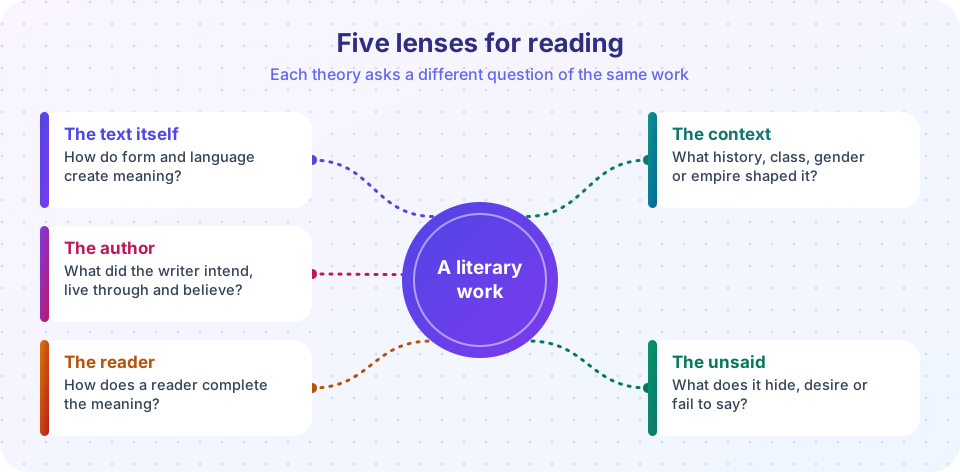
A helpful way to organize the field is by asking where meaning is said to reside:
- In the text itself. Formalism and New Criticism treat the work as a self-contained object and attend to its words, images and structure.
- In the author. Traditional biographical criticism looks to the author's life and intentions. Many modern critics argue this is unreliable or limited, but authors' contexts still matter to historians of literature.
- In the reader. Reader-response and reception theories hold that a text only becomes meaningful when somebody reads it. Different readers and different historical moments produce different readings.
- In the context. Marxist, feminist, postcolonial, new historicist and other approaches look at the historical, economic, social and political forces that shape texts and readers.
- In what the text hides or cannot say. Psychoanalytic and deconstructive approaches ask what a text represses, contradicts or fails to control.
These categories overlap, but together they give you a working map. A single essay can use more than one.
The chapter's route
The text and the reader
Power and the mind
Beyond the text
The lessons:
- Text and Reader: Formalism, Structuralism and Reader-Response
- Power, Gender and the Mind: Marxist, Feminist and Psychoanalytic Criticism
- Poststructuralism and Beyond: Deconstruction, New Historicism and New Lenses
- Chapter Review
Why bother with theory?
First, theory makes your reading more precise: you learn names for patterns you only half noticed. Second, it widens your range: when a reading seems obvious, a different lens exposes what was invisible. Third, it makes you a better writer, because a good essay does not just say "this is symbolic". It says what is at stake in the reading and why the reading matters.
Theory can also be abused. A student who runs a text through a jargon machine and stamps "patriarchal" or "ambiguous" on the result has not read. The test of a lens is whether it helps you notice something in the text. Always return to the words on the page.
"Theory tells you the one correct meaning." Theories are ways of asking questions. Good interpretations are supported by evidence and open to challenge.
"Theory is only for experts." Everyone uses theories when they read, such as assuming the author's intention or the reader's feelings. Naming them makes you more aware.
Try it
Check your understanding
Quick check · 4 questions
of 4 answered You scored / 4 · perfect!
-
1. What is a literary lens?
A lens is a theory-shaped way of looking at a text that makes some features stand out. -
2. Which approach treats the work as a self-contained object?
Formalists and New Critics concentrate on words, images and structure. -
3. What does reader-response criticism emphasize?
It holds that a text becomes meaningful through the act of reading. -
4. Why can theory be abused?
A lens should help you notice something in the words on the page, not replace reading.
Summary
- Literary theory studies how texts mean and how we should read them.
- A helpful map: meaning in the text, the author, the reader, the context, and the unsaid.
- Each lens makes some features sharp and others blurry; use several, always with evidence.
- This chapter covers formalism, structuralism, reader-response, Marxist, feminist, psychoanalytic, deconstructive and historicist approaches.
Next: Text and Reader: Formalism, Structuralism and Reader-Response
Track your progress
Create a free account to tick off lessons and pick up where you left off on any device.
of Introduction to Literature lessons completed