


















Lesson 28 of 47 · Literary Movements
Literary Movements: A Map of Styles
Chapter 6 overview: what a literary movement is, why dates are fuzzy, and a route through Romanticism, Realism, Modernism, Postmodernism and postcolonial writing.
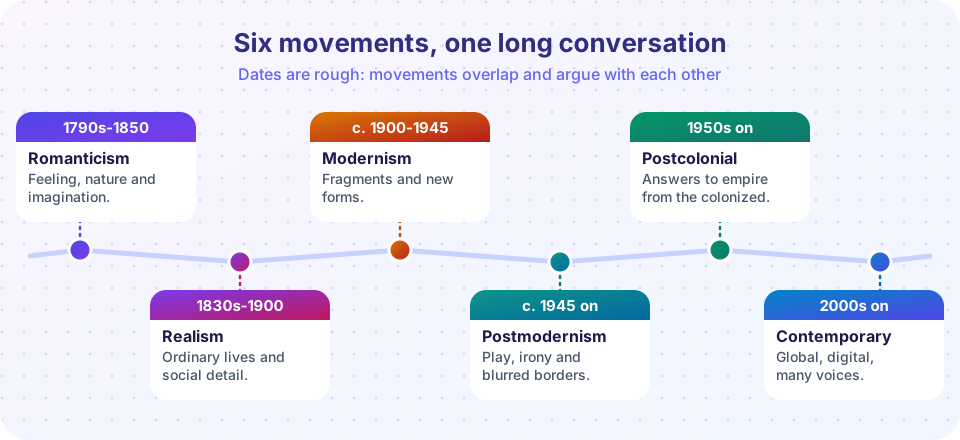
Writers do not work alone. They read each other, quarrel with each other and respond to the same wars, machines, ideas and fears. At certain moments, enough writers share enough habits that critics group them under a single label: Romanticism, Realism, Modernism and so on. These labels are called literary movements (or periods, or schools). They help us see patterns, and they help us ask why styles change.
This chapter gives you a map. You will meet five big movements, the historical events behind them, and some of the best-known writers in each. The map is useful as long as you remember it is a map: the real landscape is messier.
What you will learn
- What a literary movement is and what it is not.
- Why the dates and boundaries of movements are always approximate.
- The core features of each movement in this chapter, in outline.
- How to use a movement label as a question, not a pigeonhole.
Key terms
- Literary movement: a group of writers or works that share ideas, techniques or aims in a period.
- Period: a span of time with a recognizable literary character, such as the Victorian period.
- Convention: an accepted technique or pattern within a movement or genre.
- Reaction: a movement that defines itself against the one before.
- Canon: the set of works a culture treats as the most important or representative.
What a movement is
A literary movement is a pattern that critics notice, often after the fact. Sometimes writers announce a movement themselves. The Imagist poets of the 1910s published manifestos, and Surrealists in France issued declarations in the 1920s. More often, the label arrives later. Nobody in 1800 woke up and said "I am a Romantic". The word was applied, argued over and refined by later critics.
Movements are shaped by context: wars, revolutions, technologies, new audiences and new ideas. Romanticism grew in the age of the French Revolution (1789) and the first factories. Modernism grew from the shock of the First World War, cities and new theories of the mind. Postcolonial literature grew as empires gave up control and new nations began to write their own stories.
Movements also shape each other. Realism criticized Romantic fantasy. Modernism rejected the confident order of Realism. Postmodernism doubted Modernism's own seriousness. A good question to ask of any movement is: what is it reacting against, and what is it trying to preserve?
The map
- Romanticism
- Realism
- Modernism
- Postmodernism
- Postcolonial
The chapter's lessons are:
- Romanticism and Realism: a pair of contrasting answers to the question of what literature is for.
- Modernism and Postmodernism: the twentieth century's experiments with form and its doubts about truth.
- Postcolonial and World Literature: writing from formerly colonized places, and the question of whose stories circulate.
- Chapter Review.
How to use a label
A movement name works best as a question you ask a text, not a box you put it in. If you call a poem Romantic, ask how it treats nature and feeling, and whether it complicates them. If you call a novel Realist, ask what counts as "real" in it, whose reality it shows, and whose it leaves out. If it does not fit at all, that is interesting too.
Also remember that the movements we teach are mostly drawn from European and North American history. Other literatures have their own periods and revolutions: the Tang dynasty poets of China, the classical Persian poets, the Japanese novel of the Heian court, the Latin American Boom of the 1960s. This chapter ends by looking outward for exactly this reason.
Try it
Press Run (or Ctrl + Enter) to see the result here.
Program input · what you'd type while the program runs
Type the answers before you press Run, one per line. Each time the program reads a line (with input()), it gets the next line from this box.
Check your understanding
Quick check · 4 questions
of 4 answered You scored / 4 · perfect!
-
1. What is a literary movement?
Movements are patterns that critics notice, often after the fact, and they are always approximate. -
2. Why are the dates of movements 'rough'?
Writers cross boundaries, and styles overlap, so any date range is a convenience. -
3. A useful question to ask about any movement is:
Movements often define themselves against what came before, while keeping some of its values. -
4. Which historical event is closely linked with Romanticism's origins?
Romanticism grew in the age of the French Revolution (1789) and early industrialization.
Summary
- A literary movement is a pattern of shared style and ideas, usually named after the fact.
- Contexts such as revolutions, wars, technologies and the end of empire shape movements.
- Movements overlap and react to each other, so treat labels as questions.
- This chapter covers Romanticism, Realism, Modernism, Postmodernism and postcolonial literature.
Next: Romanticism and Realism
Track your progress
Create a free account to tick off lessons and pick up where you left off on any device.
of Introduction to Literature lessons completed