


















Lesson 18 of 47 · Fiction and Narrative
Plot and structure
Learn how plots work: conflict, Freytag's pyramid, in medias res, flashbacks, foreshadowing and suspense, with a worked example of Little Red Riding Hood.
What keeps you turning pages? Usually it is not just that things happen. It is that something is at stake, someone wants something, and an obstacle stands in the way. That tension, arranged in time, is plot. A plot is a sequence of events organized by cause and effect, shaped so that each part raises a question and the next part complicates or answers it. This lesson gives you the vocabulary for describing how stories are built, from the classic pyramid to the many ways writers bend it.
What you will learn
- What conflict is and the main types of conflict.
- The five parts of Freytag's pyramid and what each does.
- How writers rearrange time: in medias res, flashback, frame stories.
- How suspense, foreshadowing and pacing work.
- How to map the plot of any story.
Key terms
Conflict is a struggle between opposing forces that drives a plot.
Exposition is the part that sets out the characters, setting and situation.
Climax is the turning point of highest tension.
Resolution (or denouement) is the winding down after the climax.
Foreshadowing is a hint of what is to come.
Conflict: the engine of plot
A plot needs conflict. Without some resistance, nothing is at stake and nothing happens. Conflict is often divided into two broad kinds. External conflict is between a character and something outside: another person, nature, society, a machine or a supernatural force. Internal conflict takes place inside the character: desire against duty, fear against courage, loyalty against truth. Many strong stories combine both: a sailor battles a storm (external) while fighting despair (internal).
A helpful trick for finding the conflict is to complete the sentence: "The main character wants ____, but ____ stands in the way." If you cannot fill it in, look again.
Freytag's pyramid
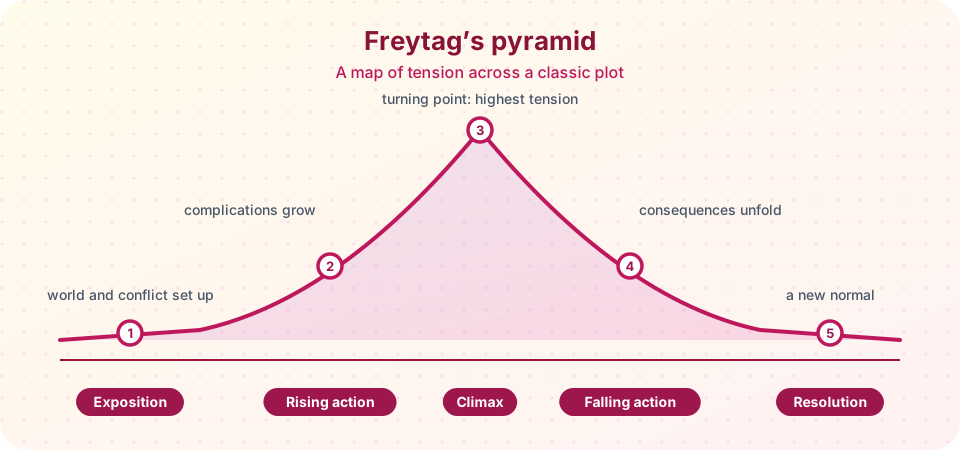
In 1863 the German writer Gustav Freytag published Die Technik des Dramas ("The Technique of Drama"), where he analyzed the structure of classical five-act plays. His diagram, a pyramid, has become the standard classroom picture of plot. Although it was designed for drama, it works well for many stories.
- Exposition. We meet the characters and the world, and learn what is normal. The exposition also plants the seeds of conflict. An important event here is the inciting incident, the moment that upsets the balance and starts the story moving.
- Rising action. Complications pile up. The character tries to solve the problem, and each attempt raises the stakes or opens a new difficulty.
- Climax. The moment of highest tension, where the conflict reaches its peak and something decisive happens. After the climax, things cannot go back.
- Falling action. The consequences of the climax unfold. Loose ends tighten.
- Resolution (denouement). The story settles into a new normal. The word denouement comes from French and means "untying," like the loosening of a knot.
Not every story fits this shape. Many modern stories begin near the climax, or end without a neat resolution. But the pyramid gives you a baseline to compare against.
Other ways to arrange events
The same events can be told in different orders. Writers choose the order to control what the reader knows and when.
In medias res. Latin for "in the middle of things": the story begins in the middle of the action, with earlier events filled in later. The ancient Roman poet Horace praised Homer for it in his Ars Poetica. The Odyssey opens when Odysseus has already been away from home for years.
Flashback and flash-forward. A flashback shows an earlier time; a flash-forward jumps ahead. They add depth: we learn why a character acts as they do, or we feel dread knowing what is coming.
Frame story. A story told inside another story. Geoffrey Chaucer's The Canterbury Tales (late fourteenth century) frames each tale as a pilgrim's contribution to a storytelling contest. Mary Shelley's Frankenstein (1818) is framed by an explorer's letters, which contain Victor Frankenstein's narrative, which contains the creature's. Frames can make a story feel layered, or can ask us how much to trust each teller.
Episodic plot. A series of loosely linked adventures, like Don Quixote or many picaresque novels, rather than one tightly knotted chain.
Circular and nonlinear structures. Some stories end where they began, changed. Others move back and forth in time, like a puzzle assembled for the reader.
Suspense, surprise and foreshadowing
The film director Alfred Hitchcock explained the difference between surprise and suspense with an image: if a bomb explodes under a table where people are chatting, the audience is surprised for fifteen seconds. If the audience knows the bomb is there, the same scene holds suspense for the whole conversation. Suspense depends on letting the reader know, or guess, that something is coming.
Foreshadowing drops hints of what is to come. A storm gathers, a character mentions a coming journey, a gun hangs on a wall. A principle often attributed to the playwright Anton Chekhov says that if a gun is shown in the first act, it should be fired by the third: details should matter. A red herring is a false clue, used especially in mystery stories to mislead. A cliffhanger ends a section on a moment of peril to compel the reader onward.
Pacing is the speed of the story. A writer can slow down with long description, or speed up with short sentences and quick scenes. Good pacing matches the story's mood: slow for dread, fast for chase.
Mapping a plot: a worked example
Take the folk tale "Little Red Riding Hood," told by Charles Perrault in 1697 and by the Brothers Grimm in 1812. In the Grimm version, we can map a plot like this.
| Stage | Event |
|---|---|
| Exposition | A mother sends her daughter with food to her ill grandmother and warns her not to leave the path. |
| Inciting incident | The girl meets a wolf and innocently tells him where her grandmother lives. |
| Rising action | The wolf reaches the cottage first and swallows the grandmother; the girl arrives and notices the "grandmother" looks strange. |
| Climax | The wolf, having been questioned ("what big teeth you have!"), swallows the girl. |
| Falling action | A huntsman passing by hears snoring and cuts open the wolf. |
| Resolution | Both are rescued; the girl resolves never to stray from the path again. |
Conflict. The girl wants to deliver the food and stay safe. The external conflict is with the wolf; the internal one is her naivety. Foreshadowing: the mother's warning, which is broken. Theme (one reading): trust and obedience, and the danger of strangers. Other readings notice the tale's fear of the forest, of growing up or of predators in disguise, which is why the story has lasted.
Common misconceptions
"The climax is the most exciting scene." It is the turning point of the main conflict, which may be quiet. In some stories, the climax is a choice or a realization.
"All stories follow the same pyramid." The pyramid is a model, not a law. Many stories invert, repeat or break it.
"Plot is just the summary." A summary lists events. Plot is the arrangement of cause and effect, and the writer's decisions about order and emphasis.
Try it
Draw your own tension curve, then chart the plot of Little Red Riding Hood.
Press Run (or Ctrl + Enter) to see the result here.
Program input · what you'd type while the program runs
Type the answers before you press Run, one per line. Each time the program reads a line (with input()), it gets the next line from this box.
Check your understanding
Quick check · 5 questions
of 5 answered You scored / 5 · perfect!
-
1. Which is the best description of conflict?
Conflict, internal or external, creates the tension that moves a plot. -
2. In Freytag's pyramid, what happens right after the climax?
The consequences unfold in the falling action, before the resolution. -
3. What does 'in medias res' mean?
Latin for 'in the middle of things': the story starts partway through. -
4. What is a red herring?
Red herrings are used especially in mysteries to divert attention. -
5. Hitchcock's bomb-under-the-table example illustrates the difference between
When the audience knows about the bomb, a calm scene becomes suspenseful.
Summary
- Plot is a sequence of events linked by cause and driven by conflict, external or internal.
- Freytag's pyramid has exposition, rising action, climax, falling action and resolution.
- Writers rearrange time with in medias res, flashbacks, frames and episodes.
- Suspense, foreshadowing, red herrings and pacing manage what the reader knows and feels.
- Map any plot by finding the conflict, the inciting incident, the climax and the change.
Track your progress
Create a free account to tick off lessons and pick up where you left off on any device.
of Introduction to Literature lessons completed