


















Lesson 1 of 47 · Getting Started
Course map: how this literature course works
Meet the nine chapters of this introduction to literature, learn who the course is for, and get a simple method for reading, noting and writing about texts.
Welcome. This course teaches you how to read literature closely, enjoy it more, and explain what you notice to other people. You do not need to be a book expert to begin. You need curiosity, a pencil and a willingness to slow down. By the end you will be able to take a poem, a story or a scene from a play, say exactly how it works, and write a clear, evidence-based essay about it.
What you will learn
- Who the course is for and what you need before you start.
- What each of the nine chapters covers and why they come in this order.
- A three-pass method for reading any text.
- How to keep a reading journal that makes your essays easier later.
- How to plan your study time so the course stays enjoyable.
Key terms
Close reading is slow, careful attention to the exact words, images and structure of a text.
Genre is a family of texts that share conventions, such as poetry, fiction or drama.
Form is the particular shape inside a genre, such as a sonnet or a short story.
Interpretation is a reasoned claim about what a text means, supported by evidence from the text.
Canon is the set of works a culture treats as especially important. Canons change over time.
Who this course is for
The course is written for learners of about eleven to eighteen, for adults returning to reading after a long gap, and for anyone who has been told that literature is "difficult" and wants to find out why people love it. It follows the common core of international school syllabuses, so it fits alongside Cambridge IGCSE and A Level English Literature, the IB language and literature courses and US high school and AP literature classes. You will meet the same skills in all of them: describe what the text does, support your claims with quotations, and consider more than one reading.
You do not need any special background. If you can read English at the level of a newspaper article, you can start. The course uses US spelling, short sentences and plain definitions, and every technical word is explained the first time it appears. Most examples are quoted from works that are in the public domain, which means they are old enough to quote freely. Where a modern work is mentioned, the course describes it in its own words and never copies it.
How the course is organized
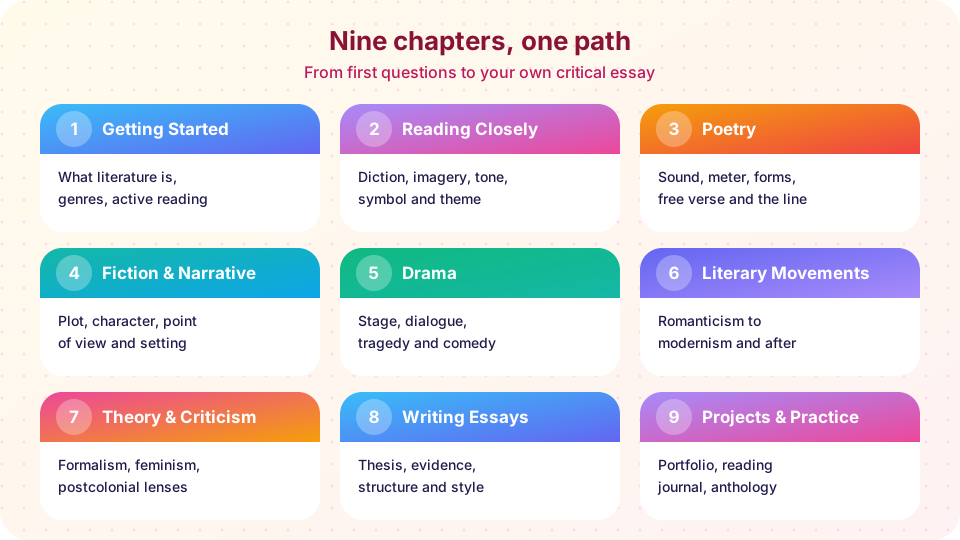
The nine chapters build on each other. The first two chapters give you the tools. The next three apply those tools to the three big literary genres. The last four widen the view and turn your reading into writing.
Chapter 1, Getting Started, asks the basic question: what is literature, and how is it different from other writing? You will meet the main genres and learn habits of active reading. Start with What is literature?.
Chapter 2, Reading Closely, is the toolbox. You will study word choice, comparison, tone, irony, symbols and themes. See Reading closely: an overview.
Chapter 3, Poetry, shows how sound, rhythm, line breaks and form create meaning in a small space. Begin at Poetry: an overview.
Chapter 4, Fiction and Narrative, covers plot, character, point of view and setting. The entry point is Fiction: an overview.
Chapter 5, Drama, treats plays as scripts meant for performance: dialogue, staging, tragedy and comedy.
Chapter 6, Literary Movements, places works in time, from Romanticism through realism and modernism to contemporary writing from around the world.
Chapter 7, Theory and Criticism, introduces the lenses scholars use, such as formalism, feminist, Marxist, psychoanalytic and postcolonial criticism, and shows how a lens changes what you see.
Chapter 8, Writing About Literature, teaches thesis statements, evidence, paragraphs and revision.
Chapter 9, Projects and Practice, gives you portfolio projects, practice passages, a glossary and a cheat sheet.
Learn to read
The three genres
The wider view
Your own voice
A three-pass method for any text
Experienced readers rarely read a serious text only once. This course asks you to read in three passes, and each lesson will remind you of them.
- Pass one: read for the experience. Do not stop to analyze. Notice where you were bored, surprised or moved. Write one sentence about your reaction.
- Pass two: read for the details. Go back with a pencil. Mark words that seem chosen, patterns that repeat and places where something changes. Write questions in the margin.
- Pass three: read for the argument. Decide on one idea you can defend, and collect the two or three pieces of evidence that support it.
The first pass protects the pleasure of reading. The second builds the skill. The third prepares you to write. You will practice all three in How to read actively.
The reading journal
Keep a notebook or a document called your reading journal. After each lesson or text, record the title and author, a one-sentence summary, one striking quotation with its page or line number, and one question you still have. After a month you will have a record of your own thinking. That record is the best raw material for essays, because the strongest essays begin with a real observation, not a borrowed one.
Planning your time
The course has roughly eighty hours of material if you read, try the examples and write short answers, which is about half a year at three hours a week. A realistic plan is two or three short sessions each week. Short, regular sessions beat one long session because close reading depends on rereading, and rereading is easier when the first reading is still fresh.
Read with a pencil and your phone out of reach. Writing a note forces you to decide what you actually noticed, and silence makes the sound of the language easier to hear.
Common misconceptions
"There is one correct meaning that the teacher already knows." Good interpretations are arguments, and arguments need evidence. Different readers can defend different readings, but a reading that ignores the words on the page is weak.
"Analysis ruins the pleasure." Most readers find the opposite: noticing how a poem works makes the next reading richer, in the way that learning about music makes you hear more in a song.
"Old books are only for experts." Many classics were written for ordinary readers and were once popular entertainment. The language is harder, but the feelings are familiar.
Try it
Plan your schedule first, then look at the suggested balance of effort across the chapters.
Press Run (or Ctrl + Enter) to see the console output here.
No output.
Press Run (or Ctrl + Enter) to see the result here.
Program input · what you'd type while the program runs
Type the answers before you press Run, one per line. Each time the program reads a line (with input()), it gets the next line from this box.
Check your understanding
Quick check · 4 questions
of 4 answered You scored / 4 · perfect!
-
1. What is the main purpose of the three-pass method?
Each pass has a different job: experience first, details second, argument third. -
2. Which statement about interpretation fits this course?
Readers may disagree, but strong readings stay anchored in the words of the text. -
3. Why does the course quote mostly public-domain works?
Older works are out of copyright, so they can be quoted; modern works are described in original words. -
4. What should a reading journal entry contain?
The mix of summary, evidence and a question builds raw material for later essays.
Summary
- The course has nine chapters: tools first, then poetry, fiction and drama, then movements, theory and writing, then projects.
- It follows the common core of international school courses and needs no special background.
- Read each text three times for different purposes: experience, details, argument.
- Keep a reading journal with a summary, a located quotation and a question.
- Plan short, regular sessions and leave time for rereading.
Next: What is literature?
Track your progress
Create a free account to tick off lessons and pick up where you left off on any device.
of Introduction to Literature lessons completed