


















Lesson 46 of 47 · Projects and Practice
Cheat Sheet: Introduction to Literature on One Page
A one-page recap of the whole course: reading closely, poetry, fiction, drama, movements, theory and essay writing, with questions to ask of any text and a reading-prompt generator.
This is the whole course in one place. Keep it open while you read, annotate, revise for an exam or plan an essay. Each section is a compact reminder, not a replacement for the lessons. When something here is unfamiliar, follow the chapter it refers to.
What you will learn
- A one-page summary of all nine chapters.
- A short list of questions to ask of any text.
- A checklist for essays and a quick way to generate reading prompts.
Key terms
- Close reading: slow, evidence-based attention to the words of a text.
- Genre: a kind of work with shared conventions.
- Movement: a pattern of shared style and ideas across writers.
- Lens: a theory-shaped way of asking questions.
- Thesis: the arguable claim an essay proves.
Chapter 1: Getting started
- Read actively: first for the story, then for the craft. Annotate in the margins.
- Keep a reading journal: questions, quotations, reactions.
- Literature rewards slow reading; every unfamiliar word is a clue.
- A text is not a puzzle with one answer. It is an invitation to interpret, with evidence.
Chapter 2: Reading closely
- Start with diction (word choice), imagery, syntax (sentence shape), sound and tone.
- Look for patterns: repetition, contrast, change.
- Ask: what is surprising, and why did the writer choose this word and not another?
- Move from observation to interpretation: what is there, how it works, why it matters.
Chapter 3: Poetry
- Poems compress. Pay attention to line breaks, stanzas, rhythm and rhyme.
- Meter is the pattern of stresses; iambic pentameter has five weak-strong pairs per line.
- Common forms: sonnet (14 lines, with a turn), ballad, elegy, epic, free verse.
- Figures of speech: metaphor, simile, personification, symbol, irony.
- Read aloud: poems are meant to be heard.
Chapter 4: Fiction and narrative
- Plot is what happens; story is the order in which a narrator tells it.
- Character: how are people built, by description, speech and action?
- Point of view: first person, third person, omniscient, limited. Is the narrator reliable?
- Setting shapes mood and meaning. Theme is a claim about an idea, not a topic.
- Look at structure: beginning, rising action, climax, resolution, or a pattern that breaks these.
Chapter 5: Drama
- A script is unfinished without performance. Imagine voices, bodies and space.
- Greek tragedy: chorus, reversal, recognition, catharsis (Aristotle's Poetics).
- Shakespeare: open-air playhouse, words as scenery, verse and prose, soliloquy.
- Modern drama: realism and the fourth wall, Chekhov's subtext, Brecht's epic theatre, Beckett's absurd, Hansberry, Wilson and others widening the stage.
Chapter 6: Literary movements
| Movement | Rough dates | Core idea |
|---|---|---|
| Romanticism | 1790s to 1850 | Feeling, nature, imagination, the individual |
| Realism | 1830s to 1900 | Ordinary life in social detail |
| Modernism | c. 1900 to 1945 | New forms for a fractured age |
| Postmodernism | c. 1945 onward | Irony, play, doubt about grand stories |
| Postcolonial | 1950s onward | Answering empire, recovering voices |
Treat labels as questions; writers cross borders.
Chapter 7: Theory and criticism
- Formalism and New Criticism: What do the words and form do?
- Structuralism: What system of conventions makes it meaningful?
- Reader-response: What does the reader bring and complete?
- Marxist: What does it show about class and ideology?
- Feminist and queer: How are gender and sexuality represented? Who speaks?
- Psychoanalytic: What does it hide or desire?
- Deconstruction: Where does the text undo its own claims?
- New Historicism: How do text and context shape each other?
Chapter 8: Writing about literature
- Read twice and annotate.
- Notice patterns and puzzles.
- Argue: a question, then a thesis that passes the tests (arguable, provable, significant).
- Draft: claim, lead-in, quotation, analysis, in each paragraph.
- Revise: argument, structure (reverse outline), sentences, proofreading.
Quote short and exact, mark verse line breaks with slashes, and cite in the style your course requires.
Chapter 9: Projects and practice
- Close reading: read aloud, find a puzzle, annotate, find a pattern, claim, paragraph.
- Comparison: choose a question, build a grid, write a thesis that concludes something about both texts, organize point by point.
Ten questions for any text
- Who is speaking, and to whom?
- What is surprising or odd?
- Which words or images repeat?
- Where does the tone shift?
- What is left out?
- What does the ending change?
- How would this look from another character's side?
- What world (class, gender, empire, time) does it assume?
- What does it echo from earlier texts?
- What is my claim, and what is my best evidence?
When you are stuck, pick one short passage and write three sentences: what is there, how it works, and why it matters. Almost every essay can grow from that.
A routine for exams and quick essays
When time is short, use a fixed routine so that nothing important is forgotten.
- Read the question twice and underline its key words (compare, how far, to what extent, show how).
- Spend five minutes planning: a one-sentence thesis and three claims, each tied to a passage you can quote.
- Open directly: name the text and author, and state your thesis in the first paragraph.
- Write each paragraph as a sandwich: claim, lead-in, short quotation, analysis.
- Include one counter-reading if the question allows it.
- Leave two minutes to read the last paragraph and the thesis together, and make sure they agree.
If you cannot remember a quotation exactly, paraphrase and point to the moment in the text instead of inventing words. Accuracy matters more than a long list of terms.
Common misconceptions
"I need to know every term and theory." You need to be able to notice and explain. Terms and theories are tools for that.
"A cheat sheet replaces reading." It points you back to the text, where all the evidence lives.
Try it
Press Run (or Ctrl + Enter) to see the result here.
Program input · what you'd type while the program runs
Type the answers before you press Run, one per line. Each time the program reads a line (with input()), it gets the next line from this box.
Check your understanding
Quick check · 4 questions
of 4 answered You scored / 4 · perfect!
-
1. What are the three sentences to write about a short passage when you are stuck?
Observation, mechanism and significance form a mini close reading. -
2. Which movement is associated with fragmentation and stream of consciousness?
Modernist writers such as Woolf, Joyce and Eliot used these techniques. -
3. Which lens asks 'What does the reader bring and complete?'
Reader-response criticism emphasizes the reader's role in making meaning. -
4. What should come last in revising an essay?
Work from argument and structure down to sentences and finally proofreading.
Summary
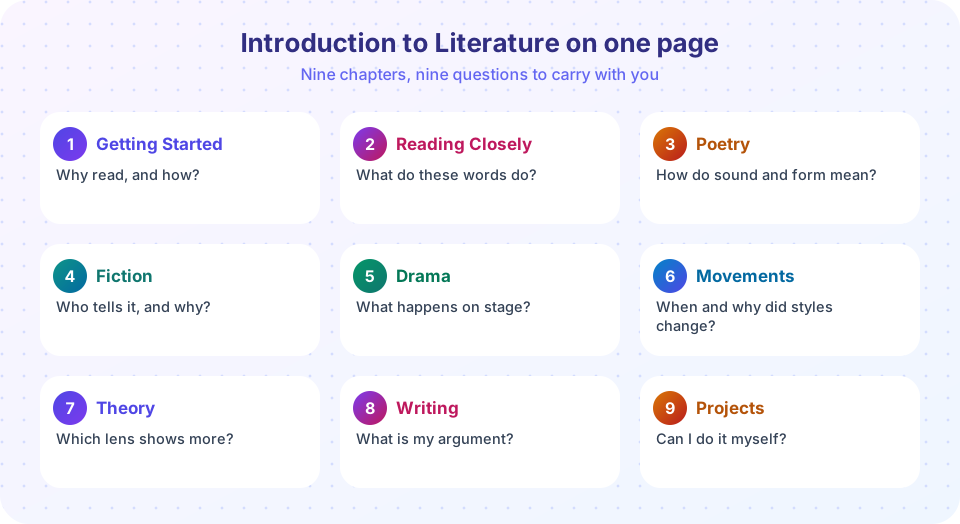
- Nine chapters, nine questions: why and how to read, which words work, how poems and stories are built, what happens on stage, how movements and theories shape reading, and how to argue in writing.
- Use the ten questions on any text, and the three-sentence method when stuck.
- Evidence comes from the text; labels and theories help you ask better questions.
Track your progress
Create a free account to tick off lessons and pick up where you left off on any device.
of Introduction to Literature lessons completed