


















Lesson 16 of 47 · Poetry
Chapter 3 review: poetry
Review the poetry chapter: speaker, sound and meter, fixed forms and free verse, applied together to an Emily Dickinson poem, with flashcards and a ten-question quiz.
You now have a full toolkit for poetry. Chapter 3 covered four big questions: who is speaking, how does it sound, what form does it take, and how does the line shape the reading? This review brings them together in one extended example, shows how they combine into an interpretation, and lets you test yourself. If anything is fuzzy, the table below links back to the lesson that taught it.
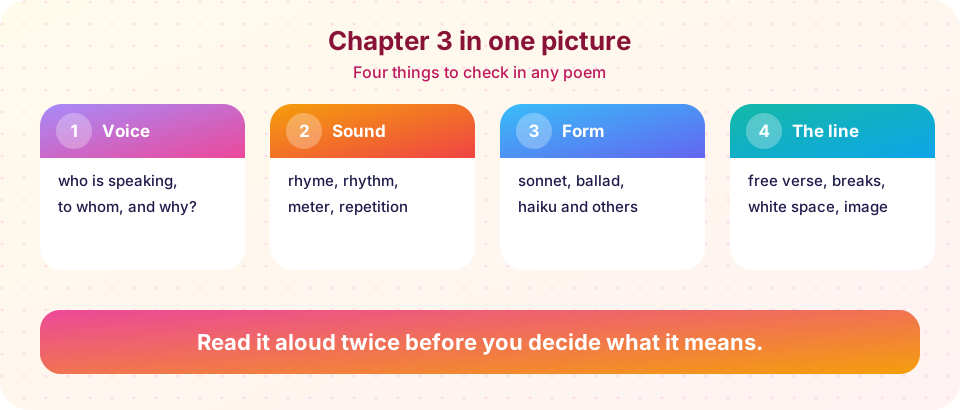
What you will learn
- A summary of the four lessons in the chapter.
- How to read one poem with voice, sound, form and line all in view.
- Which terms to know by heart.
- How a claim about a poem is built from specific evidence.
Key terms
Speaker is the voice of a poem; stanza is a group of lines.
Meter is a pattern of stress; foot is one unit of it; scansion is the marking of stresses.
Rhyme scheme is the pattern of end rhymes; slant rhyme is a near rhyme.
Volta is the turn in a sonnet or poem.
Free verse is poetry without regular meter or rhyme; enjambment runs a sentence over a line break.
The chapter at a glance
| Question | Lesson | Key ideas |
|---|---|---|
| What is a poem, and who speaks? | Poetry: an overview | speaker, line, stanza, lyric, narrative, dramatic |
| How does it sound? | Sound, rhythm and meter | rhyme, alliteration, assonance, feet, iambic pentameter, scansion |
| What pattern does it follow? | Poetic forms | sonnet, ballad, limerick, villanelle, haiku, volta |
| What does the line do? | Free verse and the line | line breaks, white space, Imagism, cadence |
A worked reading: Emily Dickinson
Here are the first two stanzas of poem 712 (as numbered in the standard modern edition by Thomas H. Johnson), usually printed with the first line as its title. Dickinson wrote it in the early 1860s; it was published after her death. It is in the public domain.
Because I could not stop for Death –
He kindly stopped for me –
The Carriage held but just Ourselves –
And Immortality.

We slowly drove – He knew no haste
And I had put away
My labor and my leisure too,
For His Civility –
Speaker and situation. The speaker is someone looking back after death, telling the story of a carriage ride. The calm, matter-of-fact voice is the first surprise: nothing about the situation sounds frightened.
Sound and meter. The poem is written in what is often called common meter or ballad meter: lines alternate between four stresses and three stresses (eight syllables, then six). Read the first line aloud: "Be-CAUSE i COULD not STOP for DEATH," four iambs. Then the second: "He KIND-ly STOPPED for ME," three iambs. The steady, hymn-like beat helps make the ride feel unhurried. The rhymes are slant: "me" and "Immortality" (the final unstressed "-ty" echoes the vowel) and "away" and "Civility." They are near-matches that never quite click, a quiet unease inside the politeness.
Form and the dashes. Dickinson's poem is made of quatrains, the building block of the ballad. The dashes are her signature: each one is a small pause, like a breath. In the first stanza they slow the speaker's voice and give the four lines a hesitant, dreamlike drift.
Voice, diction and personification. Death is a person: "He kindly stopped for me." The word "kindly" is a surprise, as is "Civility" in the second stanza, which gives Death the manners of a gentleman caller. The speaker answers with her own good manners, putting away "labor" and "leisure" as if getting ready for company. Capital letters on "Carriage," "Ourselves," "Death" and "Immortality" lend those words extra weight.
Tone. The tone is composed and a little wry. The poem treats the biggest subject with understated courtesy, and the understatement is the irony: a polite ride toward the end of life.
Interpretation. A reader could claim: "Dickinson presents death as a courteous companion, using polite diction and a steady hymn-like meter to make the unthinkable feel calm, while the slant rhymes and the passenger named 'Immortality' hint that the calm is also strange." Each part of that claim points to evidence: personification, diction, meter, slant rhyme. A different reader might emphasize the speaker's passivity or the way the poem keeps leaving work behind. Both can be defended with the same text.
This is the whole chapter in action: voice, sound, form and line together lead to an argument.
Practice on your own: a second poem
Test the routine on a poem you have not seen. Here is the last stanza of William Wordsworth's "I Wandered Lonely as a Cloud," from a poem first published in 1807 and revised by Wordsworth in 1815. It is in the public domain.
For oft, when on my couch I lie
In vacant or in pensive mood,
They flash upon that inward eye
Which is the bliss of solitude;
And then my heart with pleasure fills,
And dances with the daffodils.
Work through the four questions before you read on.
Voice. The speaker is looking back at an earlier walk, now lying "on my couch" in a vacant or thoughtful mood. The poem has moved from the past (the daffodils) to the present (the memory).
Sound. The meter is mostly iambic tetrameter, four stresses per line: "For OFT, when ON my COUCH i LIE." The rhymes are lie / eye and mood / solitude, then a closing couplet, fills / daffodils. Notice the lighter feel of the final couplet: its rhythm hurries slightly, as if the heart were dancing.
Form. The stanza has six lines with a pattern of ABABCC, a quatrain plus a couplet, which resembles the shape of a Shakespearean sonnet's ending. The couplet delivers the poem's conclusion, just as in a sonnet.
Line. "They flash upon that inward eye / Which is the bliss of solitude" runs across the line break, and the phrase "inward eye" gets its own line ending. The enjambment mirrors the way the memory flashes up suddenly.
A possible claim. Wordsworth suggests that a memory of nature can renew the mind long after the experience, so that the pleasure is stored and returned. Evidence: the verbs "flash" and "dances," the phrase "inward eye," and the movement from a lonely walk in the opening to a happy heart at the close.
If your notes differ, that is fine. The important thing is that each claim points to a line. Check your own version against the four questions: did you name the speaker and the situation, listen to the beat, notice the form and watch the line breaks?
Mistakes to avoid when writing about poems
- Treating the speaker as the poet. Write "the speaker" unless you have strong evidence that the poet is speaking directly.
- Quoting without line breaks. When you quote more than one line in running text, mark the breaks with a slash (/), so that the line structure stays visible.
- Calling every rhyme perfect. Check whether a rhyme is exact or slant, and say what the difference does.
- Paraphrasing in place of analysis. A paraphrase tells what a poem says; analysis tells how and why.
- Ignoring the title. A title is part of the poem and often points to the situation or the irony.
Common misconceptions
"A poem's meaning is a puzzle with one solution." Poems invite readings, but readings are arguments tied to evidence.
"Scansion proves what a poem means." Scansion helps you hear a line. Meaning comes from how the sound interacts with words, images and voice.
"Free verse and fixed forms are opposites." Many poems blend them, and free-verse poets often use sound and pattern as well. Both tools serve the same ends.
Try it
Flip through the chapter's key terms, then run the poem report on the Dickinson stanzas.
Press Run (or Ctrl + Enter) to see the console output here.
No output.
Check your understanding
Quick check · 10 questions
of 10 answered You scored / 10 · perfect!
-
1. In poetry, the 'speaker' is
The speaker is a created voice, even when it resembles the poet. -
2. How many stresses does a line of iambic tetrameter have?
Tetra means four, so four iambs and four stresses. -
3. In Dickinson's poem the rhyme between 'me' and 'Immortality' is
The sounds are similar but not an exact match. -
4. What is the main reason to read a poem aloud?
Poetry is built from sound; reading aloud reveals it. -
5. In a Shakespearean sonnet the final couplet usually
The couplet often sums up or reverses the argument. -
6. Which of these would be an enjambed line?
Enjambment runs the sense over the line break. -
7. Which principle did the Imagists NOT hold?
Imagists rejected rigid forms; they valued directness and economy. -
8. What is the best test of whether line breaks matter in free verse?
Meaningful breaks change the effect when moved. -
9. A haiku in the classical tradition usually contains
Seasonal reference and a cut between images are central features. -
10. Which claim about Dickinson's poem is best supported by the text?
Personification, diction like 'kindly' and 'Civility', and a hymn-like meter support the courteous reading.
Summary
- Four checks cover most poems: voice, sound, form and the line.
- Meter, rhyme and sound devices give a poem its music; forms give it a shape; free verse relies on breaks and cadence.
- A strong reading combines evidence from several of these areas.
- Read aloud twice, find the speaker, notice patterns and shifts, and argue from the text.
Next: Fiction: an overview
Track your progress
Create a free account to tick off lessons and pick up where you left off on any device.
of Introduction to Literature lessons completed