


















Lesson 42 of 47 · Writing About Literature
Chapter Review: Writing About Literature
Recap Chapter 8: plan, prove and polish a literary essay, with a checklist scorer, a summary table of thesis, evidence and revision, and a ten-question quiz.
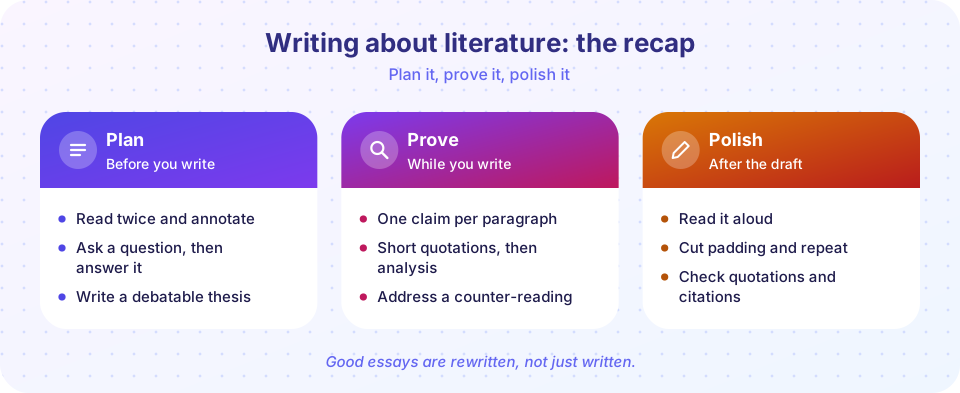
By now you have seen the whole path from reading to argument: noticing a puzzle, shaping a thesis, backing it with quotations, arranging the parts and revising. This review gathers those steps into one picture and one checklist. The checklist is something you can use on every essay you write, long after this course.
What you will learn
- A compact summary of the essay-writing process.
- A self-check list you can apply to your own drafts.
- How well you can recognize strong theses, evidence and revision choices.
The chapter in a table
| Stage | Key question | Main tools | Typical mistake |
|---|---|---|---|
| Read and notice | What patterns and puzzles are here? | Annotation, second reading | Reading only for plot |
| Thesis | What do I claim, and could someone disagree? | Question, three tests, "although" clause | A topic or a fact instead of an argument |
| Evidence | Which words prove my claim? | Short quotations, lead-ins, citations | Quotations that are long, unintroduced or unexplained |
| Analysis | How do the words create the effect? | Zooming in on diction, sound, image; linking back | Restating the quotation |
| Structure | Does each paragraph do one job in a logical order? | Outline, topic sentences, transitions, counter-argument | Summary in the middle, a conclusion that repeats |
| Revision | What would a stranger find confusing? | Reverse outline, reading aloud, feedback | Proofreading too early |
The quotation sandwich, once more
- Claim: a point in your own words.
- Lead-in: who speaks and where we are.
- Quotation: short, exact, cited.
- Analysis: how the words work and why it matters.
An essay self-check
- Does the essay answer the question that was asked?
- Is the thesis a full sentence that a reasonable reader could dispute?
- Does each paragraph begin with a claim that supports the thesis?
- Is every claim backed by a short quotation that I introduce?
- Do I explain the quotation, not just repeat it?
- Is there a counter-reading and a response?
- Does the conclusion answer the question and say why it matters?
- Did I revise for argument and structure before I proofread?
A worked mini-revision
Here is a weak sentence and three rounds of revision, using the habits from this chapter.
- Draft: "The creature is sad and this shows that he is lonely."
- Sharper claim: "The creature's loneliness drives his demand for a companion."
- With evidence: "The creature's loneliness drives his demand for a companion: he does not ask for power, only for 'a creature of another sex' who will share his exile."
Each round did one job. The first replaced a vague feeling with a claim. The second added a quotation that proves it, in a short exact piece introduced by a clear lead-in. The third step, not shown here, would add a sentence of analysis explaining why the modest wording matters. Notice that nothing was fixed by correcting spelling: the improvement came from thinking about the argument.
Common misconceptions
"Revision is correcting mistakes." It is rethinking and reshaping, and proofreading comes last.
"A good essay finds the one hidden meaning." A good essay argues for a well-supported reading and acknowledges others.
Try it
Check your understanding
Quick check · 9 questions
of 9 answered You scored / 9 · perfect!
-
1. Which of these is an arguable thesis?
Only the second makes a debatable claim with a method. -
2. Which is the correct order of the quotation sandwich?
State the claim, introduce, quote, then analyze. -
3. What does an ellipsis in a quotation show?
Ellipses mark omissions and must not change the meaning. -
4. Why is it usually best to proofread last?
Polishing text that will change wastes effort; work from big issues to small. -
5. What is the role of a counter-reading?
Concession and rebuttal strengthen an argument. -
6. Which opening is the weakest?
Over-broad openings give the reader nothing specific. -
7. Which tense is normally used for events in a literary work?
The literary present: 'Victor abandons his creature.' -
8. A paragraph that cannot be summarized in one sentence most likely:
Unity is a paragraph's main virtue; split a paragraph that does two jobs. -
9. Which is a good analytic move after a quotation?
Analysis explains how particular words create meaning and links back to the claim.
Summary
- Plan it, prove it, polish it: question, thesis, structure, evidence, analysis and revision.
- Test a thesis for disagreement, proof and significance.
- Use short, introduced, cited quotations followed by real analysis.
- Revise from argument down to proofreading.
Track your progress
Create a free account to tick off lessons and pick up where you left off on any device.
of Introduction to Literature lessons completed