


















Lesson 7 of 47 · Reading Closely
Diction and connotation: why this word?
Learn how writers choose words: denotation and connotation, formal and informal registers, concrete and abstract language, with a close reading of Wilfred Owen's war poem.
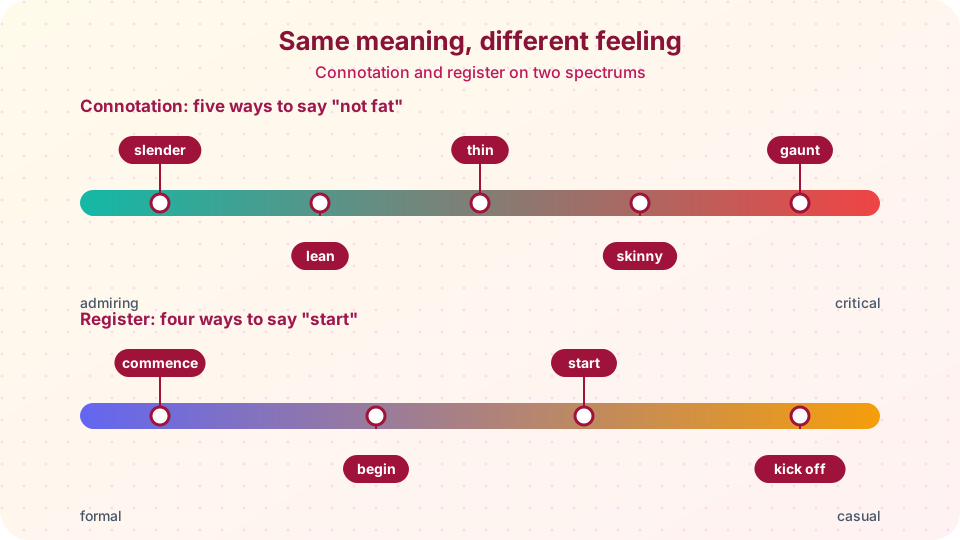
Writers work with words the way painters work with color. There are many words for almost every idea, and each one carries a slightly different shade. "Thin," "slender," "skinny" and "gaunt" all describe a body with little flesh, but a mother who says "my slender daughter" and a narrator who says "a gaunt stranger" are doing very different things. Close reading begins here, with the simplest question you can ask about a text: why this word, and not another?
What you will learn
- The difference between denotation and connotation.
- How register and level of formality shape tone.
- How concrete and abstract words work differently.
- How word origins, sound and rhythm add meaning.
- The substitution test for judging a writer's choice.
Key terms
Diction is the writer's choice and arrangement of words.
Denotation is a word's literal dictionary meaning.
Connotation is the feelings, ideas and associations a word carries beyond its literal meaning.
Register is the level of formality of language, from formal to casual.
Concrete words name things you can perceive with the senses; abstract words name ideas.
Denotation and connotation
The denotation of "home" is simple: a place where someone lives. Its connotations are much larger: warmth, family, safety, belonging. Compare it with "residence" or "dwelling," which have almost the same denotation but sound cold and official. A real estate agent sells "properties"; a poet remembers "home."
Connotations come from how a word is used in a culture. They can be positive, negative or neutral, and they can differ between communities and over time. In English, "child-like" and "childish" both refer to being like a child. The first usually praises (innocent, curious) and the second criticizes (silly, immature). A reader who misses connotation misses part of what a writer is saying.
The substitution test
A reliable tool is the substitution test. Take a word the writer chose, replace it with a synonym, and read both versions aloud. What changes? The meaning may stay the same while the feeling shifts, the rhythm breaks or the image weakens. The difference tells you what the original word was doing. Try it on a famous example.
Register and levels of diction
Register describes how formal a way of speaking is. A newspaper editorial, a text message and a legal contract use different registers. Writers pick a register to suit speaker, audience and mood, and they can shift it for effect. Critics often name three broad levels.
- High (formal) diction: elevated, often Latin-derived words, such as "commence," "demonstrate," "perish."
- Middle (neutral) diction: ordinary educated speech, such as "begin," "show," "die."
- Low (informal or colloquial) diction: everyday and slangy speech, such as "kick off," "pull the wool over someone's eyes," "croak."
English has so many levels partly because of its history. After the Norman conquest of England in 1066, French became the language of the ruling class while English was the language of ordinary people. The result: the animals in the field kept their English names (cow, pig, sheep) but the meat on the table took French-derived names (beef, pork, mutton). Many pairs of words show this split, with the Germanic-origin word often feeling plainer and the French or Latin one more formal: "ask" and "inquire," "help" and "assist," "end" and "terminate." A writer who wants a blunt, powerful line often reaches for short Anglo-Saxon words; a writer who wants dignity or distance may reach for Latinate ones.
Concrete and abstract
Concrete words appeal to the senses: "mud," "bruise," "whistle," "rust." Abstract words name ideas: "justice," "freedom," "fear." Good writing usually keeps the two in conversation. Abstract words give ideas a name; concrete words make them felt. A poem that only says "war is terrible" tells you less than a poem that shows a soldier choking, because the concrete details make you imagine the experience.
Close reading: Wilfred Owen
Wilfred Owen, an English soldier-poet, died in November 1918, a week before the First World War ended. His poems were published after his death and are in the public domain. Here are the first two lines of "Dulce et Decorum Est."
Bent double, like old beggars under sacks,
Knock-kneed, coughing like hags, we cursed through sludge,
Observe. The words are rough and physical. Young soldiers are compared to "old beggars" and "hags." They do not march; they "cursed through sludge."
Question. Why "sludge" and not "mud"? Why "cursed" and not "walked"? Why "hags," a harsh word for old women?
Apply the substitution test. Imagine: "Bent over, like old men under packs, / Weak-kneed, breathing hard, we marched through mud." The sense is nearly the same, but the effect is weaker. "Sludge" sounds heavy and sticky, with its soft sl and the thick vowel; "mud" is cleaner and more ordinary. "Cursed" suggests anger, exhaustion and a voice in the middle of the action. "Hags" and "beggars" strip away the glory of soldiers.
Interpret. Owen's diction attacks the idea that war is noble. The poem's title quotes a Latin line from the Roman poet Horace, "dulce et decorum est pro patria mori," often translated "it is sweet and fitting to die for one's country." Owen sets that high, formal Latin against low, gritty words. The clash between registers is part of his argument. (You can see the full poem in any collection of Owen's work, since it is in the public domain.)
Sound, rhythm and word choice
Words also have sounds. Hard consonants (k, t, p) can feel sharp or abrupt; soft ones (l, m, n, s) can feel smooth. A poet who writes "cursed through sludge" gets a sticky, slow-moving sound. These effects have names you will meet in Chapter 3, but you can already listen for them. Short words speed a line up; long words slow it down.
Other kinds of diction to notice
- Dialect and idiom: words marking a region or community. Mark Twain's Adventures of Huckleberry Finn (1884) records several American dialects, and he explained in a note that he did so deliberately.
- Archaic diction: old words such as "thou" and "hath," which can give a text solemnity.
- Jargon: the specialist vocabulary of a profession, which can signal expertise or exclude outsiders.
- Euphemism: a mild word for something harsh, such as "passed away" for "died." Euphemisms can comfort, or they can hide the truth.
- Loaded words: words chosen to push you toward a judgment, such as calling the same group "protesters" or "rioters." Be alert to this in any text, including the news.
Common misconceptions
"A bigger word is a better word." Plain words can be the strongest. "Mud" is not weaker than "quagmire"; each does a different job.
"Connotations are personal opinions." Some are, but many are shared across a culture. Check how a word is used in similar contexts.
"A dictionary tells me everything about a word." A dictionary gives denotation and some usage notes. Connotation also lives in context, tone and history.
Try it
Swap one word in a sentence and watch the feeling change. Then plot words on a map of warmth and formality.
Press Run (or Ctrl + Enter) to see the result here.
Program input · what you'd type while the program runs
Type the answers before you press Run, one per line. Each time the program reads a line (with input()), it gets the next line from this box.
Check your understanding
Quick check · 5 questions
of 5 answered You scored / 5 · perfect!
-
1. What is the difference between denotation and connotation?
Denotation is the literal meaning, while connotation is everything a word suggests beyond it. -
2. Which word has the most formal register?
'Commence' is Latin-derived and formal, 'begin' is neutral, and 'kick off' is casual. -
3. Why did cow, pig and sheep keep English names while the meats became beef, pork and mutton?
After 1066 French-speaking rulers ate the meat while English-speaking farmers tended the animals. -
4. In Owen's lines, 'cursed through sludge' is stronger than 'marched through mud' mainly because
The word choice conveys heavy, sticky effort and bitterness, which the plainer substitute loses. -
5. What does the substitution test involve?
Comparing the original and the substitute shows what the original word contributes.
Summary
- Diction is word choice; ask why this word and not another.
- Denotation is literal meaning; connotation is the feelings and associations.
- Register ranges from formal to casual, and English history explains many pairs of synonyms.
- Concrete words create sensation; abstract words name ideas; strong writing balances them.
- The substitution test reveals what a chosen word does.
Track your progress
Create a free account to tick off lessons and pick up where you left off on any device.
of Introduction to Literature lessons completed