


















Lesson 6 of 47 · Reading Closely
Reading closely: an overview
A big-picture guide to close reading: what it is, where it came from, four layers of a text to examine, and a worked example on the opening of A Tale of Two Cities.
Chapter 1 gave you a routine for reading. This chapter gives you the instruments. Close reading is the practice of paying slow, exact attention to how a text is made, so that your ideas about its meaning rest on evidence. It is the central skill of literary study, and you can use it on a poem, a page of a novel, a line of a play, or even an advertisement. Think of it as learning to see detail the way a naturalist sees a forest: not only "trees," but this oak, this moss, this bird call.
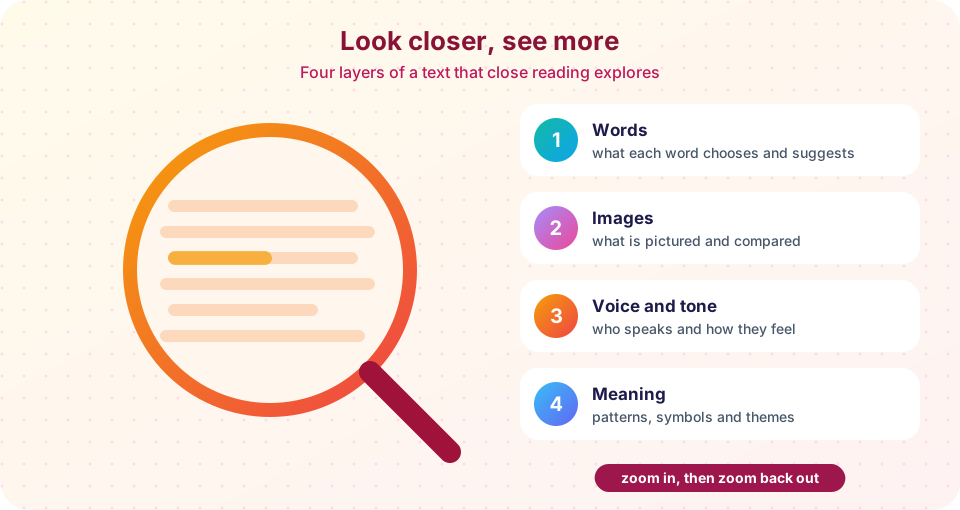
What you will learn
- What close reading is and where the term comes from.
- The four layers this chapter studies: words, images, voice and tone, and meaning.
- A four-step method: observe, question, interpret, support.
- How to move from a detail to a claim without leaping.
- What each lesson in the chapter covers.
Key terms
Close reading is detailed analysis of the words and structure of a short passage.
Diction is a writer's choice of words.
Figurative language is language that means more than its literal sense, such as metaphor and simile.
Tone is the attitude a speaker or narrator takes toward a subject or listener.
Theme is a central idea that a work explores.
Where close reading comes from
The habit of reading short passages very slowly was named and promoted in the early twentieth century. In 1929 the Cambridge critic I. A. Richards published Practical Criticism, a report of an experiment in which he gave students poems with the authors' names removed and asked them to respond. The results were humbling: able students misread meter, missed irony and judged poems by their reputations. Richards argued that reading is a skill that has to be taught. Later, American critics known as the New Critics, among them Cleanth Brooks, whose 1947 book The Well Wrought Urn became a classic, argued that the best evidence for a poem's meaning is found in the poem itself. Brooks warned against the "heresy of paraphrase," the idea that you can say what a poem means in plain words without losing something. A paraphrase is a useful step, but it is never the whole poem.
Other schools later said that the New Critics ignored history and the reader, and you will study those objections in Chapter 7. But almost all literary criticism still begins with close reading, because any theory needs evidence.
Four layers of a text
This chapter organizes close reading into four layers. They overlap, but separating them helps you decide what to look for.
- Words (diction). Why this word and not a synonym? What does it suggest beyond its dictionary meaning? See Diction and connotation.
- Images (figurative language and imagery). What pictures, comparisons and sensory details does the text create? See Figurative language.
- Voice and tone. Who speaks, and what is their attitude? Is the speaker sincere, ironic, bitter, tender? See Tone and irony.
- Meaning (symbol, motif, theme). What patterns build across the text, and what larger idea do they serve? See Symbol, motif and theme.
The chapter ends with a review that ties the layers together.
Layer 1: words
Layer 2: images
Layer 3: voice
Layer 4: meaning
A four-step method
Whatever the layer, the same four moves keep your reading disciplined.
- Observe. Notice a detail without judging it: a repeated word, an odd image, a sudden change of tone.
- Question. Ask why it is there. What would be lost if it changed?
- Interpret. Offer a possible meaning, using hedged language such as "suggests" or "may be read as."
- Support. Point to other places in the text that fit your idea. One detail is a hint; three that agree are evidence.
The most common error is to jump from observation straight to a big conclusion: "The word 'dark' appears, so the poem is about death." Slow down. Ask what else could explain the detail, and look for a pattern.
A worked example
Here is the opening of Charles Dickens's A Tale of Two Cities (1859), in the public domain.
It was the best of times, it was the worst of times, it was the age of wisdom, it was the age of foolishness...
Observe. The sentence repeats the pattern "it was the..." and pairs opposites: best and worst, wisdom and foolishness. The clauses are almost equal in length.
Question. Why open with a list of contradictions? Why repeat the same phrase? What does it do to the reader's pace?
Interpret. The repeated "it was" creates a drumbeat, and the opposites make the period feel like a time of extremes, where everything is true at once. The balance suggests that the speaker sees the age from a distance and with some irony: the passage goes on to say the period was so like the present that its "noisiest authorities" insisted on judging it only in the superlative degree.
Support. Later clauses continue the pattern ("the epoch of belief, ... the epoch of incredulity"), which confirms that the repetition is deliberate and sustained, not an accident. By linking an old period to "the present period," the text also tells us something about the narrator's purpose: this is about us, too.
Notice how many layers one sentence engages: diction (superlatives), imagery (seasons and ages), voice (a confident, slightly satirical narrator), and meaning (a theme of contradiction in history).
Zooming in and zooming out
The magnifying glass in the illustration is a useful image because a magnifying glass is something you move. Close reading is not staring at one spot until it dissolves. It is a rhythm of zooming in on a word, a line or an image and then zooming back out to ask what the whole text is doing. A reader who only zooms in collects interesting details that never add up. A reader who only zooms out produces vague summaries. The best readings alternate: a detail raises a question about the whole, and the whole sends you back to check another detail.
You will also find that close reading changes with the kind of text. In a short lyric poem, almost every word may carry weight, so you can slow down to the level of single syllables. In a long novel, you cannot examine every sentence, so you choose representative passages: the opening, a turning point, a repeated scene, the ending. The skill is knowing which passages repay your attention. As a rule of thumb, look closely at places where the style suddenly changes, where something is repeated, where a character makes a choice and where the narrator seems to say more than the plot requires.
Common misconceptions
"Close reading means finding hidden meanings the author never meant." It means noticing what is actually there. Some details are deliberate and some are not, but every claim should be checked against the text.
"If I overanalyze, I will kill the poem." Slow reading usually deepens pleasure. Analysis is a way of explaining the pleasure you already felt.
"Only literary texts deserve close reading." The method works on speeches, songs, films and ads, because all of them are made of choices.
Try it
Explore the opening with four lenses, then count its repetitions in code.
Press Run (or Ctrl + Enter) to see the console output here.
No output.
Check your understanding
Quick check · 5 questions
of 5 answered You scored / 5 · perfect!
-
1. What did I. A. Richards's 1929 experiment with unsigned poems show?
Richards found many misreadings and argued that reading has to be taught. -
2. Which is NOT one of the four layers in this chapter?
The four layers are words, images, voice and tone, and meaning. -
3. In the four-step method, what should you do after you interpret?
One detail is a hint; several details that agree are evidence. -
4. What is the 'heresy of paraphrase'?
Cleanth Brooks warned that paraphrase loses what the poem does through its form and language. -
5. The repeated phrase 'it was the...' in Dickens's opening mainly creates
Repetition builds a drumbeat, and the paired opposites emphasize contradiction.
Summary
- Close reading is slow, exact attention to how a text is made, used as the base for interpretation.
- I. A. Richards showed that reading skill must be taught; the New Critics focused on the words on the page.
- Four layers organize this chapter: words, images, voice and tone, and meaning.
- Use four steps: observe, question, interpret, support.
- Hedge your claims and look for patterns before drawing conclusions.
Next: Diction and connotation
Track your progress
Create a free account to tick off lessons and pick up where you left off on any device.
of Introduction to Literature lessons completed