


















Lesson 43 of 47 · Projects and Practice
Close Reading Project: Annotating a Sonnet
A guided close-reading project on Shelley's sonnet Ozymandias: a six-step method, line-by-line notes, rhyme analysis and a model paragraph you can compare with your own.
Everything in this course comes together when you take one short text and read it as slowly and thoughtfully as you can. A close reading is not a summary and not a list of devices. It is a sustained attempt to explain how a passage produces its effects, using the words themselves as evidence.
In this project you will read a public-domain poem, Percy Bysshe Shelley's sonnet "Ozymandias" (1818), using a six-step method, and then write a model paragraph. A single poem of fourteen lines is a good test case: short enough to hold in your head and rich enough to repay long attention.
What you will learn
- A six-step method for a close reading you can reuse on any short text.
- How to notice voice, diction, imagery, sound and structure in one poem.
- How a rhyme scheme and a turn (volta) shape the meaning.
- How to move from notes to a paragraph that makes an argument.
Key terms
- Sonnet: a fourteen-line poem, usually in iambic pentameter with a set rhyme scheme.
- Volta: the turn, a shift in thought or tone, often near the ninth line of a sonnet.
- Diction: the choice of words.
- Frame narrative: a story that contains another story, told by someone else.
- Irony: a gap between what is said and what is meant or what happens.
The poem
Percy Bysshe Shelley (1792 to 1822) published "Ozymandias" in 1818. Ozymandias is the Greek name for the Egyptian pharaoh Ramesses II. Here is the full text:
I met a traveller from an antique land,
Who said—"Two vast and trunkless legs of stone
Stand in the desert. . . . Near them, on the sand,
Half sunk a shattered visage lies, whose frown,
And wrinkled lip, and sneer of cold command,
Tell that its sculptor well those passions read
Which yet survive, stamped on these lifeless things,
The hand that mocked them, and the heart that fed;
And on the pedestal, these words appear:
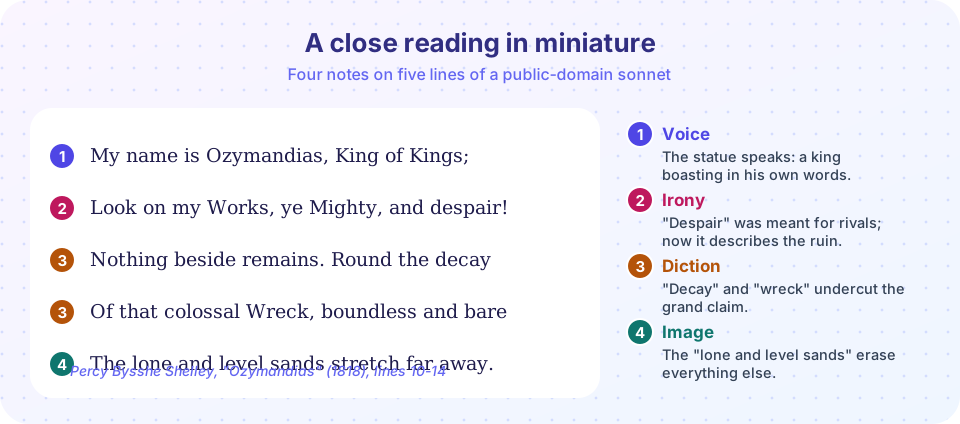
My name is Ozymandias, King of Kings;
Look on my Works, ye Mighty, and despair!
Nothing beside remains. Round the decay
Of that colossal Wreck, boundless and bare
The lone and level sands stretch far away."
The six-step method
- Read it aloud, twice. First for the sense, then for sound and rhythm.
- Ask what puzzled you. A word, a shift, an ending. The best essays start with a puzzle.
- Annotate. Mark voice (who speaks), diction, images, sound, syntax (sentence shape) and structure.
- Find a pattern. What repeats, contrasts or changes?
- Make a claim. One sentence that explains the pattern and why it matters.
- Write a paragraph using the quotation sandwich from the previous chapter.
Steps 1 to 3: reading and annotating
Voice and frame
The poem is a frame narrative with several layers. A speaker meets a traveller. The traveller describes a statue. The statue's face shows what its sculptor saw in the king. The inscription gives the king's own words. By the time we hear Ozymandias, his voice has passed through three other tellers, so the distance between reader and king is large.
Line by line
- Line 1: "antique" means ancient, and also hints at something curious or old-fashioned. The speaker keeps his distance.
- Lines 2 and 3: "vast and trunkless legs of stone" combines size and incompleteness: huge, yet cut off. "Trunkless" means without a torso. The dots after "desert" create a silence, as if the traveller pauses to look.
- Line 4: "Half sunk a shattered visage lies": the word order puts "Half sunk" first, making the face feel buried; "shattered" and "sunk" are heavy, falling words.
- Lines 4 and 5: the face still wears a "frown" and a "sneer of cold command". The ruin keeps the expression of a tyrant.
- Lines 6 to 8: the sculptor "well those passions read", meaning he understood them, and "The hand that mocked them, and the heart that fed". "Mocked" can mean imitated or ridiculed; the sculptor's hand and the king's heart are both at work. So the passions "survive" in the stone while everything living has gone.
- Line 9: "And on the pedestal, these words appear" is the volta, the turn from description to the inscription.
- Lines 10 and 11: the boast. "King of Kings" and "Look on my Works, ye Mighty, and despair!" are confident commands.
- Lines 12 to 14: "Nothing beside remains." The sentence is blunt and complete. Then "colossal Wreck, boundless and bare" pairs enormous size with ruin; and "lone and level sands" repeats the l sound in a slow, flat line that seems to stretch like the desert.
Sound and rhyme
The rhyme scheme is unusual for a sonnet: ABABACDCEDEFEF. It does not fall into the neat Shakespearean or Petrarchan pattern, which suits a poem about a regular, ordered monument that has collapsed. Notice slant rhymes, such as "stone" with "frown". Run the next code cell to see the scheme worked out.
Step 4: find a pattern
A strong pattern here is scale against ruin: huge words ("vast", "colossal", "boundless") appear beside words of breakage and emptiness ("trunkless", "shattered", "decay", "bare", "lone and level"). A second pattern is the layered telling: power is only available as a report.
Steps 5 and 6: claim and paragraph
A claim that joins both patterns: By setting colossal scale against ruin and by letting the king's words reach us only through other speakers, Shelley suggests that power survives only as a story, and an unreliable, diminishing one.
A model paragraph:
Shelley undercuts Ozymandias's boast by making the ruin speak louder than the king. The inscription demands, "Look on my Works, ye Mighty, and despair!", but the very next sentence, "Nothing beside remains", turns the order into a joke at his expense: the only despair on offer is for the king himself. The final image reinforces the irony. The "lone and level sands" repeat the l sound in a slow line that seems to stretch across the empty desert, and "level" suggests that even the proud pedestal has been flattened. Because we hear all of this through a traveller, power has become a tale told at second hand, and its only lasting author is the sculptor.
Notice how the paragraph follows the quotation sandwich, zooms in on a word ("level") and a sound, and ends by linking to the claim.
"Close reading means finding hidden symbols." It means explaining how visible choices produce effects.
"There is only one right interpretation of a poem." There are better and worse supported ones. A different reader might focus on the sculptor, who is the only surviving creator.
"The poem is only about Egypt." It is about power and time in general; the historical setting is the case study.
Try it
Press Run (or Ctrl + Enter) to see the result here.
Program input · what you'd type while the program runs
Type the answers before you press Run, one per line. Each time the program reads a line (with input()), it gets the next line from this box.
Check your understanding
Quick check · 4 questions
of 4 answered You scored / 4 · perfect!
-
1. What is the volta in Shelley's sonnet?
'And on the pedestal, these words appear' turns from the ruined statue to the king's words. -
2. Why is the poem called a frame narrative?
The layered voices keep the king at a distance. -
3. What is the main irony of the inscription?
The boast demands despair from rivals, but the surrounding ruin shows the king's works have vanished. -
4. Which step comes before making a claim in the six-step method?
You find a pattern in the annotations, then make a claim that explains it.
Summary
- A close reading explains how a text produces its effects, with evidence from the words.
- Use the six steps: read aloud, find a puzzle, annotate, find a pattern, make a claim, write a paragraph.
- In "Ozymandias", scale against ruin and layered voices combine to show power surviving only as a story.
- Practice on a short text builds every skill you need for essays.
Track your progress
Create a free account to tick off lessons and pick up where you left off on any device.
of Introduction to Literature lessons completed