


















Lesson 23 of 47 · Drama
Drama: Literature Made to Be Performed
Chapter 5 overview: what makes a play different from a poem or novel, the parts of a script, and a route through Greek tragedy, Shakespeare and modern theatre.
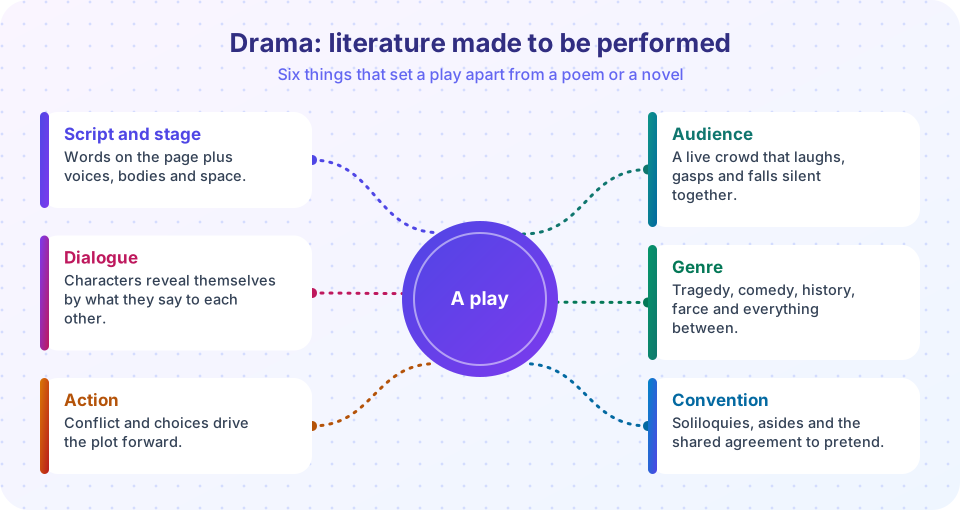
A poem can be read silently on a bus. A novel can be put down and picked up a week later. A play is different: it is written for a time and a place, for bodies and voices, and for a crowd that has agreed to sit together and watch. The words on the page are only half of the work. The other half happens when actors, a director, designers and an audience finish it.
That makes drama the most collaborative of the three great literary forms, and also the most fragile. A script is a set of instructions for an event that will never happen exactly the same way twice. This chapter shows you how to read those instructions, how to imagine the performance they point to, and how three great eras of theatre solved the same problem in very different ways.
What you will learn
- What makes drama a distinct literary form and how it differs from poetry and fiction.
- The basic parts of a script: acts, scenes, dialogue, monologue, soliloquy, aside and stage direction.
- How delivery, staging and audience change the meaning of the same words.
- How the rest of this chapter is organized and how the lessons connect.
Key terms
- Script: the written text of a play, including dialogue and stage directions.
- Dialogue: speech exchanged between characters.
- Stage direction: a note that tells actors or readers what to do or what the setting looks like.
- Convention: an agreed rule of a form, such as the audience pretending not to see the "fourth wall".
- Genre: a kind of work with shared features, such as tragedy or comedy.
Why drama is different
Think about what a novelist can do that a playwright cannot. A novelist can tell you what a character is thinking, summarize ten years in a sentence and describe the weather at length. A playwright has to show everything through what can be seen and heard. If a character is secretly afraid, an actor has to find a way to let the audience feel it, or another character has to say it, or the plot has to prove it.
This limit turns out to be a strength. Because drama cannot explain, it has to dramatize: it makes feelings visible as choices, arguments and silences. Many of the best moments in plays happen in the gap between what a character says and what the audience understands.
Drama has a second, odd feature: it is public. Reading is private, but a theatre audience reacts together. A joke lands or dies in real time. A tragic revelation can make hundreds of people hold their breath at once. Playwrights from the Greeks onward have written with that shared attention in mind.
The parts of a script
Most plays are divided into acts, which are large movements of the story, and scenes, which are smaller units usually marked by a change of place, time or characters. Shakespeare's plays in print have five acts; many modern plays have two or three.
The core of a script is dialogue, but plays have other speaking modes you will meet again and again:
- A monologue is a long speech by one character, addressed to other characters on stage.
- A soliloquy is a speech in which a character, alone or effectively alone, speaks their thoughts aloud for the audience. Hamlet's "To be, or not to be" is the most famous example.
- An aside is a short remark to the audience, or to a few characters, that others on stage are supposed not to hear.
Then there are stage directions: instructions about movement, setting, lighting and tone. Older plays have few. Shakespeare's "Exit, pursued by a bear" in The Winter's Tale is one of the most famous, and an Elizabethan reader would have been amazed at how many a modern playwright like Eugene O'Neill or Arthur Miller wrote. Some modern scripts contain pages of novelistic description before a word of speech.
Same words, different play
Here is a quick experiment. Take one ordinary sentence and change which word the actor stresses. The words on the page do not change at all, yet the meaning does. This is why a script is not a complete work: it needs interpretation, and interpretation is where acting and directing begin.
Genre: the shared agreement
Audiences arrive with expectations. If a play is called a tragedy, we expect serious events and probably a painful ending. If it is a comedy, we expect confusion, wit and a resolution that restores order, often with a marriage or a feast. A history play dramatizes real rulers and public events. Farce piles up mistakes at speed. Modern drama invents further hybrids, such as tragicomedy, and some playwrights, like Bertolt Brecht or Samuel Beckett, deliberately frustrate our expectations to make us think.
Genres are not cages. They are promises that a play can keep, bend or break, and noticing what a playwright does with a promise is a good way into criticism.
Your route through the chapter
Where drama began
The wooden O
The modern stage
The chapter has three content lessons and a review:
- Greek Tragedy and Aristotle: the City Dionysia, the chorus, Oedipus the King and the Poetics.
- Shakespeare and the Elizabethan Stage: the playhouse, boy actors, verse and prose, soliloquy and language as scenery.
- Modern Drama: Ibsen and Chekhov, Brecht, Beckett, and the American and Black theatre traditions.
- Chapter Review: a one-page picture, a recap table and a ten-question quiz.
Try it
Press Run (or Ctrl + Enter) to see the result here.
Program input · what you'd type while the program runs
Type the answers before you press Run, one per line. Each time the program reads a line (with input()), it gets the next line from this box.
Check your understanding
Quick check · 4 questions
of 4 answered You scored / 4 · perfect!
-
1. Why is a script often called an incomplete work?
A script is a set of instructions for a performance. Meaning is finished in the theatre, through acting, staging and audience response. -
2. Which speech is spoken by a character alone, giving the audience their thoughts?
A soliloquy lets a character think aloud for the audience. An aside is a brief remark, and a stage direction is a note, not speech. -
3. What can a novelist do easily that a playwright cannot?
Drama must show inner life through speech, action and silence, because it has no built-in narrator. -
4. In the stress experiment, what changed between the six versions of the sentence?
The same words carry different meaning depending on delivery, which is why performance is part of interpretation.
Summary
- Drama is literature written for performance, so it is collaborative, public and unfinished on the page.
- A script is built from dialogue, monologue, soliloquy and aside, with stage directions that range from sparse to detailed.
- Delivery changes meaning, so a good reader of drama imagines the stage.
- Genres are promises to the audience that a play can keep or break.
Track your progress
Create a free account to tick off lessons and pick up where you left off on any device.
of Introduction to Literature lessons completed