


















Lesson 13 of 47 · Poetry
Sound, rhythm and meter in poetry
Learn how poems use rhyme, alliteration, assonance and meter, how to scan a line, and what iambic pentameter, ballad meter and other patterns sound like.
Poems were sung and chanted long before they were read silently, and the music has never left. A poem's sounds, the way it rhymes, repeats and moves, are not decoration on top of the meaning. They are part of it. This lesson gives you the vocabulary of that music: the sound effects poets use, and the system of stress and rhythm called meter. By the end you will be able to mark the beat of a line, name its pattern and hear what the pattern does.
What you will learn
- The main sound devices: rhyme, alliteration, assonance, consonance and onomatopoeia.
- The difference between rhythm and meter.
- The five basic feet and the common line lengths.
- How to scan a line step by step.
- What variations and caesura do to a pattern.
Key terms
Rhyme is the matching of the sounds of words, usually from the last stressed vowel to the end.
Alliteration is the repetition of initial consonant sounds; assonance is the repetition of vowel sounds; consonance is the repetition of consonant sounds inside or at the end of words.
Meter is a regular pattern of stressed and unstressed syllables in a line of verse.
Foot is the unit of meter, usually one stressed syllable with one or two unstressed ones.
Scansion is the marking of a line's stresses and feet.
The music of words
Rhyme. End rhyme joins the last words of lines, as in "bright" and "night." Internal rhyme happens inside a line. Slant or near rhyme uses similar but not identical sounds ("home" and "come"), a favorite of Emily Dickinson. Eye rhyme looks alike but sounds different ("love" and "move").
Alliteration. Samuel Taylor Coleridge's "The Rime of the Ancient Mariner" (1798) has a ship moving across a still ocean in a line that sails: "The fair breeze blew, the white foam flew, / The furrow followed free." The repeated f sound seems to blow and flow. Alliteration was the main structural device of Old English poetry such as Beowulf, which relied on it rather than on rhyme.
Assonance and consonance. Alfred, Lord Tennyson wrote, in The Princess (1847), of "The moan of doves in immemorial elms, / And murmuring of innumerable bees." The repeated m and n sounds and the long o and u vowels make the line hum. It is also an example of onomatopoeia, where the sound imitates the thing it names, as in "murmuring."
Euphony and cacophony. Smooth, pleasing sounds are called euphony; harsh, clashing ones, cacophony. Poets switch between them for effect. In the Owen lines you met earlier, "cursed through sludge" is deliberately rough.
Refrain. A repeated line or phrase, like the last line of Frost's "Stopping by Woods," builds emphasis and memory.
Rhythm and meter
Rhythm is the pattern of sound in any language: speech has rhythm, and so does prose. Meter is rhythm made regular and countable. English is a stress language: some syllables are said more strongly than others. In the word "poem," the first syllable is stressed (PO-em). In "begin," the second is (be-GIN). Meter organizes these stresses into repeating units called feet.
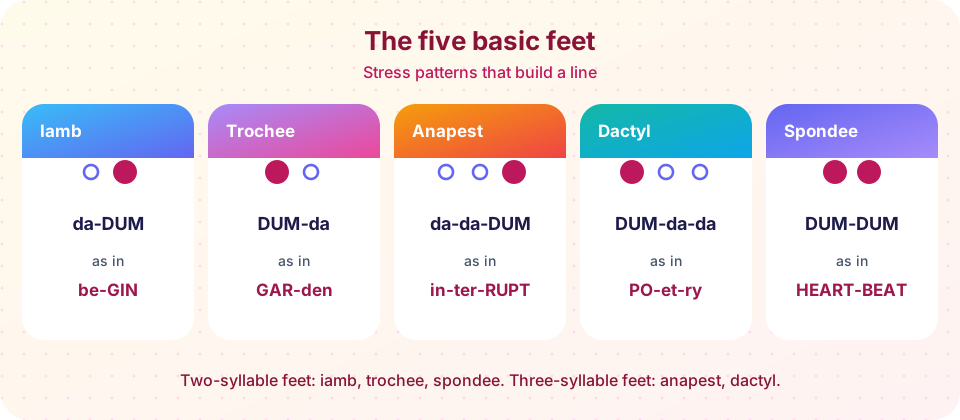
| Foot | Pattern | Sounds like | Example |
|---|---|---|---|
| Iamb | unstressed, stressed | da-DUM | be-GIN |
| Trochee | stressed, unstressed | DUM-da | GAR-den |
| Anapest | two unstressed, then stressed | da-da-DUM | in-ter-RUPT |
| Dactyl | stressed, then two unstressed | DUM-da-da | PO-et-ry |
| Spondee | two stressed | DUM-DUM | HEART-BEAT |
The number of feet in a line gives it a length name: monometer (1), dimeter (2), trimeter (3), tetrameter (4), pentameter (5), hexameter (6), heptameter (7), octameter (8). A line is named by its foot and length: "iambic pentameter" means five iambs.
Famous meters
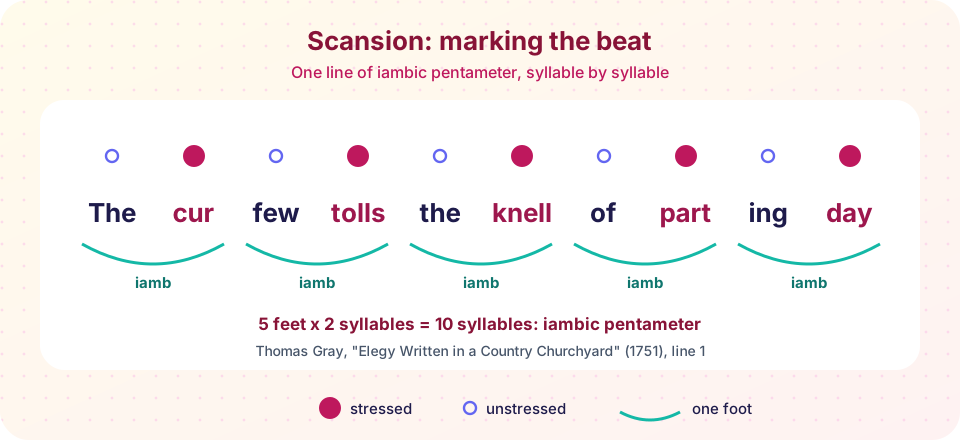
Iambic pentameter is the most important meter in English poetry. Its rhythm, da-DUM da-DUM da-DUM da-DUM da-DUM, is close to natural speech and the rise and fall of a heartbeat. Thomas Gray began his "Elegy Written in a Country Churchyard" (1751) with "The curfew tolls the knell of parting day," a regular iambic pentameter line, as the illustration above shows. Shakespeare's sonnets use rhymed iambic pentameter, and his plays use unrhymed iambic pentameter, called blank verse, which John Milton also chose for Paradise Lost (1667).
Trochaic meter begins with a stress and has a firm, driving feel. In Macbeth the witches chant in trochaic tetrameter: "Double, double toil and trouble; / Fire burn and cauldron bubble." The change from the characters' iambic speech to the witches' chant makes them sound strange. Edgar Allan Poe's "The Raven" (1845) uses trochaic octameter, as in "Once upon a midnight dreary, while I pondered, weak and weary."
Anapestic meter gallops. Clement Clarke Moore's "A Visit from St. Nicholas" (1823) opens, "'Twas the night before Christmas, when all through the house," which runs da-da-DUM four times.
Dactylic meter tumbles forward. Tennyson's "The Charge of the Light Brigade" (1854) begins "Half a league, half a league," a dactylic rhythm that sounds like hoofbeats.
Ballad meter alternates four-stress and three-stress lines, usually iambic, and often rhymes the second and fourth lines. It is the pattern of folk ballads and of many hymns and Dickinson poems. In "Because I could not stop for Death," the first line, "Because I could not stop for Death," has four stresses, and the second, "He kindly stopped for me," has three.
How to scan a line
- Say the line aloud, naturally, as you would speak it. Do not force a rhythm.
- Mark each syllable with a slash (/) for stressed or an x for unstressed. Stress lives on the content words (nouns, verbs, adjectives) and in the stressed syllable of longer words. Small function words (the, of, a) are usually unstressed.
- Look for the repeating unit. Do pairs of x/ appear (iambs)? Or /x (trochees)?
- Count the feet and name the meter.
- Notice variations. Poets break the pattern deliberately; a break draws attention.
Variations. A common variation is substitution, swapping one foot for another. A line of iambic pentameter often begins with a trochee for energy: many readers hear Shakespeare's Richard III open with a stress on the very first word, "Now is the winter of our discontent." Another is the caesura, a pause inside a line, often marked by punctuation. Shakespeare's "To be, or not to be, that is the question" has a caesura after "be." Variations are where much of the meaning hides. Where a regular rhythm suddenly stumbles, ask what is being emphasized.
Do not worship the pattern
Scansion is a tool, not a code. Real speech does not always follow the pattern exactly, and readers sometimes disagree about stress. If two experienced readers disagree about one syllable, that is not an error; it may be an ambiguity the poet was happy to leave. The point of scanning is to hear the shape of a line and to notice where it surprises you.
Common misconceptions
"All poems have meter." Free verse does not (see free verse and the line). Meter is one option among many.
"Iambic pentameter means exactly ten syllables." Often, but lines can have an extra unstressed syllable at the end (a feminine ending), as in "To be, or not to be."
"Rhyme and meter are the same." Rhyme is matching sounds; meter is a stress pattern. A poem can have one without the other.
Try it
Let the computer classify a stress pattern, then listen to the difference between feet.
Press Run (or Ctrl + Enter) to see the console output here.
No output.
Check your understanding
Quick check · 5 questions
of 5 answered You scored / 5 · perfect!
-
1. What is iambic pentameter?
Penta means five and an iamb is da-DUM, so the line has ten syllables with five stresses. -
2. Which foot is DUM-da?
A trochee is a stressed syllable followed by an unstressed one. -
3. Repeating the same initial consonant sound, as in 'The fair breeze blew, the white foam flew,' is called
Alliteration repeats beginning consonant sounds. -
4. What is blank verse?
Blank verse is unrhymed iambic pentameter, used by Shakespeare and Milton. -
5. Why does a poet break a regular meter?
Variations are often meaningful: they emphasize or surprise.
Summary
- Sound devices include rhyme, alliteration, assonance, consonance, onomatopoeia and refrain.
- Meter is a regular pattern of stresses; its units are feet: iamb, trochee, anapest, dactyl, spondee.
- A line is named by foot and length, as in iambic pentameter.
- To scan, read naturally, mark stresses, find the repeating foot and notice variations.
- Treat scansion as a way of hearing, not a rigid code.
Track your progress
Create a free account to tick off lessons and pick up where you left off on any device.
of Introduction to Literature lessons completed