


















Lesson 9 of 47 · Reading Closely
Tone, voice and irony
Learn to hear a text's tone, tell speaker from author, spot verbal, situational and dramatic irony, and read satire, with examples from Swift, Poe and Sophocles.
Imagine someone saying "Great job" after you drop a tray of plates. You know from the voice that they do not mean it. In speech we hear tone instantly: the pitch, the pause, the smile. On the page, there is no voice, so a writer has to build tone out of words, rhythm and detail. Learning to hear tone is one of the most important parts of reading well, because it tells you how to take what is said. A joke read as a threat, or a satire read as a sincere proposal, is a total misreading. This lesson shows you how tone is built, who the voice in a text belongs to, and how irony makes a gap between what is said and what is meant.
What you will learn
- The difference between tone and mood.
- How to separate the author from the speaker, narrator or persona.
- How diction, syntax, detail and punctuation build tone.
- Verbal, situational and dramatic irony, and how irony differs from sarcasm.
- How satire uses irony to criticize.
Key terms
Tone is the attitude a speaker or narrator takes toward the subject or the audience.
Mood is the feeling a text creates in the reader.
Persona is the voice a writer adopts, distinct from the writer's own self.
Irony is a gap between appearance and reality, or between what is said and what is meant.
Satire is writing that uses humor, exaggeration or irony to criticize people or institutions.
Tone is not mood
People often mix up these two. Tone belongs to the speaker: their attitude, such as tender, bitter, playful, solemn, scornful or detached. Mood belongs to the reader: the feeling the text produces, such as dread, comfort or suspense. The two can differ. A calm, gentle narrator (tone) can describe horrors that make you shudder (mood). That clash is itself a powerful effect.
Try this: choose a precise word for the tone, not a vague one. "Negative" is too general. "Resentful," "weary," "mocking" and "nostalgic" are specific, and specific words lead to better analysis.
Who is speaking? Author, speaker and persona
When you read "I" in a poem or a story, it is almost never safe to assume the "I" is the author. The writer may create a speaker (in a poem), a narrator (in fiction) or a persona (a mask). The poet Robert Browning built a whole form, the dramatic monologue, around speakers who reveal themselves unintentionally. Edgar Allan Poe's story "The Tell-Tale Heart" (1843) begins:
True!—nervous—very, very dreadfully nervous I had been and am; but why will you say that I am mad?
The narrator insists he is calm and sane, but the broken rhythm, the exclamation and the defensive question tell us the opposite. The tone is anxious and over-eager, and the gap between his claim and his manner makes him an unreliable narrator, one whose account cannot be fully trusted. Reading tone here means listening to what the voice does as well as what it says.
How writers build tone
Tone comes from many small choices.
- Diction. "Scrawny" and "slender" carry different attitudes (see diction).
- Syntax. Short, clipped sentences can feel tense or cold. Long, flowing ones can feel dreamy or breathless.
- Details. What a narrator chooses to mention, and what is omitted, reveals attitude.
- Imagery and figures. Comparing a politician to a crab says something unflattering.
- Punctuation and rhythm. Dashes, exclamations and fragments create the effect of a speaking voice.
- Understatement or exaggeration. Both signal an attitude.
When you analyze tone, point to these features. "The tone is bitter" is a claim; "the tone is bitter because the narrator repeats 'again' and ends each sentence on a flat, short word" is analysis.
Three kinds of irony
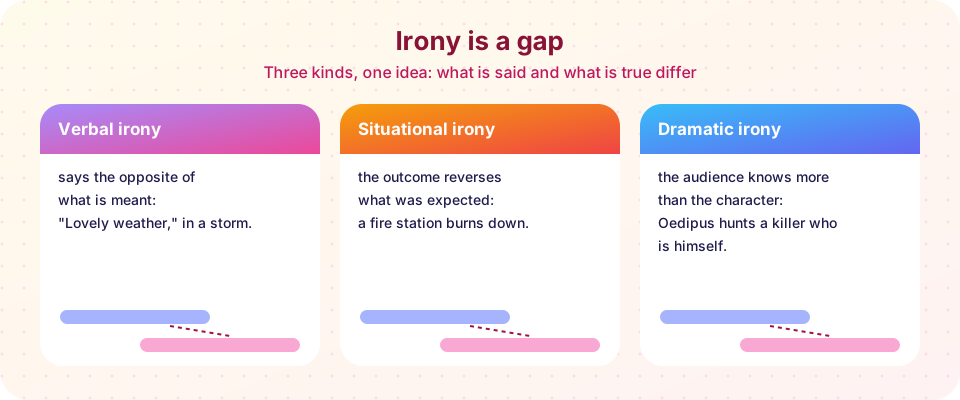
Verbal irony is saying the opposite of what you mean, or something quite different. Austen's famous opening, "a truth universally acknowledged," is verbal irony: the narrator says "truth" and means "assumption." Sarcasm is a sharp, often hostile kind of verbal irony meant to wound; irony in general may be gentle and playful.
Situational irony is when events turn out opposite to what was expected. A fire station burns down. A famous safety expert is injured by his own invention. Readers feel the shock and humor of an outcome reversing a plan.
Dramatic irony is when the audience knows something that a character does not. It is named for drama because it works so well in theater. In Sophocles's play Oedipus the King (first performed in the fifth century BCE), the audience knows from the old myth that Oedipus himself killed the previous king. Yet Oedipus, ruler of Thebes, swears to hunt down the killer and punish him. Every confident speech is charged with irony, because we know the curse falls on the speaker.
Satire: irony with a target
Satire uses irony, exaggeration and humor to criticize. Jonathan Swift's essay "A Modest Proposal" (1729) pretends to offer a sensible solution to Irish poverty. In a calm, reasonable tone, the speaker writes: "I have been assured by a very knowing American of my acquaintance in London, that a young healthy child well nursed, is, at a year old, a most delicious nourishing and wholesome food." The proposal is to sell the children of the poor as food for the rich. The shocking suggestion is delivered in a mild, statistical voice.
Read the gap. If the speaker were sincere, he would be a monster. The tone is calm; the content is horrifying; the reader concludes that Swift is not the speaker but is attacking the attitudes that treat the poor as a resource to be used. The gap between tone and content is the irony, and the target is the indifference of the powerful.
A step-by-step approach to tone
- Read aloud. Where does your voice rise, slow down or sharpen?
- Name a precise tone word, then a second that qualifies it ("tender but wary").
- Find the evidence: diction, syntax, detail, figures.
- Check for a shift. Tone often changes at a turning point. Where does it change, and why?
- Test for irony. Ask: would the speaker really mean this at face value? Is there a gap between what is said and what the text expects us to see?
Common misconceptions
"Tone and mood are the same." Tone is the speaker's attitude. Mood is the reader's feeling.
"The speaker is the author." Always allow for a persona, especially in poems, satire and first-person fiction.
"Irony means something funny or unlucky." Real irony needs a gap between two levels of meaning. A coincidence is not automatically ironic.
Try it
See how one event sounds in three tones, then chart the widening gap of dramatic irony.
Press Run (or Ctrl + Enter) to see the result here.
Program input · what you'd type while the program runs
Type the answers before you press Run, one per line. Each time the program reads a line (with input()), it gets the next line from this box.
Check your understanding
Quick check · 5 questions
of 5 answered You scored / 5 · perfect!
-
1. Tone is best defined as
Tone belongs to the speaker; mood is what the reader feels. -
2. Which is an example of dramatic irony?
Dramatic irony depends on the audience knowing more than a character. -
3. Why is the narrator of 'The Tell-Tale Heart' called unreliable?
The gap between his claim and his voice means we cannot trust his account. -
4. In Swift's 'A Modest Proposal,' what creates the irony?
The mild tone clashes with the content, signaling Swift's attack on indifference to the poor. -
5. Which is the best tone description?
Precise tone words lead to better analysis than vague ones.
Summary
- Tone is the speaker's attitude; mood is the reader's feeling.
- Do not assume the speaker is the author; look for persona and unreliable narrators.
- Tone is built from diction, syntax, details, figures, rhythm and punctuation.
- Irony is a gap: verbal (said versus meant), situational (expected versus actual), dramatic (audience versus character).
- Satire uses irony to criticize a target; read the gap between tone and content.
Next: Symbol, motif and theme
Track your progress
Create a free account to tick off lessons and pick up where you left off on any device.
of Introduction to Literature lessons completed