


















Lesson 19 of 47 · Fiction and Narrative
Character and characterization
Learn how fiction creates characters: protagonists, antagonists and foils, round and flat characters, direct and indirect characterization, motivation and character arcs, with examples from Austen and Dickens.
Think of a story you remember. Chances are you remember a person: Elizabeth Bennet, Scrooge, Huckleberry Finn, Hamlet. Plots fade, but characters stay with us because they feel like people. Yet characters are not real people. They are made out of words, and each word is a choice. This lesson shows how writers build characters, how to read them closely, and how to talk about what they want, how they change and what they mean.
What you will learn
- The main character roles: protagonist, antagonist, foil and supporting characters.
- Round and flat, static and dynamic characters.
- Direct and indirect characterization, and the five ways of showing character.
- How motivation, flaws and contradictions create depth.
- How to describe a character arc.
Key terms
Protagonist is the central character; antagonist is the main opposing force or person.
Foil is a character whose contrast highlights another's qualities.
Round characters are complex and surprising; flat characters are simple and consistent.
Static characters stay the same; dynamic characters change.
Characterization is the way a writer reveals a character.
Character roles
The protagonist is the main figure whose desires drive the story. The antagonist opposes the protagonist, and may be a person, a group, nature or even the protagonist's own flaw. A foil sets off another character by contrast: in Pride and Prejudice, Mr. Darcy's reserve contrasts with the sociable Mr. Bingley. Foils help us notice qualities we might otherwise miss. Supporting characters fill out the world and often reveal the protagonist by how they respond.
Round and flat, static and dynamic
In Aspects of the Novel (1927), E. M. Forster divided characters into flat and round. Flat characters are built around a single idea or quality and can be summed up in a sentence; round characters have enough complexity to surprise us convincingly. A test is whether a character can surprise us in a way that feels true. Flat characters are not necessarily bad: comic and minor figures like Mrs. Micawber in Dickens, who is defined by her vow never to desert her husband, work well when flat. The trouble comes only when the main characters stay flat.
A different pair of terms describes change. A static character stays essentially the same; a dynamic character changes in a significant way. Ebenezer Scrooge in Dickens's A Christmas Carol (1843) is the classic dynamic character, transformed by his visions. Sherlock Holmes in most of his stories is static: his constancy is part of his appeal. A round character can be static, and a flat character can change; the two pairs measure different things (complexity and change).
Direct and indirect characterization
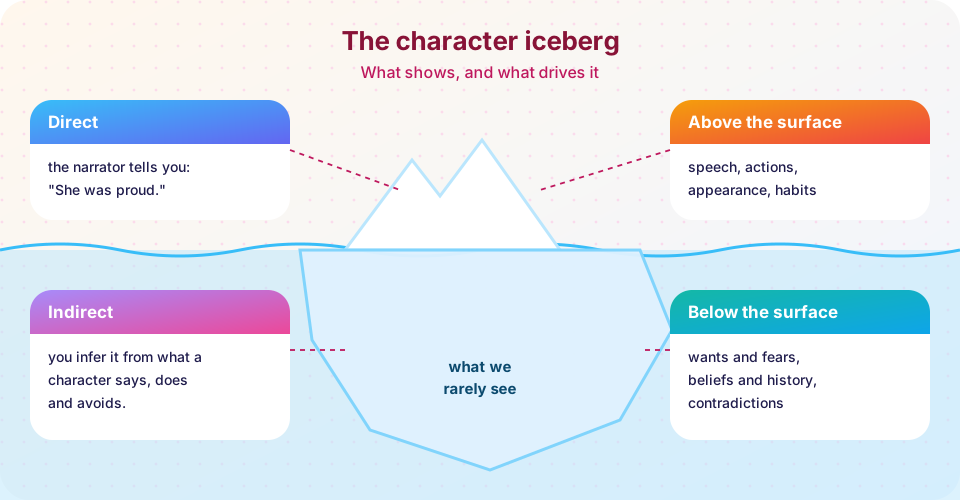
Direct characterization is when the narrator or another character tells us what someone is like. Jane Austen opens Emma (1815) by describing her heroine: "Emma Woodhouse, handsome, clever, and rich, with a comfortable home and happy disposition, seemed to unite some of the best blessings of existence; and had lived nearly twenty-one years in the world with very little to distress or vex her." Look closely: the word "seemed" and the phrase "very little to distress or vex her" hint that the novel will test this comfortable picture. Direct statements can contain irony.
Dickens introduces Scrooge directly too: "Oh! But he was a tight-fisted hand at the grindstone, Scrooge! a squeezing, wrenching, grasping, scraping, clutching, covetous, old sinner!" The piled-up adjectives, with their harsh sounds, show the narrator's attitude as much as Scrooge's nature.
Indirect characterization shows character through what a person does and says, and how others react. Experts often call this "show, don't tell," though telling has its place. A handy memory aid lists five ways of showing a character:
- Speech: what they say and how they say it.
- Thoughts: what goes on in their mind (if the point of view allows).
- Effect on others: how other characters respond to them.
- Actions: what they do, especially under pressure.
- Looks: appearance, clothes, gestures and habits.
Compare two ways of showing nervousness. Telling: "Maria was nervous." Showing: "Maria folded the program into a smaller and smaller square." The second gives us an action that implies a feeling, and it lets the reader do the work of noticing.
Motivation: what the character wants
Strong characters want something, and the story tests how they pursue it. It helps to distinguish a character's want (a conscious goal) from their need (something they may not recognize). Scrooge wants to be left alone with his money; he needs connection and generosity. The gap between want and need is the engine of many character arcs.
Complexity also comes from flaws and contradictions. A generous person who is secretly vain, a bully who is afraid, a criminal who loves animals: these contradictions are what make characters feel real. In Mary Shelley's Frankenstein, the creature is monstrous in action but eloquent and wounded in speech, and that mix keeps readers arguing about whether to pity or condemn him.
Character arc
A character arc is the path of change a character takes, usually driven by the plot's pressure. Three common arcs are:
- Positive change: the character overcomes a flaw or learns a truth (Scrooge).
- Negative change: the character is corrupted or defeated (Macbeth's rise and collapse).
- Flat arc: the character remains steady but changes the world around them.
To describe an arc, name the character at the start (want, flaw, belief), the pressure points in the middle and the character at the end. Then say what caused the change. For a strong analysis, find a moment in the text where the change is visible, such as a decision that the early character could not have made.
Names, voice and stereotypes
Writers choose names with care. "Scrooge" sounds like a squeeze; "Jane Eyre" is plain and strong; in older writing, names like "Squire Allworthy" or "Mr. Gradgrind" announce a type. A distinctive voice, a way of speaking, can be as identifying as a face. Beware stereotypes and stock characters (the wicked stepmother, the wise old mentor, the comic sidekick). Stock figures are useful shortcuts, but they flatten people. Good writers either deepen them or use them knowingly.
How to analyze a character
- Describe the character in three words, then check each one against the text.
- List direct statements about them, and note who says them.
- List their actions, especially choices under pressure.
- Identify want, need, flaw and contradiction.
- Trace change from beginning to end.
- Ask what the character represents or contrasts with, and what the story suggests about them.
Common misconceptions
"A character is a real person." Characters are constructed. Treating them as real can be a fun exercise, but analysis should focus on what the writer chose to include and why.
"Round characters are good; flat characters are bad." Flat characters have purposes. What matters is whether the character's complexity suits their role.
"'Show, don't tell' is a rule." It is advice. Telling is efficient and sometimes beautiful, especially in Austen and Dickens.
Try it
Build a character profile with a visible side and a hidden side, then scan a passage for "telling" words.
Press Run (or Ctrl + Enter) to see the console output here.
No output.
Check your understanding
Quick check · 5 questions
of 5 answered You scored / 5 · perfect!
-
1. Which of these is an example of indirect characterization?
Indirect characterization shows traits through actions, speech, thoughts or others' reactions. -
2. What is a foil?
Foils, such as Bingley beside Darcy, let us see qualities by comparison. -
3. A dynamic character is one who
Dynamic characters change; static characters do not. -
4. What is the difference between a want and a need?
The gap between what a character wants and needs often drives their arc. -
5. Why does the word 'seemed' matter in Austen's opening description of Emma?
'Seemed' signals a gap between appearance and reality, setting up the novel's irony.
Summary
- Key roles are protagonist, antagonist, foil and supporting characters.
- Round characters surprise convincingly; flat ones are simple; static ones stay the same; dynamic ones change.
- Direct characterization tells; indirect characterization shows through speech, thoughts, effect on others, actions and looks.
- Want, need, flaw and contradiction create depth, and a character arc traces change.
- Analyze characters with evidence from the text, not as if they were real people.
Next: Point of view
Track your progress
Create a free account to tick off lessons and pick up where you left off on any device.
of Introduction to Literature lessons completed