


















Lesson 5 of 47 · Getting Started
Chapter 1 review: getting started
Review what literature is, the main genres and forms, and the routine of active reading. Includes a worked example on a poem by Emily Dickinson and a ten-question quiz.
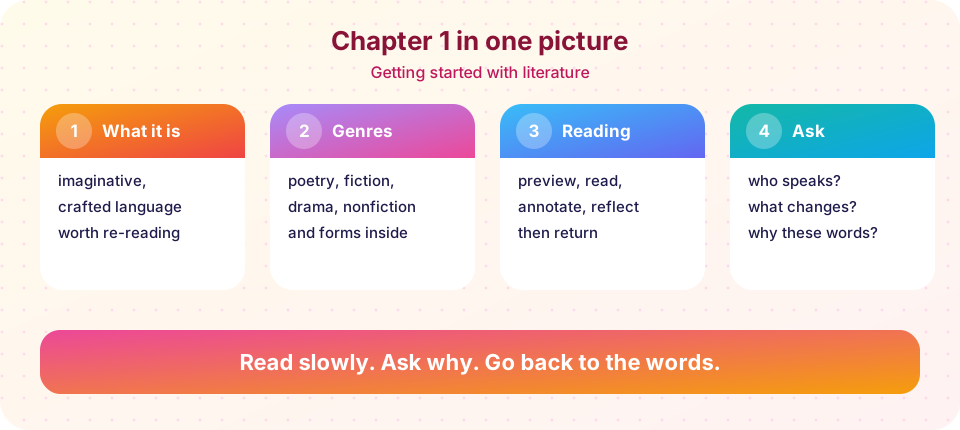
You have finished the first chapter. Before moving on, pause to pull the pieces together. This review recaps the main ideas, applies them all to one short poem, and gives you flashcards and a ten-question quiz. If any part feels shaky, follow the links back to the lesson. Reviewing after a gap of a day or two is one of the best things you can do for memory.
What you will learn
- The key ideas of the four lessons in this chapter, in one place.
- How to use all of them together on a single short text.
- Which terms to be able to define without looking.
- How to plan spaced review so the ideas stay with you.
Key terms
Literariness is the quality that makes language artistic: rhythm, imagery, careful word choice.
Genre, form and mode name the family, the shape and the speaking situation of a text.
Convention is an expected feature of a genre.
Annotation is marking a text with highlights, circles, questions and notes.
Interpretation is an argument about meaning, supported by quotation.
The chapter in five lines
| Lesson | The key idea | One thing to remember |
|---|---|---|
| Course map | Nine chapters, three-pass reading, a reading journal | Read once for experience, once for detail, once for argument. |
| What is literature? | Craft, imagination, openness to interpretation and endurance | Meaning grows between author, text, reader and world. |
| Genres and forms | Poetry, fiction, drama and nonfiction, with forms inside | Genres set expectations that writers can meet or break. |
| How to read actively | Preview, read, annotate, reflect | A few consistent marks and good questions beat heavy highlighting. |
Putting it all together: a worked example
Here is the first stanza of a poem by Emily Dickinson (1830 to 1886). Most of her poems were published only after her death; this one appeared in the second collection of her work, in 1891. The text below is in the public domain.
"Hope" is the thing with feathers -
That perches in the soul -
And sings the tune without the words -
And never stops - at all -
Step one, the lens of the chapter: what is this? The genre is poetry and the form is a lyric: one voice offering a thought. The title is only the opening line, since Dickinson usually left her poems untitled. Looking at the page, you see four short lines and a lot of dashes. The dashes are Dickinson's habit; they slow the reading and create small pauses, almost like breaths.
Step two: first read for the experience. It sounds gentle and a little surprising. Hope, an abstract feeling, is turned into a bird.
Step three: second read, annotated.
- "Hope" in quotation marks: the word is held up for inspection, as if the poem were about the idea of hope as well as the feeling.
- "the thing with feathers": an odd way to say "bird." Dickinson does not name the bird. She makes the reader do the work, which is a small act of craft. This is a metaphor, because hope is said to be a creature, not merely to be like one.
- "perches in the soul": the soul becomes a place, like a tree or a windowsill. Margin question: what kind of soul has a perch for hope?
- "sings the tune without the words": hope is a melody that needs no language. That suggests hope is a feeling beneath speech.
- "And never stops - at all -": the final line pauses on both sides of "at all." Reading aloud, you linger there. The dashes make the claim feel stubborn.
Step four: the argument. A reader could argue that Dickinson makes hope feel small, living and persistent, rather than grand. She imagines it as a bird: fragile, but always singing. Notice that the claim comes directly from the details. You will refine this skill in Chapter 2.
Step five: the four elements. Using the diagram from the lesson on what literature is, ask what each corner adds. The author lived a quiet, mostly private life, which may affect how personal the poem feels. The text is a compressed metaphor. The reader (you) might hear the bird as comforting or as stubborn, depending on your experience. The world includes nineteenth-century American religious language of the soul and the church hymns Dickinson knew.
This is all one poem, four lines, and you could write a page about it from your notes. That is what close, active reading does.
Questions beginners often ask
"What if I do not like the text?" That is useful information. Ask what in the text produces the dislike: the voice, the pace, the subject, the style? A reader who can explain a dislike is already analyzing. You do not have to love every text, but you should try to understand why it works for the people who do.
"What if I see something nobody else sees?" Test it. Look for two or three places in the text that support your idea and ask whether a fair reader could follow your reasoning. Original observations are what essays are made of, but they have to be anchored in the words.
"How slow is too slow?" Slow enough to notice and fast enough to keep the story or argument alive. Most readers should read the first pass at normal speed and spend their slow time on the second pass, with a pencil, on a small number of passages.
"Do I have to know the history?" It helps, and later chapters will give you context. But you can begin with the words alone. Many students find that a few facts about when and where a work was written explain details that seemed strange, such as an unusual word or a custom that no longer exists.
"Is it cheating to look things up?" Never. Skilled readers look up words, places and references all the time. The real cheat is copying someone else's interpretation without understanding it. Reading other people's views is fine as long as you compare them with your own reading of the text and give credit.
How to study this chapter
Use the review in three short sessions rather than one long one. In the first, reread your annotations from the lessons and try to define the key terms aloud. In the second, a day or two later, take a short poem or a paragraph of prose and run the four-step routine on it from scratch: preview, read for experience, annotate, state a claim. In the third, a week later, explain the difference between genre and form to someone else. If you can teach an idea, you know it. Keep your reading journal open as you go, and add one question per session that you still cannot answer. Those questions will find their answers in the chapters ahead.
Terms you should be able to define
Try defining each of these in your own words before you flip the cards below: literature, literariness, genre, form, mode, convention, subgenre, hybrid, canon, oral tradition, annotation, paraphrase, interpretation. If a definition will not come, return to the lesson that introduced it.
Common misconceptions
"I understand it if I can summarize it." A summary says what happens. An interpretation says how and why the text makes its effect. You need both.
"Annotating means finding the poem's secret code." Annotations record what you noticed and asked. They are not a decoding key.
"The first definition I learn is the final one." Definitions of literature are debated; hold yours loosely and test it on real examples.
Try it
Use the flashcards to test yourself, then plan your review dates.
Press Run (or Ctrl + Enter) to see the console output here.
No output.
Check your understanding
Quick check · 10 questions
of 10 answered You scored / 10 · perfect!
-
1. Which term names a broad family such as poetry or drama?
A genre is a broad family; a form is a specific pattern inside it. -
2. Which is the best example of a form?
A sonnet is a specific form within the genre of poetry. -
3. Which statement best describes how meaning arises, according to this chapter?
Discussions of literature draw on all four elements. -
4. Why are canons worth questioning?
Canons are useful but chosen by people with power, so they reflect who was heard. -
5. What is the main aim of the first read in the three-pass method?
Pass one protects the experience; analysis comes later. -
6. Which annotation best fits a word repeated three times?
Repetition is a clue; circling it helps you notice the pattern. -
7. In Dickinson's stanza, calling hope 'the thing with feathers' is an example of
Hope is said to be a bird without the word 'like' or 'as', which makes it a metaphor. -
8. A novella is usually
Novellas fall between short stories and novels in length. -
9. What does a prose poem do?
A prose poem is written in paragraphs but keeps poetry's compression. -
10. Which is the best way to stay with a long novel?
A steady pace with a buffer keeps reading sustainable.
Summary
- Literature is crafted, imaginative language that rewards interpretation and rereading.
- Meaning grows between author, text, reader and world.
- The main genres are poetry, fiction, drama and nonfiction, each with forms and conventions.
- Active reading means previewing, reading for experience, annotating and building an argument.
- Review after a day, three days, a week and a month to keep what you learned.
Track your progress
Create a free account to tick off lessons and pick up where you left off on any device.
of Introduction to Literature lessons completed