


















Lesson 3 of 47 · Getting Started
Genres and forms of literature
Learn the four main literary genres and the forms inside them, from sonnets to novellas to essays, and see how genre sets up expectations that writers can meet or break.
Walk into a library and you will find the books sorted. Poetry is on one shelf, novels on another, plays on a third. These groups are genres, and they are one of the most useful tools a reader has. A genre is a promise. When you open a book labeled "mystery," you expect a puzzle and a solution. When you see short lines with white space around them, you expect to read slowly and listen for sound. Genre lets you start reading with the right expectations, and, as you will see, it also gives writers something to play with.
What you will learn
- The difference between a genre, a form and a mode.
- The main features of poetry, fiction, drama and nonfiction.
- Typical length categories for prose fiction.
- How writers mix and break genre conventions.
- How to use genre as a reading tool without letting it limit you.
Key terms
Genre is a broad category of literature, such as poetry, fiction, drama or nonfiction.
Form is a specific pattern within a genre, such as a sonnet, a novella or a monologue.
Convention is an expected feature of a genre or form, such as rhyme in a ballad or a detective in a detective story.
Subgenre is a smaller family within a genre, such as science fiction within fiction.
Hybrid is a work that blends genres, such as a novel written in verse.
Genre, form and mode
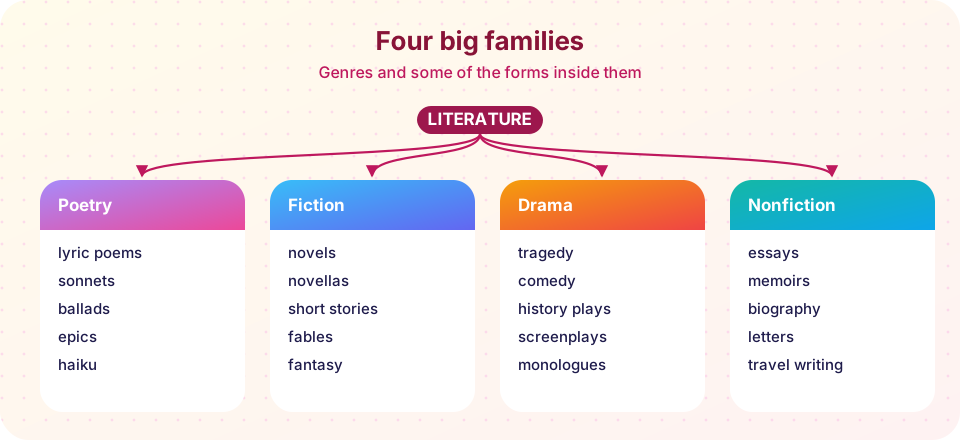
People use these words loosely, so it helps to fix them. A genre is the big family. A form is a particular shape inside it. So "poetry" is a genre, and "sonnet" is a form. "Fiction" is a genre, and "short story" is a form. A third word, mode, describes how the work speaks. Since the ancient Greek philosophers Plato and Aristotle, critics have described three basic modes: the lyric, where one voice expresses feeling or thought; the epic or narrative, where a storyteller recounts events; and the dramatic, where characters speak and act for themselves. These three modes still sort most literature, and one genre can use more than one. A narrative poem such as Dante's Divine Comedy belongs to the genre of poetry but works in a narrative mode.
Poetry
Poetry is language organized into lines, usually with attention to sound, rhythm and imagery. It compresses meaning: a poem of fourteen lines can carry as much feeling as a chapter. Poems can be lyric (a single voice, as in a sonnet or an ode), narrative (a story in verse, as in a ballad or epic), or dramatic (a speaker addressing a listener, as in a dramatic monologue). Chapter 3 is devoted to poetry, with lessons on sound and meter, forms and free verse.
Fiction
Fiction is prose narrative about invented people and events. Its main forms are usually sorted by length.
- Flash fiction is a complete story in a few hundred words or fewer. There is no official limit; under about a thousand words is the common convention.
- A short story can usually be read in one sitting and focuses on one central conflict or moment.
- A novella is longer than a story and shorter than a novel. Joseph Conrad's Heart of Darkness (1899) is a famous example.
- A novel is long enough to develop many characters, settings and subplots.
One widely used set of boundaries comes from the awards of the Science Fiction and Fantasy Writers of America, which place a novelette at 7,500 to 17,500 words, a novella at 17,500 to 40,000 and a novel above 40,000. These numbers are conventions for awards, not laws of nature, but they give you a feel for the scale.
Fiction also divides into subgenres by content: historical fiction, mystery, romance, fantasy, science fiction, horror, realism. Many subgenres have their own conventions. Edgar Allan Poe's "The Murders in the Rue Morgue" (1841) is often called the first modern detective story, and Mary Shelley's Frankenstein (1818) is often seen as an early work of science fiction. Older narrative forms such as the fable (a short tale with a moral, like those attributed to Aesop) and the fairy tale (a folk story with magic, collected by the Brothers Grimm in the early 1800s) sit near fiction, too. Chapter 4 explores plot, character, point of view and setting.
Drama
Drama is written to be performed. The text is a script made of dialogue (what characters say) and stage directions (what they do and how the stage looks). Because the audience watches and listens in real time, drama depends on action, conflict and speech that feels alive. The classic forms are tragedy (a serious story that ends badly, as in Sophocles's Oedipus the King), comedy (a story of mistakes and reconciliation ending happily, as in many of Shakespeare's plays) and history plays. Modern forms include the screenplay and the radio play. A script is incomplete until actors and directors bring it to life, which is why drama gets its own chapter.
Nonfiction
Nonfiction is writing about real people, events and ideas. Much nonfiction is simply informative, such as a manual or a news report. Literary nonfiction uses the techniques of literature: voice, image, structure and sometimes narrative. Its forms include the essay (a short, personal or argumentative piece; the French writer Michel de Montaigne gave it its name from essais, "attempts," in 1580), the memoir (a writer's remembered experience), biography (the story of someone's life), letters and diaries, and travel writing. The line between fiction and nonfiction is not always sharp. A memoir shapes memory into a story, and a historical novel builds invented scenes on real events.
Hybrids and boundary-crossers
Writers often mix genres, and some of the most memorable works live in the borderlands. Alexander Pushkin's Eugene Onegin (1825 to 1832) is a novel told in verse. Charles Baudelaire's Paris Spleen (1869) collects prose poems, which use the compression of poetry without line breaks. A graphic novel combines pictures and words, and an epistolary novel tells its story through letters. Even fiction can contain poetry, and plays can contain songs.
When a work crosses boundaries, ask what the mixture does. A verse novel gets the intensity of poetry plus the length and plot of a novel. A prose poem gets the freedom of a paragraph while keeping the focus on images.
Conventions: promises you can keep or break
Each genre carries conventions. A fairy tale begins "once upon a time." A tragedy shows a hero's downfall. A detective story ends with an explanation. Readers feel satisfied when conventions are met and surprised when they are cleverly changed. Jane Austen's Northanger Abbey (written about 1798 and published in 1817) has fun with Gothic novels: its heroine expects dark secrets in an old house, and finds mostly ordinary life. The joke only works because readers know the genre.
Use genre as a starting guess, not a cage. Ask: "What does this genre usually do, and how does this text follow or change it?" The answer often leads straight to an interpretation.
Common misconceptions
"Genre fiction is not real literature." Mystery, science fiction and fantasy have produced works of great craft and lasting influence. Quality does not depend on the shelf.
"Poetry has to rhyme." Much poetry rhymes and much does not. You will study free verse in Chapter 3.
"A play is just a story with the narrator removed." A play is built for performance, with pace, space and bodies on a stage. The same story told as a novel and as a play feels different.
Try it
A small program can notice surface features of a text, but it will also show you why genre needs a human reader. Then see how fiction lengths compare.
Press Run (or Ctrl + Enter) to see the console output here.
No output.
Press Run (or Ctrl + Enter) to see the result here.
Program input · what you'd type while the program runs
Type the answers before you press Run, one per line. Each time the program reads a line (with input()), it gets the next line from this box.
Check your understanding
Quick check · 5 questions
of 5 answered You scored / 5 · perfect!
-
1. What is the relationship between genre and form?
Poetry is a genre and the sonnet is a form of it; fiction is a genre and the short story is a form. -
2. Which genre is written to be performed?
Drama is written as a script for actors, with dialogue and stage directions. -
3. Under the SFWA award categories, a text of 25,000 words would be a
Novellas run from 17,500 to 40,000 words in those categories. -
4. What is a prose poem?
Prose poems keep the compression and imagery of poetry but drop line breaks, as in Baudelaire's Paris Spleen. -
5. Why does Northanger Abbey work as a joke?
The humor depends on the reader's expectations about Gothic novels.
Summary
- A genre is a broad family of texts; a form is a specific shape within it; a mode describes who speaks.
- The four main genres are poetry, fiction, drama and nonfiction, each with many forms.
- Prose fiction forms are often sorted by length: flash fiction, short story, novelette, novella, novel.
- Hybrids such as verse novels and prose poems mix genres on purpose.
- Conventions create expectations that writers can meet or break; ask what a text does with them.
Next: How to read actively
Track your progress
Create a free account to tick off lessons and pick up where you left off on any device.
of Introduction to Literature lessons completed