


















Lesson 21 of 47 · Fiction and Narrative
Setting and atmosphere
Learn how setting works in fiction: place, time and social world, how settings create mood, drive conflict and symbolize ideas, with close readings of Dickens's Bleak House and Hardy.
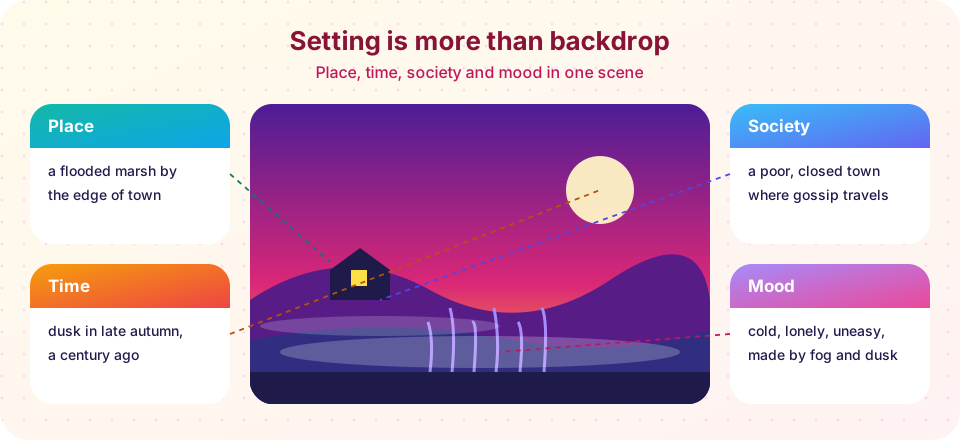
"It was a dark and stormy night" has become a joke because it is the cliché of cliché: weather used as an announcement. Yet underneath the joke lies a real truth. Where and when a story happens shapes what happens in it, and the feeling of a place can be as powerful as any character. A story set on a crowded ferry feels different from one set in an empty desert, even if the plot is the same. This lesson looks at how writers use setting, the place, the time and the social world of a story, to build mood, create pressure and carry meaning.
What you will learn
- The four layers of setting: place, time, society and mood.
- The functions of setting: backdrop, mood, conflict, character and symbol.
- How atmosphere is built from sensory detail.
- What the pathetic fallacy is.
- How to analyze a setting with evidence.
Key terms
Setting is the time and place in which a story happens, together with its social and cultural world.
Atmosphere (or mood) is the emotional feeling a setting creates in the reader.
Pathetic fallacy is giving human feelings to nature so that the weather or landscape seems to mirror a character's mood.
Local color is detailed use of a region's customs, speech and scenery.
Gothic is a style that uses ruins, castles, storms and dread to create fear and mystery.
The layers of setting
Place. Where does the story happen: a city, a village, a ship, a house, a single room? Place includes geography, climate and the objects in it. A cramped kitchen and a vast ballroom produce different stories.
Time. When does it happen? Setting in time includes the era (Victorian England, the Jazz Age), the season, the time of day and even the length of the story. A story that happens in a single afternoon feels different from one that spans a century. Historical settings bring their own rules: the clothes, the technology, the social expectations.
Social world. Who lives here, and what are their rules? A setting includes class, customs, language and values. Jane Austen's settings are mostly drawing rooms and country houses, but the real setting is an economic and social order in which women's choices are narrow and marriage is a matter of money. Understanding the social setting changes how you read every conversation.
Mood. The combination of these layers creates atmosphere: tense, cozy, lonely, festive, sinister. Mood is not a separate layer but the result of the other three, built from detail.
What setting does in a story
A setting can serve several functions at once.
- Backdrop. It provides a believable place for events.
- Mood. It sets an emotional tone. Gothic novels use ruins and storms for dread; comedies often take place in sunny gardens.
- Conflict. Setting can be an obstacle or antagonist. In Robinson Crusoe (1719), the island is the challenge: Crusoe must survive it. In Mary Shelley's Frankenstein, the frozen Arctic frames the struggle at the end.
- Character. A setting can reveal or shape character. What someone keeps in their room says something about them. A character who is out of place in a setting creates tension.
- Symbol. A place can stand for an idea. Lonely moors can represent wildness and passion, a river can represent a journey into the unknown, a house can represent a family's decay.
Atmosphere is built from detail
Atmosphere comes from specific sensory details, not from adjectives like "creepy." A good writer chooses a few concrete details and lets the reader feel the mood. Charles Dickens's Bleak House (1853) begins with one of the best-known settings in English fiction:
London. Michaelmas term lately over, and the Lord Chancellor sitting in Lincoln's Inn Hall. Implacable November weather. As much mud in the streets as if the waters had but newly retired from the face of the earth...

Fog everywhere. Fog up the river, where it flows among green aits and meadows; fog down the river, where it rolls defiled among the tiers of shipping and the waterside pollutions of a great (and dirty) city.
Observe. The opening has no verbs in its first sentences: "London." "Fog everywhere." They are fragments, like snapshots. The details are physical (mud, fog, shipping), and the diction ("implacable," "defiled," "pollutions") is harsh.
Question. Why open with weather and mud, rather than with a person? Why repeat "fog"?
Interpret. The repeated fog creates a mood of confusion and obscurity. The novel's plot concerns a legal case in the Court of Chancery that drags on for generations, ruining people. The fog is not only weather but a symbol of the court's confusing, endless process. The fog is both atmosphere and symbol, and it spreads through the book as a motif. The famous line "As much mud in the streets as if the waters had but newly retired from the face of the earth" even recalls the Flood, suggesting a world waiting to be judged.
Support. The fog comes back later, and the court's "Lord Chancellor" sits "at the very heart of the fog," in Dickens's words. When the setting returns in the plot, we see it was not a mere backdrop.
Pathetic fallacy
The critic John Ruskin coined the term pathetic fallacy in 1856 for the habit of writers who give nature human feelings, as when the sky weeps at a funeral. (Ruskin used the term as criticism; today it is a neutral label.) When a storm rises as a character's rage rises, or sunshine arrives with a happy ending, the setting echoes the mood. Writers use this effect for emphasis, and sometimes they play with it for irony, as when a joyful event takes place in pouring rain.
Setting and point of view
A narrator's perspective colors what we notice about a setting. A traveler sees a village as picturesque; a resident sees it as a cage. Compare how the same marsh would be described by a bird-watcher and by someone who is lost in the fog at dusk. The words chosen and the details selected reveal the narrator, as well as the place. When you analyze a setting, ask whose eyes we are using.
Place as character
Some settings are so powerful that they become characters. Thomas Hardy's novel The Return of the Native (1878) opens with a chapter titled "A Face on Which Time Makes but Little Impression," describing Egdon Heath, a wild stretch of land that seems to hold its own will. The heath shapes the lives of the people who live on it, trapping some and drawing others. Emily Brontë's Wuthering Heights (1847) gives its house and the surrounding moors as much emotional force as any person in the story.
How to analyze a setting
- List the details of place, time and social world.
- Name the mood in a precise word or two (not just "scary").
- Find the sensory details that create it (sound, smell, touch, sight).
- Ask what job the setting does: backdrop, mood, conflict, character, symbol.
- Track change. Does the setting change as the story moves along? Does it come back?
- Test the alternative. Imagine the same events in a different setting. What changes?
Common misconceptions
"Setting is just where the story happens." It also shapes mood, pressure and meaning.
"Weather in a story is always symbolic." Sometimes it is just weather. Look for repetition and connection to the plot.
"A fantasy world has no real setting." Invented worlds still have place, time and a social order, and these shape the story as much as real ones.
Try it
Mix time and weather to see how atmosphere changes, then count sensory words in two passages.
Press Run (or Ctrl + Enter) to see the console output here.
No output.
Check your understanding
Quick check · 5 questions
of 5 answered You scored / 5 · perfect!
-
1. Which is NOT one of the layers of setting named in the lesson?
Setting includes place, time, social world and the mood they produce. -
2. In Bleak House, the fog is best described as
The repeated fog creates mood and stands for the Chancery court's obscurity. -
3. What is the pathetic fallacy?
Ruskin coined the term for nature that seems to share human feelings. -
4. Which sentence best builds atmosphere?
Concrete sensory details create mood better than abstract adjectives. -
5. In which book does the setting act as an obstacle because the hero must survive it?
The island in Robinson Crusoe is the challenge the hero must overcome.
Summary
- Setting has layers: place, time, social world and the mood they create.
- It can work as backdrop, mood, conflict, character or symbol, often several at once.
- Atmosphere comes from specific sensory details, not labels.
- The pathetic fallacy lets nature mirror human feeling.
- Analyze setting by listing details, naming the mood, finding the job it does and testing alternatives.
Next: Chapter 4 review
Track your progress
Create a free account to tick off lessons and pick up where you left off on any device.
of Introduction to Literature lessons completed