


















Lesson 41 of 47 · Writing About Literature
Structure and Revision
Plan an outline, write clear paragraphs, openings and endings, handle counter-arguments, and revise at the level of argument, paragraph and sentence, with a reverse-outline method.
A great thesis and good quotations can still produce a muddled essay if the pieces are in the wrong order. Structure is what lets a reader follow your thinking: each paragraph does one job, each job builds on the last, and the ending feels earned. Revision is the process of making the structure visible and the thinking sharper.
This lesson gives you tools for both: an outline you can actually use, a model for strong paragraphs, advice for introductions and conclusions, and a method for revising a draft that works from the biggest problems down to the smallest.
What you will learn
- How to build an outline that tests your argument before you draft.
- The structure of a strong body paragraph and how to link paragraphs.
- How to write an introduction and conclusion that do real work.
- A four-level revision method, including the reverse outline.
Key terms
- Outline: a plan listing the main claim of each section in order.
- Topic sentence: the first sentence of a paragraph, stating its claim.
- Transition: a word or phrase that shows how one idea connects to the next.
- Reverse outline: an outline made from a finished draft, to see what it actually says.
- Global revision: changes to argument and structure, as opposed to polishing sentences.
Outlining
An outline is a test of your argument, not a cage. Before drafting, list your thesis and then the main claim for each body paragraph, in the order a reader needs them. Ask of each claim: does it support the thesis? Is it different from the others? Does it come after what the reader needs to know to understand it?
A simple outline for an essay on Shelley's creature might look like this:
- Thesis: Shelley makes us sympathize with the creature by letting him narrate his own story.
- Claim 1: His early experiences show innocence and curiosity.
- Claim 2: His rejection by the people he helps explains his anger.
- Claim 3: Victor's refusal to listen repeats the original neglect.
- Counter-reading: The creature commits murder, but the text frames it as consequence, not nature.
Notice the order. We begin with the creature's innocence, which creates sympathy, then move to the pressures that change him, and end with the failure of the one person who could help. That is a progression: each claim builds on the one before.
Be wary of the "five-paragraph essay" as a rigid formula. It is useful for beginners, but a good argument may need two paragraphs on a hard point, or a short paragraph for a quick contrast. Let the argument decide the number.
The body paragraph
A strong body paragraph has a recognizable shape:
- Topic sentence: makes one claim, linked to the thesis.
- Evidence and analysis: one or two quotation sandwiches (see the previous lesson).
- Concluding or linking sentence: says why the point matters and prepares the next paragraph.
Here is a short example about Ozymandias:
The poem's final image is its most powerful. The speaker describes "the lone and level sands" stretching away, and the adjectives suggest an emptiness no boast can fill. Even "level" hints that the proud pedestal has been flattened into the same plain as everything else. In this way the ending turns the king's command to despair into a joke at his own expense.
Read the paragraph's four sentences and you can hear the shape: claim, evidence, analysis, link. Many teachers use acronyms (PEEL: point, evidence, explain, link), but the idea is the same.
Unity is the paragraph's main virtue. If a paragraph tries to do two things, split it. Length follows content: very long paragraphs hide their logic, while strings of tiny paragraphs may lack development. A good test is to try to summarize each paragraph in one sentence. If you cannot, it is probably doing too much.
Transitions show relationships: however, by contrast, similarly, as a result, more importantly. Use them to express real logic, not as decoration. A deeper transition repeats a key idea from the previous paragraph: "The creature's innocence makes his rejection all the more painful."
Introductions
An introduction has three jobs: orient the reader (title, author, brief context), raise the question (why this issue is interesting or debatable), and state the thesis, usually as the last sentence.
Avoid these common openings:
- "Since the dawn of time, humans have ..." (too broad)
- A dictionary definition.
- A plot summary.
- "In this essay I will ..." (announcement).
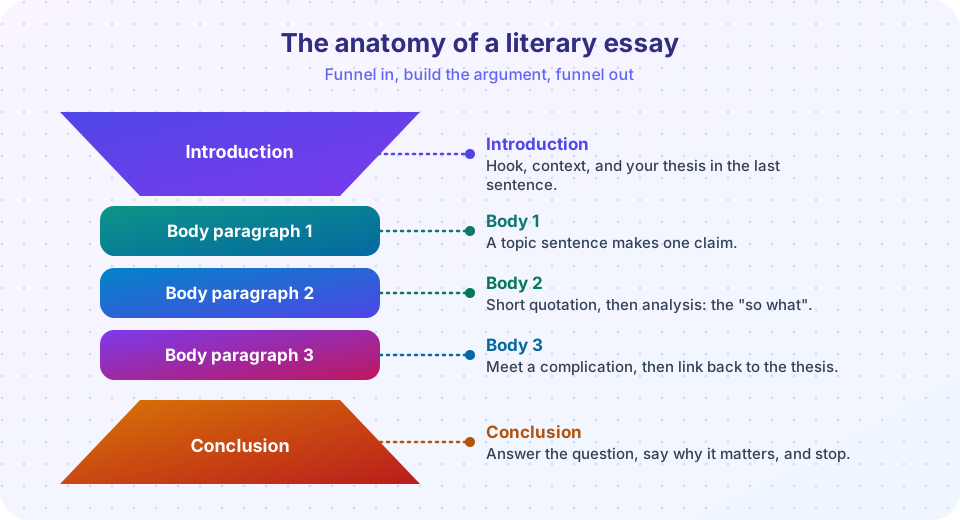
Instead, start close to your topic. You might begin with a puzzle in the text, a striking detail or a short quotation, then widen enough to give context, then narrow to the thesis. That is why the introduction in the diagram is a funnel.
Counter-arguments
A persuasive essay does not pretend there is only one way to read. Somewhere, usually in the third or fourth paragraph, acknowledge a reasonable objection, then respond. For the creature essay: "It might be argued that the creature's murders show a violent nature. Yet the text places each act after a specific cruelty, so violence appears as a response, not an origin." This concession and rebuttal shows that you have thought about the other side, which makes your argument stronger.
Conclusions
A conclusion is the funnel in reverse: answer the question, say why it matters, and stop. Do not simply repeat the introduction. Show what the argument has achieved: how it changes the reading of the work, what it reveals about the writer's method, or how it connects to a larger concern. Avoid introducing a brand-new piece of evidence, apologizing ("This is just my opinion"), or ending with a sweeping statement about "society".
Revision: four levels
Revision means "seeing again". Experienced writers revise in layers, working from large to small.
Level 1: argument
- Does the essay answer the question?
- Does the thesis match what the essay actually argues?
- Is every paragraph needed?
Level 2: structure
Make a reverse outline. Read your draft and write one short note for each paragraph saying what it does. Look at the list. Are the claims in a logical order? Are two paragraphs making the same point? Does a paragraph claim something the evidence does not support? Many weaknesses become obvious when the essay is flattened into a list.
Level 3: paragraphs and sentences
- Does each paragraph have a clear topic sentence and analysis, not just a quotation?
- Are quotations short and smoothly introduced?
- Cut padding: "it is important to note that", "very", "in my opinion", "this shows that" (unless something specific follows).
- Prefer active verbs. "Shelley withholds the creature's name" is stronger than "The creature's name is withheld by Shelley".
- Replace vague words (thing, aspect, interesting) with precise ones.
Level 4: proofreading
Only at the end, fix grammar, spelling, punctuation and citation format. Read aloud, slowly, or read the essay backwards one sentence at a time to spot errors. A clean surface shows respect for your reader, but polishing sentences in a paragraph you will delete is wasted effort, which is why proofreading comes last.
Get feedback. A peer or teacher can tell you where they got lost. Ask specific questions: "Where did you stop being convinced?" "What did you expect next?"
"Revision means correcting spelling." That is proofreading. Revision begins with argument and structure.
"The first draft should be perfect." First drafts are for finding out what you think.
"A conclusion should repeat the introduction." It should move forward by answering the question and saying why it matters.
Try it
Press Run (or Ctrl + Enter) to see the result here.
Program input · what you'd type while the program runs
Type the answers before you press Run, one per line. Each time the program reads a line (with input()), it gets the next line from this box.
Check your understanding
Quick check · 5 questions
of 5 answered You scored / 5 · perfect!
-
1. What is the purpose of an outline?
An outline is a tool for testing your argument before drafting. -
2. What is a reverse outline?
Writing what each paragraph does shows structural weaknesses. -
3. Where does the thesis usually appear in an introduction?
The introduction narrows from context to the thesis, which is usually the last sentence. -
4. What should a conclusion do?
A good conclusion shows what the argument has achieved without padding or new arguments. -
5. In what order should revision usually proceed?
Work from the biggest issues down to the smallest so you do not polish sentences you will delete.
Summary
- Use an outline to test your argument; let the argument decide the number of paragraphs.
- Body paragraphs make one claim, supply evidence and analysis, and link onward.
- Introductions orient, raise the question and state the thesis; conclusions answer, explain why it matters and stop.
- Include a counter-argument with concession and rebuttal.
- Revise in four levels: argument, structure (reverse outline), paragraph and sentence, then proofreading.
Track your progress
Create a free account to tick off lessons and pick up where you left off on any device.
of Introduction to Literature lessons completed