


















Lesson 45 of 47 · Projects and Practice
Glossary of Literary Terms
A glossary of more than fifty literary terms grouped by language, sound, narrative, drama and criticism, with short examples, flashcards and a searchable term finder.
A glossary is a toolbox. Literary terms are not decoration. Each one names a pattern that writers use on purpose, and once you can name it, you notice it everywhere. This lesson collects the key terms from the whole course, grouped by what they describe, with short examples. Use it as a reference while you read, and as revision before an exam.
Examples come from the public-domain works used in this course, or are invented for this lesson. Where a term has several meanings, the most common one in introductory literature courses is given.
What you will learn
- Short, accurate definitions of more than fifty literary terms.
- How terms group into families: language, sound, narrative, drama and criticism.
- How to use flashcards and search to learn them.
Key terms
- Device: a technique a writer uses for effect.
- Figure of speech: language used in a non-literal way, such as metaphor.
- Convention: a customary technique of a genre or period.
- Context: the historical, cultural or biographical setting of a work.
Language and imagery
- Allegory: a story whose characters and events stand for ideas, often moral or political, in a sustained system.
- Allusion: a brief reference to another text, person or event. Calling a scientist "a modern Prometheus" is an allusion.
- Ambiguity: language that supports more than one meaning, sometimes deliberately.
- Connotation and denotation: denotation is a word's dictionary meaning; connotation is the feelings and associations it carries. "Home" and "house" denote similar things, yet "home" connotes warmth.
- Diction: a writer's choice of words, such as formal, plain or slangy.
- Hyperbole: deliberate exaggeration, as in "I've told you a million times".
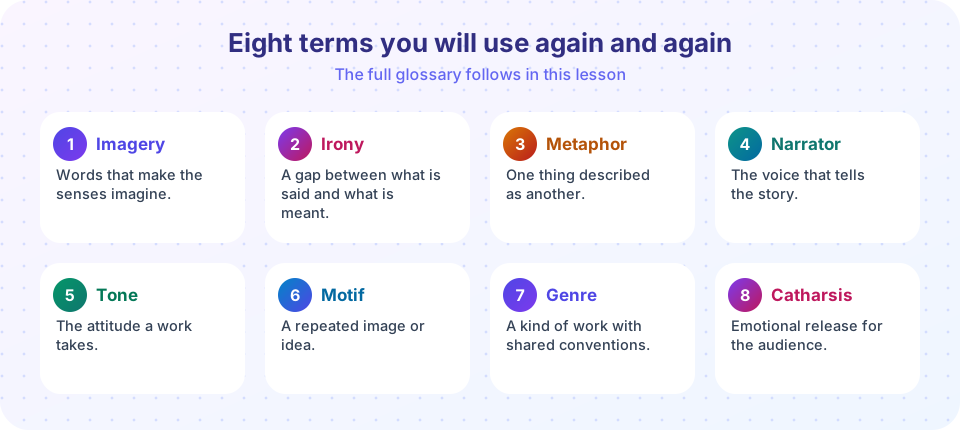
- Imagery: language that appeals to the senses: sight, sound, touch, taste, smell. Not only visual.
- Irony: a gap between expectation and reality. Verbal irony says one thing and means another; situational irony is an outcome opposite to what was expected; dramatic irony occurs when the audience knows more than the characters.
- Juxtaposition: placing two things side by side to highlight contrast.
- Metaphor: describing one thing as another, without "like" or "as": "Life's but a walking shadow" (Macbeth).
- Metonymy: naming something by an associated thing: "the crown" for the monarchy.
- Oxymoron: a phrase combining opposites, such as "bittersweet" or "deafening silence".
- Paradox: a statement that seems contradictory but may express a truth.
- Personification: giving human qualities to non-human things.
- Pun: wordplay exploiting double meanings or similar sounds.
- Simile: a comparison using "like" or "as".
- Symbol: something that stands for something beyond itself, such as a dove for peace.
- Synecdoche: a part standing for a whole, such as "hands" for workers.
Sound and verse
- Alliteration: repetition of initial consonant sounds: "the lone and level sands".
- Assonance: repetition of vowel sounds within nearby words.
- Ballad: a narrative poem or song, often in short stanzas with a refrain.
- Blank verse: unrhymed iambic pentameter, used by Shakespeare and Milton.
- Couplet: two consecutive lines that rhyme.
- Elegy: a poem of mourning.
- Enjambment: a sentence running over the end of a line without a pause.
- Epic: a long narrative poem about heroic deeds, such as the Odyssey.
- Free verse: poetry without regular meter or rhyme scheme.
- Meter: the pattern of stressed and unstressed syllables in a line. Iambic pentameter has five iambs (weak-strong) per line.
- Quatrain: a four-line stanza.
- Sonnet: a fourteen-line poem; the Shakespearean sonnet rhymes ABAB CDCD EFEF GG, and the Petrarchan has an octave and sestet.
- Stanza: a grouped set of lines in a poem, like a paragraph.
- Volta: the turn in a sonnet, when the argument or mood shifts.
Narrative and fiction
- Antagonist and protagonist: the protagonist is the central character; the antagonist opposes them.
- Characterization: how a writer builds character, by direct description or by showing speech and action.
- Climax: the point of highest tension or turning point in a plot.
- Foil: a character who contrasts with another to highlight qualities.
- Frame narrative: a story containing another story, as in Frankenstein or "Ozymandias".
- Motif: a recurring image, idea or pattern in a work.
- Narrator: the voice that tells the story. First-person uses "I"; third-person uses "he, she, they"; an omniscient narrator knows everything; an unreliable narrator cannot be fully trusted.
- Plot: the arrangement of events in a story.
- Point of view: the perspective from which a story is told.
- Setting: the time and place of a story.
- Stream of consciousness: a technique that follows the flow of a character's thoughts.
- Theme: a central idea or concern explored in a work. A theme is not a single word ("love") but a claim ("love may demand sacrifice").
- Tone: the attitude a work takes toward its subject and audience, such as playful, bitter, solemn.
- Voice: the distinctive style and personality of a narrator or author.
Drama
- Anagnorisis: recognition, a moment of discovery in a plot.
- Aside: a brief remark to the audience that other characters do not hear.
- Catharsis: the emotional release or clarification an audience feels, in Aristotle's account of tragedy.
- Chorus: in Greek drama, a group commenting on the action; in Shakespeare, sometimes a narrator.
- Dialogue and monologue: speech between characters; a long speech by one.
- Fourth wall: the imaginary wall between stage and audience in realistic theatre.
- Hamartia: an error or flaw that begins the hero's downfall.
- Peripeteia: a reversal of fortune or expectation.
- Soliloquy: a speech in which a character thinks aloud for the audience.
- Stage direction: an instruction about action, setting or tone in a script.
- Subtext: meaning beneath the spoken words.
- Tragedy and comedy: serious drama ending in downfall; drama of confusion and resolution, often festive.
Criticism and context
- Canon: the set of works a culture treats as most important.
- Close reading: attentive analysis of the words and form of a text.
- Context: the circumstances surrounding a work.
- Deconstruction: reading that shows how a text undermines its own claims.
- Genre: a category of works with shared conventions, such as tragedy, sonnet or detective novel.
- Intertextuality: the relationships among texts, through echo, allusion and rewriting.
- Ideology: a set of ideas that makes a social order seem natural.
- Postcolonial: concerned with the legacies of colonialism.
- Reader-response: criticism that emphasizes the reader's role in making meaning.
- Thesis: the main arguable claim of an essay.
"A symbol has one fixed meaning." Symbols are shaped by context. A river can mean time, a boundary or a cleansing, depending on the work.
"Theme means topic." A topic is a subject ("war"); a theme is a claim about it.
"Irony means coincidence." Irony concerns a gap in meaning or expectation.
Try it
Check your understanding
Quick check · 5 questions
of 5 answered You scored / 5 · perfect!
-
1. Which pair of terms describes a word's dictionary meaning and its associations?
Denotation is the dictionary meaning; connotation is the cluster of feelings and associations. -
2. Which device does 'the crown' for 'the monarchy' illustrate?
Metonymy names something by an associated thing. -
3. What is dramatic irony?
The audience's superior knowledge creates tension and double meanings. -
4. How does a theme differ from a topic?
'War' is a topic; 'war destroys the people who start it' is closer to a theme. -
5. What is enjambment?
The sense carries over the end of one line into the next.
Summary
- Terms group into families: language and imagery, sound and verse, narrative, drama, and criticism.
- Denotation and connotation, irony, metaphor, motif and tone are the workhorses of close reading.
- Use definitions as handles for noticing, then always show how the device works in a specific text.
- Revisit this page with the flashcards and search to make the terms your own.
Track your progress
Create a free account to tick off lessons and pick up where you left off on any device.
of Introduction to Literature lessons completed