


















Lesson 24 of 47 · Drama
Greek Tragedy and Aristotle
How tragedy began at the Athenian festival of Dionysus, how Oedipus the King works, and what Aristotle meant by hamartia, reversal, recognition and catharsis.
Almost every Western idea about drama starts in one city, Athens, in one century, the fifth before the common era. A few hundred plays were written for competitions held at festivals, and only a small fraction survive. Yet the survivors by Aeschylus, Sophocles and Euripides gave us the word tragedy, the idea of the tragic hero, and a vocabulary that critics still use. Aristotle, writing about a century later, tried to explain why these plays moved their audiences so powerfully.
In this lesson you will look at the theatre in which tragedies were performed, follow the plot of one great play, Oedipus the King, and learn the main terms of Aristotle's Poetics. You will also see where critics disagree with him.
What you will learn
- How and where Greek tragedy was performed, and what the chorus did.
- The plot of Oedipus the King and why it is a model of dramatic irony.
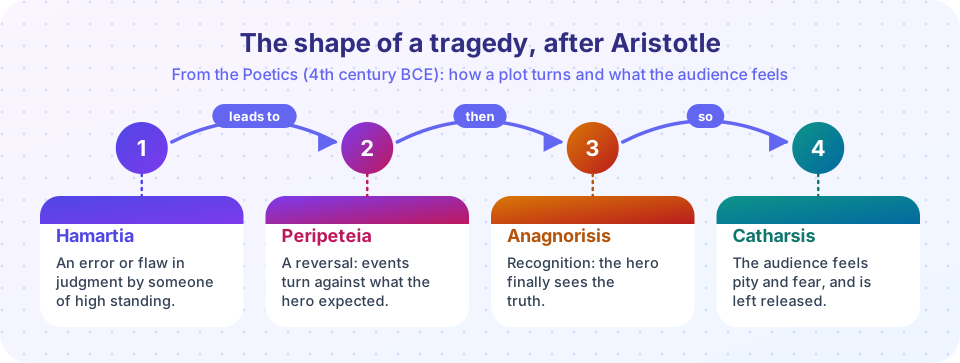
- Aristotle's key terms: hamartia, peripeteia, anagnorisis and catharsis.
- Why critics debate the meaning of these terms and how later writers used them.
Key terms
- Tragedy: a serious play in which a central figure suffers a downfall, usually from a mix of character, choice and fate.
- Chorus: a group of performers who sang, danced and commented on the action.
- Hamartia: an error, mistake or flaw that sets the downfall in motion.
- Peripeteia: a reversal, when events turn against what a character expects.
- Anagnorisis: recognition, the moment a character moves from ignorance to knowledge.
- Catharsis: the emotional release or clarification the audience experiences.
The festival and the theatre
Tragedies were performed at the City Dionysia, a spring festival in honour of the god Dionysus. It was a civic and religious event, not a night out. Citizens gathered in an open-air theatre cut into a hillside below the Acropolis. Each playwright who was chosen to compete presented a group of plays on consecutive days, and judges awarded a prize. The theatre had three main parts:
- the theatron, the "seeing place" where the audience sat on the slope;
- the orchestra, the circular dancing floor where the chorus moved;
- the skene, a building behind the orchestra, used for entrances and as a backdrop.
All the actors were men, and they wore masks that made faces readable at a distance and allowed one actor to play several roles. By the time of Sophocles, three actors shared the speaking parts. The chorus, a group of a dozen or more, sang and danced between scenes, and it often spoke as ordinary citizens or elders: frightened, hopeful, sometimes wrong. A modern theatre might use a narrator, a crowd or a musical number to do the same work.
Greek tragedies usually drew on well-known myths. The audience knew in advance that Oedipus was doomed or that Agamemnon would be murdered. That has a consequence for how the plays work. Suspense about what happens matters less than how it happens and what it means.
Oedipus the King: a model plot
Sophocles' Oedipus the King, usually dated to around 429 BCE, begins with a plague in the city of Thebes. Oedipus, the king, promises to save his people. The oracle at Delphi says the plague will end only when the murderer of the previous king, Laius, is found and punished. Oedipus swears to find him and curses him in advance.
What the play slowly reveals is that Oedipus is the murderer. Years before, he had killed a stranger on the road without knowing the man was Laius, his own father. He then solved the riddle of the Sphinx, became king of Thebes, and married the widowed queen Jocasta, who is his mother. Every step of his rise was also a step towards disaster.
The play is a masterclass in dramatic irony: the audience knows more than the character. When Oedipus declares that he will pursue the killer as if for his own father, the audience hears a terrible joke that he cannot hear. Each scene tightens the net. The prophet Tiresias accuses him and he angrily refuses to listen. A messenger arrives from Corinth with news meant to comfort him, and it ends up shattering him. A shepherd, reluctantly, confirms the truth. Jocasta understands first, leaves the stage and takes her own life. Oedipus blinds himself and asks to be exiled.
Aristotle's Poetics
Aristotle (384 to 322 BCE) wrote the Poetics as a study of how poetry works, drawing on tragedy and epic. He defines tragedy as the imitation of a serious, complete action that arouses pity and fear and achieves a catharsis of such feelings. He says tragedy has six parts, in order of importance:
- Plot (mythos), the arrangement of events;
- Character (ethos);
- Thought (dianoia), the ideas and arguments;
- Diction (lexis), the language;
- Song (melos);
- Spectacle (opsis), the visual side.
He ranks plot highest because tragedy is about action and life, not just personality. That is worth remembering when a modern reader assumes tragedy is mostly about "character".
The key terms in action
- Hamartia is often translated "tragic flaw", but Aristotle's word may simply mean a mistake or error of judgment. Oedipus is not a wicked man. His errors of anger, pride and ignorance of his own origin are what bring him down. The debate matters: if hamartia is a flaw of character, the hero deserves blame; if it is an error, the play is more about vulnerable humans in an uncertain world.
- Peripeteia is a reversal. In Oedipus, the messenger from Corinth is meant to reassure the king, and his news does the opposite.
- Anagnorisis is recognition. Aristotle singles out plots where reversal and recognition happen at once, and he praises Oedipus the King for this.
- Catharsis is the most disputed. The Greek word can suggest purgation, purification or clarification. Some critics read it as emotional relief, others as learning to feel the right emotions about the right things, others as something that happens in the plot itself.
"The tragic hero has a fatal flaw." This is a common school summary, but it goes further than Aristotle, whose term can mean a mistake. Many tragedies, including Antigone and Medea, are better understood as conflicts between powerful claims than as flaws in one character.
"Catharsis means the audience feels better." It is one reading, but scholars have also read it as purification or clarification, and the debate is not settled.
Other voices of Greek theatre
Tragedy had rivals and companions:
- Aeschylus (c. 525 to c. 456 BCE) wrote the Oresteia (458 BCE), a trilogy about murder, revenge and the founding of a court of law.
- Sophocles (c. 496 to 406 BCE) wrote Antigone, in which a young woman defies the king's decree to bury her brother, a clash of family duty and state law.
- Euripides (c. 480 to 406 BCE) wrote Medea, a play in which a betrayed wife takes terrible revenge, and often gave sympathetic voices to outsiders and women.
- Aristophanes (c. 446 to c. 386 BCE) wrote comedies such as Lysistrata and The Frogs, mixing political satire, obscenity and song.
Greek tragedies also use a messenger to report violent events that happen off stage, which is why you rarely see bloodshed in them. Later tragedy, such as the plays of Seneca in ancient Rome, shifted towards on-stage horror, and both traditions fed Renaissance drama.
How later writers used Aristotle
Renaissance critics treated the Poetics as a rulebook, and they invented the three unities of time, place and action, saying a play should happen in about a day, in one place, and with one main plot. Aristotle stresses unity of action; the other two were added by later commentators. Shakespeare ignored them freely, and French classical dramatists such as Racine obeyed them closely. The argument about whether Aristotle's categories describe or prescribe has never quite ended, and it is a good example of a theory being larger than its source.
Try it
Check your understanding
Quick check · 5 questions
of 5 answered You scored / 5 · perfect!
-
1. Where were Greek tragedies first performed?
Tragedies were competition entries at the City Dionysia, a civic and religious festival held in an open-air theatre. -
2. What is dramatic irony in Oedipus the King?
Because the myth was familiar, the audience knows Oedipus is the killer. His confident words therefore carry a second, terrible meaning. -
3. Which statement best matches Aristotle's use of hamartia?
The Greek term can be translated 'mistake' or 'error of judgment', which is why many scholars avoid the school phrase 'fatal flaw'. -
4. Which of Aristotle's six parts of tragedy does he rank highest?
Aristotle treats plot as the soul of tragedy because it is the imitation of action. -
5. Which of the three unities did Aristotle himself stress?
He emphasizes unity of action. The unities of time and place were added by Renaissance critics.
Summary
- Greek tragedy was a civic, religious and competitive art, performed by masked male actors and a chorus in an open-air theatre.
- Oedipus the King shows dramatic irony, reversal and recognition working together.
- Aristotle's Poetics ranks plot first and names hamartia, peripeteia, anagnorisis and catharsis, though each term is debated.
- Later critics turned his observations into rules, such as the three unities, which writers then followed or broke.
Track your progress
Create a free account to tick off lessons and pick up where you left off on any device.
of Introduction to Literature lessons completed