


















Lesson 31 of 47 · Literary Movements
Postcolonial and World Literature
How writers from formerly colonized places answered empire: language, identity, hybridity and memory in Achebe, Rhys, Ngugi, Rushdie and Adichie, plus world literature debates.
For several centuries, a handful of European empires ruled large parts of the world. Their administrators, missionaries and novelists described the peoples they ruled, usually from outside. When independence movements gathered strength in the twentieth century, writers in those places began to write back. They told the stories empire had left out, argued over which language to use, and invented forms that mix local and inherited traditions.
This lesson looks at postcolonial literature, a broad and lively body of writing, and at the wider idea of world literature. It is less a movement with a manifesto than a family of questions about power, voice and belonging.
What you will learn
- What "postcolonial" means and how the field developed.
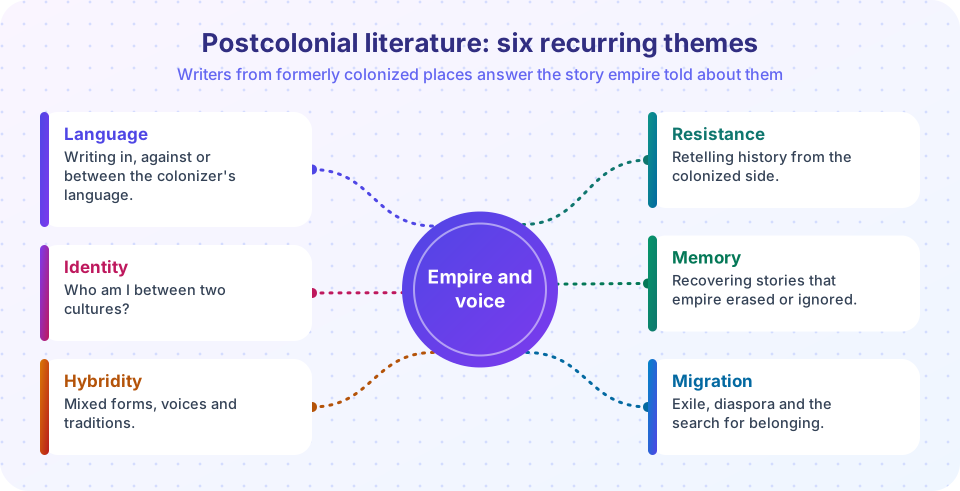
- Six recurring themes: language, identity, hybridity, resistance, memory and migration.
- Key writers and works from Africa, the Caribbean, South Asia and beyond.
- Why debates about world literature, translation and the canon matter.
Key terms
- Colonialism: control of one territory and its people by another power, for settlement or profit.
- Postcolonial: concerned with the effects and legacies of colonialism, both after independence and during colonial rule.
- Hybridity: the blending of cultures, languages or forms, a term associated with the critic Homi Bhabha.
- Orientalism: Edward Said's term for Western ways of representing "the East" that served imperial power.
- Diaspora: a population scattered from its homeland, and its sense of identity.
Context: empire and independence
The British, French, Portuguese, Spanish, Dutch and Belgian empires each shaped the places they ruled in different ways, but they shared patterns: extraction of resources, unequal law, and the imposition of European languages and schools. A wave of independence followed the Second World War: India and Pakistan in 1947, Ghana in 1957, Nigeria in 1960, Jamaica and Algeria in 1962, Kenya in 1963, Zimbabwe in 1980, among many others. Independence did not instantly end economic or cultural influence, which is why many critics prefer to talk about legacies and sometimes "neocolonialism".
The term "postcolonial" is sometimes disputed. It might suggest that colonialism is over, or lump together very different histories, such as settler colonies like Australia and Canada and places like India or Nigeria. Many scholars use it carefully and in the plural: postcolonial literatures.
Foundational voices
A few landmarks mark the field's growth.
- Aimé Césaire (Martinique) published Notebook of a Return to the Native Land (1939), a poem that helped launch négritude, a movement affirming Black identity and culture.
- Frantz Fanon (Martinique and Algeria) wrote Black Skin, White Masks (1952) and The Wretched of the Earth (1961), analyzing the psychology and politics of colonization.
- Chinua Achebe (Nigeria, 1930 to 2013) published Things Fall Apart (1958), set among the Igbo in the late nineteenth century. It shows a complex society, with its own laws and rituals, before and during the arrival of missionaries and colonial government. Its title comes from W. B. Yeats's poem "The Second Coming". In a 1975 lecture, later published as "An Image of Africa", Achebe criticized Joseph Conrad's Heart of Darkness (1899) for treating Africa as a backdrop for a European crisis. Critics still debate the argument, and many teachers pair the two works.
- Jean Rhys (born in Dominica) wrote Wide Sargasso Sea (1966), a prequel to Jane Eyre that gives a voice to Bertha Mason, the "madwoman in the attic", as a Creole woman in the Caribbean.
- Edward Said's Orientalism (1978) argued that Western literature, art and scholarship had represented "the East" in ways that justified domination. Gayatri Spivak's essay "Can the Subaltern Speak?" (1988) asked whose voice is heard when the powerless are represented. Homi Bhabha's The Location of Culture (1994) explored hybridity and in-between spaces.
Six recurring themes
Language
Which language should a writer use? Achebe chose English and argued that it could be bent to carry the weight of his African experience, mixing it with Igbo proverbs and rhythms. Ngũgĩ wa Thiong'o of Kenya, in Decolonising the Mind (1986), argued that African literature should be written in African languages, and he turned to Gikuyu. Both positions are serious responses to the same problem. Others, like Caribbean poets, use creole forms.
Identity and hybridity
Many works feature characters caught between cultures: an educated narrator among relatives, a migrant in London, a child in two languages. Hybridity can be painful, but it can also be creative, and Salman Rushdie has described the mixing of cultures as a source of new stories.
Resistance and memory
Writers retell history from the colonized side. Adichie's Half of a Yellow Sun (2006) revisits the Nigerian civil war. Arundhati Roy's The God of Small Things (1997) probes caste and class in Kerala after independence. Derek Walcott's epic Omeros (1990) transposes Homer to the Caribbean. Jamaica Kincaid's A Small Place (1988) addresses tourists in Antigua directly.
Migration
Tayeb Salih's Season of Migration to the North (1966) follows a Sudanese man who studied in Europe and returns home, and explores the colonial encounter through a dark, complex plot. Contemporary diasporic writers explore exile, return and the sense of belonging in several places.
Throughout, formal choices matter: shifts between languages, oral storytelling, multiple narrators, magical realism and unreliable memory. Postcolonial literature is not defined by one style.
World literature
Goethe, in 1827, spoke of Weltliteratur, a literature that crosses national borders. Today the idea raises hard questions: which works get translated, which win international prizes, and who decides what counts as "world" literature? Most winners of the Nobel Prize in Literature have been European or North American, though the prize has also gone to writers such as Naguib Mahfouz (Egypt, 1988), Derek Walcott (Saint Lucia, 1992) and Wole Soyinka (Nigeria, 1986). Translation matters enormously: a reader in one language sees only what was translated, and a translator's choices shape the work.
The Nigerian writer Chimamanda Ngozi Adichie, in a 2009 talk, warned of "the danger of a single story": if you only hear one story about a people, you risk mistaking it for the whole truth. That is a good rule for any reader. Read widely, notice who is missing, and ask who is speaking.
"Postcolonial literature is only about the past." Many works deal with present-day politics, migration, climate and economy.
"All postcolonial writers think alike." They disagree about language, nationalism, tradition and the West, sometimes fiercely.
"Writing in English means adopting the colonizer's values." Many writers transform English, using it to challenge the empire that spread it.
Try it
Press Run (or Ctrl + Enter) to see the result here.
Program input · what you'd type while the program runs
Type the answers before you press Run, one per line. Each time the program reads a line (with input()), it gets the next line from this box.
Check your understanding
Quick check · 5 questions
of 5 answered You scored / 5 · perfect!
-
1. Which novel by Chinua Achebe was published in 1958?
Things Fall Apart (1958) shows Igbo society before and during colonial arrival. -
2. What is hybridity?
Hybridity, a term used by Homi Bhabha, names the mixing of cultures and the new forms that arise. -
3. What is the main argument of Said's Orientalism (1978)?
Said argued that Western scholarship and art helped create images of the East that justified domination. -
4. Which writer argued that African literature should be written in African languages?
In Decolonising the Mind (1986) Ngũgĩ made this case and turned to writing in Gikuyu. -
5. What does Adichie mean by 'the danger of a single story'?
She argues that a single narrative flattens people, and reading many stories corrects it.
Summary
- Postcolonial literature answers the legacies of empire from the perspective of the colonized and their descendants.
- Recurring themes: language, identity, hybridity, resistance, memory and migration.
- Key figures include Césaire, Fanon, Achebe, Rhys, Ngũgĩ, Said, Spivak, Bhabha, Rushdie, Roy and Adichie.
- World literature raises questions about translation, prizes and whose stories circulate.
Track your progress
Create a free account to tick off lessons and pick up where you left off on any device.
of Introduction to Literature lessons completed