


















Lesson 40 of 47 · Writing About Literature
Evidence and Quotation
Choose strong evidence, introduce and format quotations correctly, and write analysis that explains how the words work, with the quotation sandwich and examples from Shelley.
An argument without evidence is only an opinion. In literary writing, the main evidence is the words of the text. But a quotation placed in an essay is not self-explanatory. Readers need to know why you chose it, where it comes from, and what you see in it that they might miss. The skill is in the combination: a precise piece of evidence, smoothly introduced, followed by analysis that shows how the words support your claim.
This lesson teaches the quotation sandwich, a simple structure that makes your paragraphs stronger, plus the practical rules of introducing, shortening and citing quotations.
What you will learn
- How to choose evidence that is relevant, concise and rich.
- The four moves of the quotation sandwich.
- How to introduce, shorten, punctuate and cite quotations, including verse.
- How to analyze the words, not just repeat them.
Key terms
- Quotation: the exact words of the text, in quotation marks or in a block.
- Lead-in (signal phrase): words that introduce a quotation and tell the reader who speaks or where we are.
- Ellipsis: three dots (...) showing words have been omitted.
- Block quotation: a longer quotation set off from the text in an indented block, without quotation marks.
- Paraphrase: your own wording of an idea from the text, with no quotation marks.
Choosing evidence
Good evidence has three qualities:
- Relevant. It directly supports the claim in the paragraph. A famous line that is only loosely related belongs elsewhere.
- Concise. Quote the part that does the work. A long passage hides the words you want your reader to see. Often a phrase of three to ten words is enough.
- Rich. It has something to analyze: an unusual word, an image, a rhythm, a shift in tone, a contrast. Plain statements of plot give you little to say.
Also choose evidence that is representative. If a character is sympathetic in a single sentence and cruel for the rest of the book, one kind quotation would mislead. A good essay sometimes shows a pattern across several moments, using brief quotations from different parts of the work.
When to quote and when to paraphrase. Quote when the exact wording matters: striking diction, imagery, rhythm, irony. Paraphrase when you only need to report what happens or what a character does. Too many long quotations make an essay look like a collage; too few leave claims unproven.
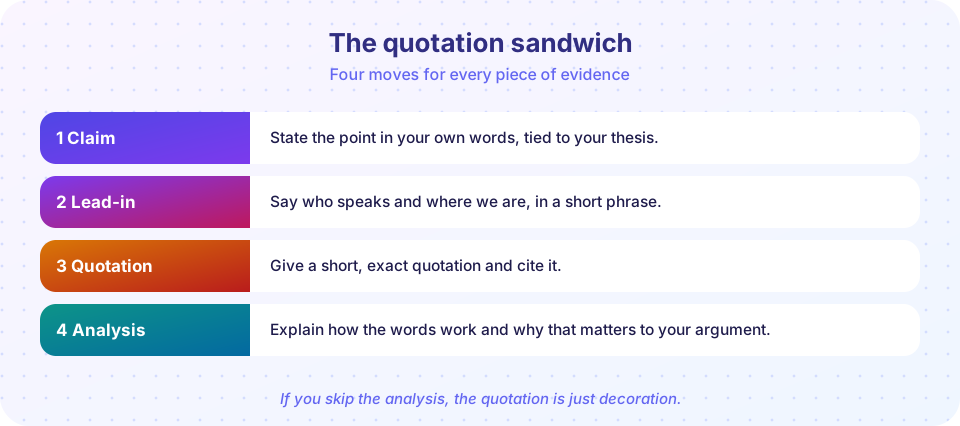
The quotation sandwich
Think of each piece of evidence as a four-part structure.
- Claim. State the point in your own words, tied to your thesis.
- Lead-in. Introduce the quotation with a short phrase: who speaks, where we are, what is happening.
- Quotation. Give the exact words, with a citation.
- Analysis. Explain how the words create the effect and why that supports the claim.
Here is an example paragraph built on this structure, using a famous speech from Mary Shelley's Frankenstein:
Shelley uses religious language to make the creature's grievance feel like a moral charge against his maker. Confronting Victor, the creature declares, "I ought to be thy Adam, but I am rather the fallen angel" (ch. 10). By casting himself first as the Adam Victor should have cherished, then as the fallen angel punished for no crime, he turns the relationship between maker and made into a question of parental duty. The word "ought" matters most: it names an obligation Victor has failed, so the reader hears the creature's anger as justified complaint rather than mere menace.
Look at how it works. The claim is in the first sentence. The lead-in ("Confronting Victor, the creature declares") tells us who speaks and when. The quotation is short and exact. The analysis has three layers: it interprets the two biblical figures, it explains the contrast between them, and it zooms in on one word, "ought", showing how a single word shapes our reaction. Then it links back to the claim by saying how the reader responds.
The chapter reference follows the 1831 text, where this scene is in chapter 10. Editions differ in numbering, so always cite the edition you use.
Introducing quotations
A quotation should never drop into a paragraph like a stone in a pond. Fit it into your own sentence in one of these ways:
- With a signal phrase and a comma: The creature declares, "I ought to be thy Adam."
- Folded into your sentence: The creature says he "ought to be" Victor's Adam, not an outcast.
- With a colon after a complete sentence: Shelley gives the creature a biblical complaint: "I ought to be thy Adam."
Use varied, precise verbs: argues, insists, admits, implies, concedes, pleads, protests. Avoid repeating "says".
Shortening and adapting
To remove words from the middle of a quotation, use an ellipsis (three dots). To change or add a word so a quotation fits your grammar, use square brackets: "[the creature] pleads". Do not change the meaning, and never use ellipses to cut out words that would alter the sense. Keep the original spelling; if the original contains an obvious error, add [sic] only when necessary.
Punctuation follows convention. In American style, commas and periods go inside the closing quotation mark, and a parenthetical citation comes after the closing quote but before the final period if the quote ends your sentence: the creature calls himself "the fallen angel" (ch. 10). In British style you may place punctuation outside when it is not part of the quoted text. Follow the style guide you were given.
Quoting poetry
Verse needs extra care because line breaks matter. For up to two or three lines, run the quotation into your sentence and mark each line break with a slash and a space on each side. For example, the last lines of Shelley's sonnet describe the ruin: "Nothing beside remains. Round the decay / Of that colossal Wreck, boundless and bare." Preserve capital letters and punctuation as in the poem.
For longer passages, use a block quotation: begin on a new line, indent it, and do not use quotation marks. In MLA style, this is for more than four lines of prose or more than three lines of verse; other styles such as Chicago have different thresholds, so check the one you are using. A block quotation must be discussed. Never leave it hanging without commentary before and after.
Citing
Most literature courses use MLA style, with a short parenthetical citation of author and page number (or line numbers for poems, act, scene and line for plays), and a "Works Cited" list at the end. Chicago style uses footnotes. For a play, you might write (Macbeth 2.1.33). The exact format depends on the instructor and edition, so follow the guide and be consistent.
Citation also protects you from plagiarism. If you use someone else's words or ideas, from a critic or a classmate, give credit. When you bring in a critic, introduce them by name and say what they argue, then engage with it: agree, qualify or disagree. A paragraph made of other people's quotations is not your argument.
Analysis: what to say after the quotation
Beginning writers often quote and then restate: "This shows that the creature feels angry." That gives the reader nothing new. Try these moves instead:
- Zoom in on a word. Why this word and not a neighbor? What associations does it bring? ("ought" implies obligation.)
- Describe the effect. How does the language make a reader feel or think?
- Notice sound and rhythm. Is there repetition, a heavy stress, a sudden break?
- Connect to context. Does the quotation echo another text or a historical moment? (The creature's Adam and fallen angel recall John Milton's Paradise Lost, which Shelley's novel also uses as an epigraph.)
- Tie back to the claim. End by saying what this adds to your argument.
A useful test: delete the quotation. If your analysis could stay unchanged, it does not depend on the words, so go deeper.
"The quotation speaks for itself." It rarely does. Your task is to show how and why it matters.
"More quotations mean more evidence." Fewer, shorter, better-analyzed quotations usually persuade more.
"Ellipses are free." They must not change the meaning of the sentence.
Try it
Check your understanding
Quick check · 5 questions
of 5 answered You scored / 5 · perfect!
-
1. What are the four moves of the quotation sandwich?
Each piece of evidence needs a claim, a lead-in, an exact quotation and analysis. -
2. When should you quote rather than paraphrase?
Quote when the words themselves are the evidence; paraphrase when only the content matters. -
3. What do square brackets do inside a quotation?
Brackets signal your alteration, such as '[the creature] pleads'. -
4. How are line breaks marked when quoting two lines of verse in a sentence?
A slash with a space on each side marks line breaks. -
5. Why is 'This shows that the creature feels angry' weak analysis?
Good analysis zooms in on words, describes effects and links back to the claim.
Summary
- Choose evidence that is relevant, concise and rich, and quote only when the wording matters.
- Use the quotation sandwich: claim, lead-in, quotation, analysis.
- Integrate quotations grammatically, use ellipses and brackets honestly, and mark verse line breaks with slashes.
- Cite according to the style guide, credit critics, and make analysis do real work after every quotation.
Next: Structure and Revision
Track your progress
Create a free account to tick off lessons and pick up where you left off on any device.
of Introduction to Literature lessons completed