


















Lesson 36 of 47 · Theory and Criticism
Poststructuralism and Beyond: Deconstruction, New Historicism and New Lenses
Learn what deconstruction and poststructuralism claim, how New Historicism links texts to their time, and what ecocriticism, trauma theory and distant reading add to literary study.
Structuralism looked for stable systems beneath texts. In the late 1960s, a group of thinkers, mostly French, argued that those systems were less stable than structuralists had hoped. If meaning comes from differences between signs, and signs only point to other signs, then meaning can never be fully fixed. This is the starting point of poststructuralism and of its best-known method, deconstruction.
At the same time, other critics turned in a different direction: back to history, but a more complicated history than the old kind, in which texts and their times shape each other. And in recent decades, new lenses have arrived from ecology, trauma studies, disability studies and data science. This lesson tours them, with an eye to what each lets you see and where each can mislead.
What you will learn
- The main claims of poststructuralism, and how deconstruction reads a text.
- The ideas of Barthes and Foucault about authors, power and discourse.
- What New Historicism and cultural materialism do differently from old-fashioned historical criticism.
- A quick map of newer lenses: ecocriticism, trauma theory and distant reading.
Key terms
- Poststructuralism: a group of theories that question the stability of structures and fixed meanings.
- Deconstruction: a way of reading that shows how a text's own logic undermines its apparent claims.
- Différance: Derrida's coined word combining "differ" and "defer": meaning arises from difference and is always postponed.
- Discourse: a system of statements and practices that shapes what can be said and known.
- Distant reading: analysis of large collections of texts using quantitative methods.
Poststructuralism
Barthes and the author
Roland Barthes, who had been a structuralist, changed direction in the late 1960s. In "The Death of the Author" (1967), he argued that a text is "a tissue of quotations" drawn from countless other texts, and that the reader, not the author, is where its meaning is assembled. In S/Z (1970), he read a short story by Balzac line by line, distinguishing "readerly" texts (which give readers a passive role) from "writerly" ones (which demand active making).
Foucault: discourse and power
Michel Foucault asked how knowledge and power are entangled. In "What Is an Author?" (1969), he treated the author as a function that societies use to classify and control texts. In later works he argued that systems of knowledge, such as medicine, law and psychiatry, define what counts as normal and what as deviant. For literary critics, discourse became a key word: texts are part of larger networks of speech that make some ideas thinkable and others not.
Derrida and deconstruction
Jacques Derrida (1930 to 2004) challenged the Western habit of building thought on binary oppositions: speech and writing, presence and absence, nature and culture, reason and emotion. In each pair, he said, one term has traditionally been privileged as primary and the other treated as secondary or corrupt. Philosophy, from Plato on, favored speech over writing, as if the spoken word were closer to truth.
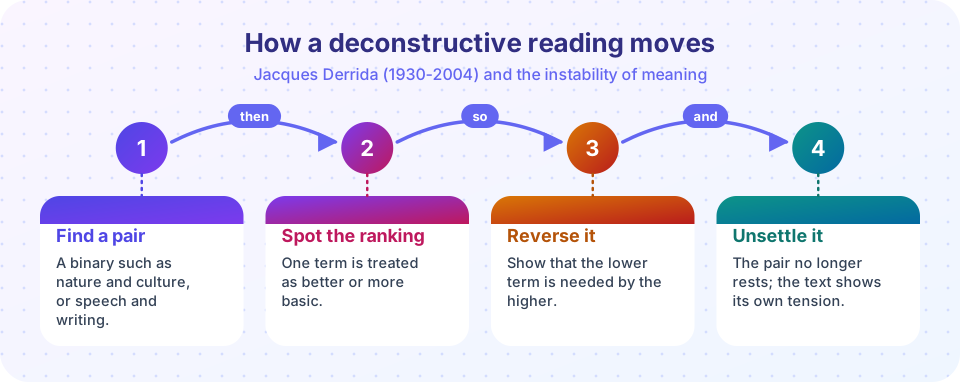
Deconstruction does not destroy a text. It reads it closely to show how it relies on the very thing it excludes. A deconstructive reading typically moves through four steps:
- Find a pair of opposed terms that the text relies on (for instance, nature and culture).
- Spot the ranking: which term is treated as better or more basic?
- Reverse it: show that the lower term is needed by the higher one, or that the "natural" term depends on the "artificial" one.
- Unsettle the pair: show that the opposition cannot hold and that meaning is more slippery than the text claims.
Derrida coined différance to describe how meaning is both different (it depends on differences between signs) and deferred (it is never fully present). His much-quoted sentence from Of Grammatology (1967), usually translated "there is nothing outside the text", does not mean that nothing exists beyond books. It means that we have no access to meaning outside systems of signs, interpretation and context.
A short example: a text may praise "natural" feeling over "artificial" convention, yet it uses highly crafted rhetoric to do so. A deconstructive reader notes this, not to mock the text, but to show that nature here is an effect of art. Critics at Yale, such as Paul de Man, developed a rigorous version focused on rhetoric and figures like metaphor.
Critiques
Detractors accuse deconstruction of obscurity, relativism or irresponsibility. Defenders reply that it asks for more careful reading, not less, and that its target is false certainty. For a student, the practical lesson is valuable: notice binaries, notice what a text excludes, and test your own claims for hidden assumptions.
New Historicism and cultural materialism
New Historicism emerged in the 1980s, associated with Stephen Greenblatt (Renaissance Self-Fashioning, 1980) and critics like Louis Montrose. Old historical criticism treated history as a background that explains the text. New Historicists treat texts and other documents as equals in a wider network: a play can be read alongside a travel report, a legal case, a medical treatise or a royal proclamation. They look for "circulation of social energy", the way ideas and anxieties move between genres, and they argue that power is often exercised through culture. A New Historicist reading of a Shakespeare play might compare it with accounts of witchcraft trials or colonial voyages, asking how the theatre reproduces or questions official ideas.
In Britain, cultural materialism (Jonathan Dollimore and Alan Sinfield, Political Shakespeare, 1985) shares many aims but is more openly political, asking how texts can be used to challenge dominant ideas today.
Newer lenses
- Ecocriticism studies literature and the physical environment. Cheryll Glotfelty and Harold Fromm's collection The Ecocriticism Reader (1996) and Lawrence Buell's The Environmental Imagination (1995) helped establish it. Critics ask how nature is represented, whether the text sees humans as separate from nature, and how literature responds to climate change.
- Trauma theory (for example Cathy Caruth, Unclaimed Experience, 1996) examines how texts represent events too overwhelming to be fully understood at the time, and how fragmented, repetitive narration may express them.
- Disability studies asks how disability is portrayed, often as a metaphor or a problem to be fixed, and what it means to read from the perspective of disabled people.
- Digital humanities applies computing. Franco Moretti proposed distant reading, analyzing hundreds or thousands of books to spot patterns invisible to a single reader (Graphs, Maps, Trees, 2005). Critics worry that data lose the texture of reading; supporters say the two methods complement each other.
These lenses show that theory is not finished. New questions arise when new social concerns and new tools appear.
"Deconstruction says texts mean nothing." It argues that meaning is never fully fixed, not that texts are meaningless. Its readings are usually detailed and text-based.
"New Historicism is just background information." It treats texts and context as mutually shaping, and it reads non-literary documents as texts.
"Distant reading replaces close reading." Most practitioners use it to generate questions that close reading then explores.
Try it
Press Run (or Ctrl + Enter) to see the result here.
Program input · what you'd type while the program runs
Type the answers before you press Run, one per line. Each time the program reads a line (with input()), it gets the next line from this box.
Check your understanding
Quick check · 5 questions
of 5 answered You scored / 5 · perfect!
-
1. What does deconstruction typically do with a binary opposition?
A deconstructive reading shows how the privileged term relies on the one it excludes. -
2. What is Foucault's idea of discourse?
Discourse links knowledge and power by shaping what counts as thinkable. -
3. How does New Historicism differ from older historical criticism?
New Historicists read literature and other documents together as parts of one network of culture and power. -
4. What does Barthes's 'The Death of the Author' (1967) argue?
Barthes treated the text as a weave of quotations whose unity lies in the reader. -
5. Who proposed 'distant reading'?
Moretti proposed analyzing large collections of texts with quantitative methods.
Summary
- Poststructuralism questions fixed meaning; deconstruction shows how texts rely on what they exclude.
- Barthes and Foucault shifted attention from authors to readers, discourse and power.
- New Historicism and cultural materialism read literature alongside other documents as part of a network of power and culture.
- Ecocriticism, trauma theory, disability studies and distant reading show the field still growing.
Track your progress
Create a free account to tick off lessons and pick up where you left off on any device.
of Introduction to Literature lessons completed