


















Lesson 8 of 47 · Reading Closely
Figurative language and imagery
Understand similes, metaphors, personification, hyperbole, understatement and imagery, learn the tenor and vehicle method, and practice analyzing a poem by Robert Burns.
When someone says "I'm starving," they usually do not mean they are about to die of hunger. When a poet writes that fog "comes on little cat feet," no one expects to find paw prints. These are figures of speech: ways of saying one thing in order to mean or suggest another. Figurative language is not decoration added to plain statements. It is one of the main ways literature makes ideas vivid, memorable and hard to forget. This lesson teaches you to spot the main figures, to explain what they do, and to read imagery, the pictures and sensations that language creates.
What you will learn
- The difference between literal and figurative language.
- How to recognize simile, metaphor, personification, hyperbole and understatement.
- What metonymy, synecdoche, apostrophe and paradox are.
- How imagery works through the five senses.
- A method for explaining what a figure does: tenor, vehicle and ground.
Key terms
Literal language means exactly what it says. Figurative language means something beyond the literal.
Simile compares two unlike things using "like" or "as."
Metaphor says one thing is another, with no "like" or "as."
Imagery is language that appeals to the senses.
Tenor, vehicle, ground are three parts of a comparison: the subject, the thing it is compared to, and what they share.
The main figures
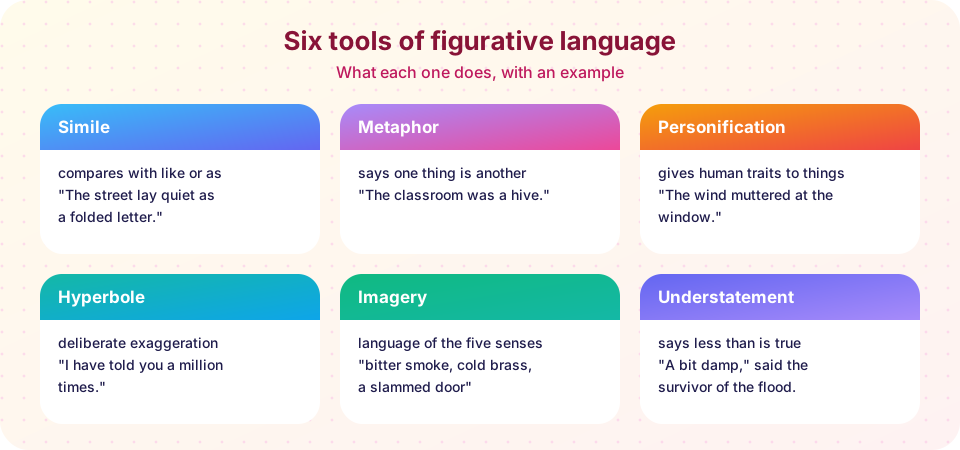
Simile. A simile compares with "like" or "as": "The street lay quiet as a folded letter." Robert Burns wrote in 1794, "O my Luve is like a red, red rose / That's newly sprung in June." Notice how the simile makes a claim: love is fresh, bright and beautiful, and, like a rose, delicate.
Metaphor. A metaphor drops the signal word and states the comparison directly: "The classroom was a hive." In As You Like It, Shakespeare's Jaques says, "All the world's a stage, / And all the men and women merely players." The metaphor turns life into theater, with entrances, exits and parts to play. Metaphors can be extended across a passage. A poem that keeps developing a single comparison across many lines is using an extended metaphor. The seventeenth-century poet John Donne became famous for the conceit, a surprising extended comparison, as when he compares two lovers to the two legs of a drawing compass in "A Valediction: Forbidding Mourning."
Beware dead metaphors, which were once vivid and are now ordinary: "the leg of a table," "a bright idea," "grasp a concept." And beware mixed metaphors, which blend incompatible images, such as "we'll burn that bridge when we come to it."
Personification. The text gives human qualities to something not human: "The wind muttered at the window." Burns, Wordsworth and Dickinson all use it often, and so did the old fables.
Hyperbole. Deliberate exaggeration, for emphasis or humor: "I have told you a million times." Hyperbole is the engine of tall tales.
Understatement. The opposite: saying less than is true. "It was a bit damp," said of a flood. Understatement often creates humor or deep feeling, because the reader fills the gap.
Metonymy and synecdoche. In metonymy a thing is named by something closely associated with it: "the crown" for the monarchy, "Washington" for the U.S. government. In synecdoche a part stands for the whole: "all hands on deck," "wheels" for a car.
Apostrophe. The speaker addresses someone absent or something not human: "O Rose, thou art sick!" or an ode "To Autumn." It signals strong feeling.
Paradox and oxymoron. A paradox is a statement that seems contradictory but contains a truth ("the child is father of the man," as Wordsworth wrote). An oxymoron is two contradictory words side by side: "bittersweet," "deafening silence."
Imagery: the language of the senses
Imagery is language that makes you see, hear, smell, taste or feel. Most imagery is visual, but the best writers use every sense. When John Keats begins his 1819 ode "To Autumn" with "Season of mists and mellow fruitfulness," he gives the season a damp, soft, sweet-smelling quality using only a few words. Imagery can also be kinesthetic (the feeling of movement) or organic (inner sensations like hunger or a racing heart).
Images do not only describe. They set mood and carry ideas. Carl Sandburg's tiny poem "Fog" (1916) says the fog "comes on little cat feet." The image makes a cloud of water silent, soft and animal-like, and the next lines say it sits and looks over the city before moving on. The poem is imagery and metaphor in one.
How to explain a figure: tenor, vehicle, ground
In 1936 the critic I. A. Richards proposed two terms for the two parts of a metaphor: the tenor (the subject being described) and the vehicle (the thing used to describe it). A third idea, the ground, names what the two share. Take Burns's simile.
- Tenor: the speaker's love.
- Vehicle: a red rose newly bloomed in June.
- Ground: freshness, beauty, color, perhaps delicacy and a short season.
Often the most interesting question is what does not fit. A rose has thorns and fades within days. Does Burns want us to think about that? The poem's later lines claim that his love will last "till a' the seas gang dry," so the second half of the poem stretches the comparison. Asking about the mismatch can lead to a richer reading.
A method for analysis
- Identify the figure and quote the words.
- Name tenor and vehicle.
- List what they share (the ground), and what does not fit.
- Explain the effect: what feeling or idea does the comparison add that plain statement would not?
- Connect it to the rest of the text: does the image recur or develop?
A frequent mistake is to name a device and stop. "This is a metaphor" is not analysis. "This metaphor presents the school as a hive, suggesting a crowd of busy bodies united by a single purpose, and perhaps hinting at a loss of individuality" is.
Common misconceptions
"Figurative language is only for poems." Newspapers, advertisements and everyday talk are full of it.
"A simile is weaker than a metaphor." A simile can be gentler and more exact, and the word "like" lets the writer control how far the comparison goes.
"Imagery means pictures." Imagery includes sound, smell, taste, touch and movement.
Try it
First see how a naive program tries to find figures and where it fails. Then test your own recognition.
Press Run (or Ctrl + Enter) to see the console output here.
No output.
Check your understanding
Quick check · 5 questions
of 5 answered You scored / 5 · perfect!
-
1. Which sentence contains a simile?
A simile uses 'like' or 'as' to compare two unlike things. -
2. In Burns's line 'O my Luve is like a red, red rose,' the tenor is
The tenor is the subject being described, here the speaker's love; the rose is the vehicle. -
3. 'All hands on deck' is an example of
A part, hands, stands for the whole person. -
4. Why is 'This is a metaphor' not a full analysis?
Analysis explains what the figure adds in meaning and feeling. -
5. Which is imagery?
Imagery appeals to the senses and is not limited to sight.
Summary
- Figurative language says one thing to suggest another; literal language means what it says.
- Key figures include simile, metaphor, personification, hyperbole, understatement, metonymy, synecdoche, apostrophe and paradox.
- Imagery draws on all five senses and carries mood and meaning.
- Use tenor, vehicle and ground to explain a comparison, and look for what does not fit.
- Always explain a figure's effect; naming it is not enough.
Next: Tone, voice and irony
Track your progress
Create a free account to tick off lessons and pick up where you left off on any device.
of Introduction to Literature lessons completed