


















Lesson 37 of 47 · Theory and Criticism
Chapter Review: Theory and Criticism
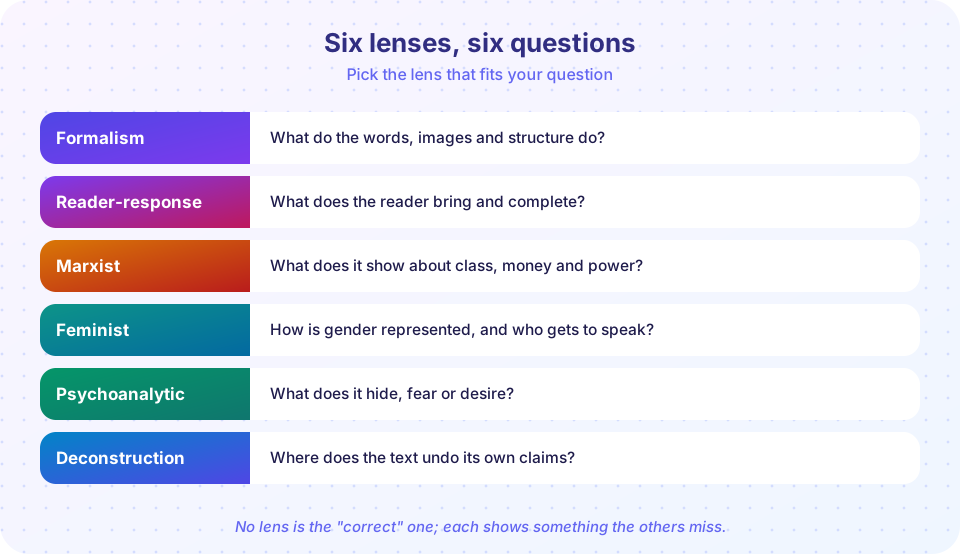
Recap Chapter 7 with a summary of six critical lenses and their guiding questions, a lens-matching game, a comparison table and a ten-question quiz.
This chapter introduced a lot of names. The aim now is not to memorize them but to be able to say, for each approach, what question it asks and what it is good at noticing. If you can do that, you can pick the right lens for a text and explain your choice in an essay.
What you will learn
- A one-line question for each major critical approach.
- A comparison of strengths and blind spots.
- How well you can match a question or concept to its lens.
The chapter in a table
| Approach | Core question | Key names | Best at | Blind spot |
|---|---|---|---|---|
| Formalism and New Criticism | What do the words and form do? | Shklovsky, Richards, Brooks, Wimsatt | Close reading, patterns, irony | History, authors and politics |
| Structuralism | What system of conventions makes this meaningful? | Saussure, Propp, Lévi-Strauss, Genette, Barthes | Patterns across many texts | What is special in a single work |
| Reader-response | What does the reader bring and complete? | Rosenblatt, Iser, Jauss, Fish | Gaps, expectations, changing readings | Risk of relativism |
| Marxist | What does it show about class, money and ideology? | Marx, Gramsci, Williams, Eagleton, Jameson | Power and the economic context | Can reduce works to economics |
| Feminist and queer | How are gender and sexuality represented, and who speaks? | Woolf, de Beauvoir, Showalter, Gilbert and Gubar, Butler, Sedgwick | Absence, representation, voice | Early versions neglected race and class |
| Psychoanalytic | What does it hide, fear or desire? | Freud, Jung, Lacan, Kristeva, Bloom | Strange, obsessive or haunted texts | Reductive or unprovable claims |
| Deconstruction | Where does the text undo its own claims? | Derrida, de Man | Hidden binaries and unstable meaning | Charged with obscurity |
| New Historicism | How do this text and its time shape each other? | Greenblatt, Montrose, Dollimore | Linking literature to power and culture | Selective use of context |
Ideas to carry forward
- A theory is a lens, not a verdict. It focuses your attention; you still have to prove your reading from the text.
- Use evidence. Whatever the lens, a good reading points to specific words and passages.
- Combine lenses. Many of the best essays use two, such as class and gender, or form and history.
- Notice your own lens. Everyone reads from somewhere, and naming your assumptions makes your argument stronger.
- Be fair to the other side. Know the criticism of your chosen approach.
Choosing a lens
Start from your question, not from a theory. If you are puzzled by a word or a pattern of images, begin with the formalist questions. If you are puzzled by what a character is allowed to do, ask about class and gender. If the ending troubles you, ask what the text hides or what a different reader might expect. Then test the lens: does it help you notice a specific line you had missed? If it does, keep going. If you find yourself forcing the text to fit the theory, step back and change the question. A strong essay often uses one main lens and borrows a second to answer an objection, and it always keeps the evidence in front of the theory.
Common misconceptions
"There is one correct theory." The field is plural by design. Different questions need different lenses.
"Using theory means using jargon." The best critics explain ideas in clear language and use terms only when they help.
Try it
Check your understanding
Quick check · 10 questions
of 10 answered You scored / 10 · perfect!
-
1. Which lens most directly asks who holds money and power in a text?
Marxist critics examine class, economics and ideology in literature. -
2. What did Wimsatt and Beardsley call the mistake of judging a work by the author's intention?
'The Intentional Fallacy' (1946) argued the text, not the author's intention, is the object of criticism. -
3. Who wrote Literature as Exploration (1938) and described reading as a transaction?
Rosenblatt's transactional theory is an early reader-response approach. -
4. In Saussure's terms, what is the 'signified'?
The signifier is the form; the signified is the concept. -
5. Which of these is a typical feminist critical question?
Feminist criticism asks about representation, voice and the conditions of women's writing. -
6. Which concept belongs to psychoanalytic criticism?
Repression, dreamwork and the uncanny are Freudian ideas used by psychoanalytic critics. Base and superstructure belong to Marxism. -
7. What does Derrida's différance combine?
The coined word suggests meaning arises from difference and is always deferred. -
8. How do New Historicists treat non-literary documents?
They read legal, medical, travel and political texts together with literature. -
9. Which is the best use of a theory in an essay?
A lens is valuable when it helps you notice something in the words on the page. -
10. A common criticism of reader-response approaches is:
Critics ask how to distinguish better readings from worse; theorists reply with textual constraints or interpretive communities.
Summary
- Each approach asks a distinct question and notices distinct things; none is final.
- Combine lenses, ground claims in evidence and know the criticisms of your chosen approach.
- Next, you will turn these reading skills into writing: building a literary argument.
Track your progress
Create a free account to tick off lessons and pick up where you left off on any device.
of Introduction to Literature lessons completed