


















Lesson 2 of 47 · Getting Started
What is literature?
Explore what makes a text literature: craft, imagination, endurance and interpretation. Meet oral epics, novels and poems, and learn four ways to think about meaning.
Ask ten people what literature is and you will get ten answers. Some will say "old books." Some will say "the stuff we study in school." Others will say "writing that moves you." All of these answers contain a grain of truth, and none of them is enough. This lesson does not hand you a single definition to memorize. It gives you a set of useful questions, so you can decide for yourself whether a text rewards the kind of attention this course teaches.
What you will learn
- Why literature is hard to define, and four features that most definitions share.
- How oral and written traditions fit together.
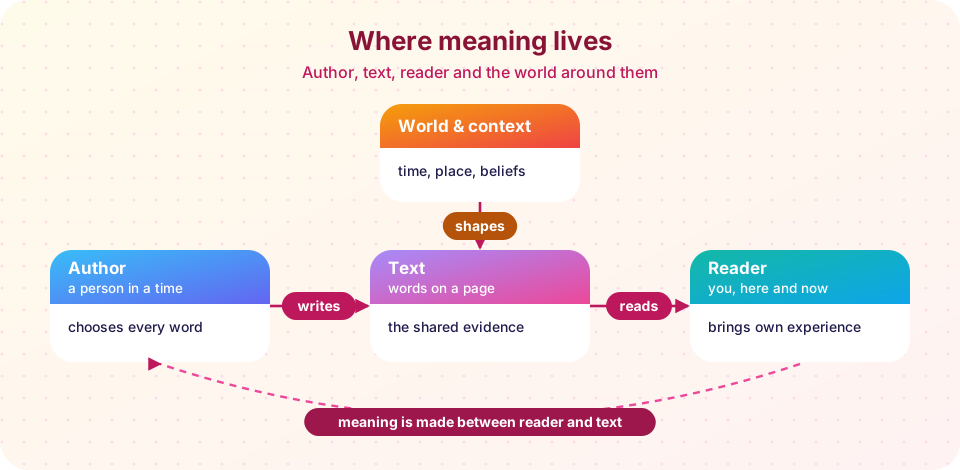
- The four elements any discussion of a work draws on: author, text, reader and world.
- Why the canon changes, and what "world literature" adds.
- How to test a text with the questions of craft, interpretation and endurance.
Key terms
Literature is imaginative or artistically shaped language, written or spoken, that rewards close attention and repeated reading.
Literariness is the quality of language that draws attention to itself, a term used by Russian Formalist critics in the early twentieth century.
Oral tradition is the passing of stories, poems and songs by speaking and memory rather than writing.
Canon is a body of works regarded as authoritative or important by a culture or institution.
Context is the historical, social and personal circumstances around a text.
Where the word comes from
The English word "literature" comes from the Latin littera, "letter." For a long time it meant simply "knowledge gained from books." Only in the eighteenth and nineteenth centuries did it narrow to mean imaginative writing such as poems, plays and novels. That history is a clue: the boundaries of literature have always been drawn by people, and different people draw them in different places.
Four features most definitions share
No single test sorts every text into "literature" and "not literature," but four features come up again and again.
1. Craft. Literary texts are shaped with care. The writer chooses words for sound, rhythm and suggestion as well as for information. In 1921 the linguist Roman Jakobson argued that the subject of literary study should be "literariness," the features that make a verbal work a work of art, such as rhythm, imagery and the foregrounding of the words themselves. When you read "It is a truth universally acknowledged, that a single man in possession of a good fortune, must be in want of a wife" (Jane Austen, Pride and Prejudice, 1813), the sentence tells you something about marriage and money, but it also performs a joke. The grand, official phrase "a truth universally acknowledged" is followed by a claim that is anything but universal. The craft is part of the content.
2. Imagination. Literature often builds worlds that are not literally true: characters who never lived, speakers who are not the author, events that never happened. Yet it can tell us true things about people. A novel can be "invented" and still be accurate about jealousy. Nonfiction can also be literature when it shapes real experience with the tools of imagination, as in a memoir or an essay.
3. Openness to interpretation. A weather report has one job: to be understood the same way by everyone. A literary text usually allows several defensible readings. Is the speaker of a poem sincere or ironic? Is a ghost real or imagined? That openness is not a flaw. It is why people keep rereading.
4. Endurance and rereading. Many works we call literature keep their power after centuries, though some admired works fade and some forgotten ones are rediscovered. A good test is whether a text gives you something new the second or third time.
Oral and written literature
Literature did not begin with printing, or even with writing. Long before texts were written down, communities told stories, sang epics and recited poems from memory. The Iliad and the Odyssey, attributed to Homer and set down in Greek around the eighth century BCE or a little later, grew out of oral performance. The Epic of Gilgamesh, from ancient Mesopotamia, survives on clay tablets, with the oldest versions about four thousand years old. The Indian epic Mahabharata took shape over many centuries. In West Africa, griots (hereditary storytellers and musicians) have preserved histories in spoken and sung form. Chinua Achebe's novel Things Fall Apart (1958) draws on Igbo oral proverbs as part of its style.
This matters for how you read. Oral literature leans on repetition, rhythm and fixed phrases that help memory and please the ear. Those habits survive in written poetry and even in prose. When a modern poem repeats a line or a story uses the rule of three, it is using techniques that oral storytellers perfected.
The canon, and what it leaves out
Schools often teach a canon, a list of works that experts consider essential. A canon is useful because it gives a shared set of references: you see how later writers answer earlier ones. But canons are made by institutions, and they reflect who held power. For centuries the Western school canon was dominated by men writing in a handful of European languages. Women writers, writers from Asia, Africa and the Americas, and writers whose work circulated orally were often overlooked.
"World literature" is the answer to that narrowness. It includes works such as Murasaki Shikibu's The Tale of Genji (early eleventh century, Japan), often called the first novel, One Thousand and One Nights (a collection of stories from the Arab world and beyond), Miguel de Cervantes's Don Quixote (1605, Spain), and the many twentieth-century voices who wrote against colonial rule. Reading in translation raises a question you will meet again: part of what you read is the translator's art, not only the author's.
Four elements in every conversation about a work
In his 1953 book The Mirror and the Lamp, the critic M. H. Abrams described four elements that any theory of art must account for: the work itself, the artist who made it, the audience who receives it, and the universe, meaning the world it represents. The illustration above uses plainer words for the same idea.
- Author: what did the writer intend, and what were their circumstances?
- Text: what do the words, structure and images actually do?
- Reader: what do you bring, and how might other readers respond differently?
- World and context: what was happening when the work was written, and what is happening now?
Different approaches in this course lean on different corners of the diagram. Close reading concentrates on the text. Historical criticism looks at the world. Reader-response criticism stresses the reader. You will meet them in the chapters on theory. For now, notice that a rich discussion usually touches all four.
A quick test for any text
When you are unsure whether to treat a text as literature, ask three questions.
- Craft: Can I point to choices in the language that go beyond plain information?
- Interpretation: Is there something here that thoughtful readers could discuss or disagree about?
- Return: Would I get something new from reading it again?
A shopping list fails all three. A lullaby, a song lyric, a graphic novel or a speech might pass them. The point of the test is not to build walls but to decide what kind of attention a text deserves.
Common misconceptions
"Literature means old and difficult." Literature is being written today, in every language, and much of it is easy to read. Difficulty is not a measure of quality.
"Literature is true because it is beautiful." Beautiful writing can mislead. Part of reading well is asking whether a text's picture of the world is fair, including whose voices it leaves out.
"The author's intention is the meaning." Authors matter, but a text can mean more than its author saw. A work also changes as readers and times change.
Try it
Statistics cannot decide what literature is, but they can show you how texts differ. Then try the sorting exercise, which has no single right answer.
Press Run (or Ctrl + Enter) to see the console output here.
No output.
Check your understanding
Quick check · 5 questions
of 5 answered You scored / 5 · perfect!
-
1. Which of these is NOT one of the four features discussed in the lesson?
Age is not a feature of literature. Literature is being written today. -
2. What did Roman Jakobson mean by 'literariness'?
Jakobson argued that literary study should focus on what makes language artistic, such as rhythm, imagery and attention to the words themselves. -
3. Why do canons deserve questions?
Canons are useful for shared reference, but they are chosen by people and have often left out women, non-European writers and oral traditions. -
4. Which pair names two of the four elements in Abrams's framework?
Abrams described work, artist, audience and universe. -
5. What is a good reason to reread a text?
Rereading is the main method of close reading: later readings reveal patterns.
Summary
- "Literature" has no single agreed definition; its boundaries have shifted over time.
- Four common features are craft, imagination, openness to interpretation and endurance.
- Oral traditions came first and still shape written literature.
- Canons are made by people and institutions; world literature widens the view.
- Discussions of a work draw on author, text, reader and world.
- Test a text by asking about craft, interpretation and whether it rewards a return.
Next: Genres and forms
Track your progress
Create a free account to tick off lessons and pick up where you left off on any device.
of Introduction to Literature lessons completed