


















Lesson 4 of 47 · Getting Started
How to read actively
Learn a practical routine for reading poems, stories and plays: preview, annotate, ask questions, read aloud and summarize, with a worked example on a short poem by William Blake.
Passive reading is when your eyes move across the page and nothing sticks. Active reading is a conversation: you ask the text questions, mark what surprises you and make small predictions that the next lines confirm or overturn. It sounds like extra work, but it makes difficult texts easier, because you always know what you are looking for. This lesson gives you a simple routine you can use on every text in the course.
What you will learn
- A four-step routine: preview, read, annotate, reflect.
- A small set of annotation marks and how to keep them consistent.
- Good questions to ask while reading.
- How to handle old language, long sentences and hard passages.
- Why reading aloud helps with poems and plays.
Key terms
Annotation is a note, mark or comment made on or about a text while reading.
Paraphrase is a restatement of a passage in your own plainer words.
Prediction is a guess about what comes next, made on the basis of clues in the text.
Context clue is a hint in the surrounding words that helps you understand an unfamiliar word.
Close reading is slow attention to the details of language and structure.
Step 1: Preview
Before you read the first line, look at what surrounds it. Who wrote it, and when? What is the title? How long is the text, and in what form: a poem, a story, a scene from a play? A few seconds of previewing gives you a frame. A title can be a clue by itself: a poem called "The Sick Rose" is probably not just about gardening.
Educators have recommended this kind of surveying for a long time. Francis Robinson's study method SQ3R, published in 1946, begins with "survey" and "question" before "read, recite, review." You do not need to memorize the method. Keep its core idea: arrive with questions.
Step 2: Read for the experience
On the first read, do not stop to look things up. Let the text work on you. Notice your reactions. If you are confused, keep going for a page; many confusions clear up. Afterward, jot down one sentence: "I felt unsettled" or "I was lost in the middle but loved the ending." That sentence is your starting point. It is data about the text's effect, and later you will explain what in the text produced it.
Step 3: Annotate on the second read
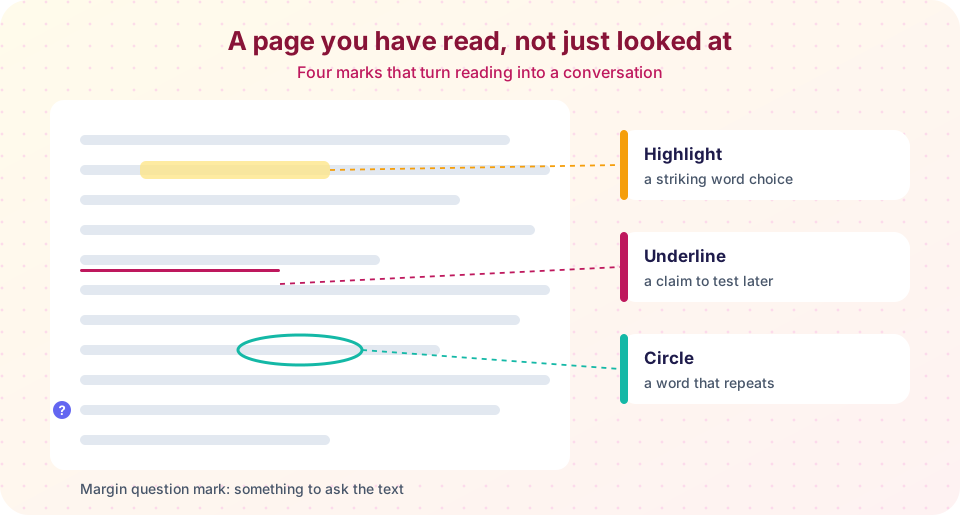
On the second read, take a pencil and mark the page. Consistency matters more than any particular symbols. Here is a simple set.
| Mark | Use it for |
|---|---|
| Highlight | a striking word, phrase or image |
| Underline | a key claim, turning point or sentence you may quote |
| Circle | a word or idea that repeats |
? in the margin |
something confusing, odd or surprising |
! in the margin |
a moment of strong feeling or insight |
| Arrow | a link between two parts of the text |
| Margin note | a short comment: why this matters |
Do not highlight everything. A page that is entirely yellow tells you nothing. Aim for no more than a handful of marks per page, and make most of your notes questions or connections rather than copies of the text.
Good questions to ask
- Who is speaking, and to whom? Can I trust this voice?
- What changes between the beginning and the end?
- Why this word, and not a plainer one?
- Where and when does it happen, and does that matter?
- What repeats, contrasts or surprises?
- How does the form (line breaks, chapters, stage directions) shape my reading?
A worked example
Read this short poem by William Blake, published in 1794 in Songs of Experience. It is in the public domain.
O Rose, thou art sick!
The invisible worm,
That flies in the night,
In the howling storm,
Has found out thy bed
Of crimson joy,
And his dark secret love
Does thy life destroy.
First read, for the experience. The poem is short and feels sinister. Something is attacking a flower. You may not know yet why it feels like more than gardening.
Second read, annotating. A reader might mark the following.
- "sick" in the first line: a human word applied to a plant. This is personification, treating the rose as if it could be ill.
- "invisible worm": the attacker cannot be seen. Worms do not fly, so this is a strange creature, not an ordinary pest. Margin question: what is it?
- "crimson joy": a bright color joined to an emotion. Is the rose a symbol of something alive and passionate?
- "dark secret love": love destroys the rose. That is a contradiction worth circling, because love is normally good. Margin note: love that harms.
Third read, for an argument. From these marks a reader could build the claim: "Blake's poem suggests that love can be destructive when it is secret and possessive." Notice the process. The claim grows out of marked details, not out of a guess. Other readers might argue the rose stands for a person, for innocence, or for society itself. Each reading must come back to the words. You can practice this kind of reasoning in Chapter 2.
Handling difficult language
Older texts and dense poems can feel like a wall. A few habits help.
- Read aloud. Sound carries meaning. Poems and plays especially were made to be heard. Reading aloud forces you to notice rhythm, punctuation and where a sentence really ends.
- Paraphrase line by line. Restate each sentence in your own words. If you cannot, mark it with a question mark and come back.
- Follow the grammar, not the line breaks. In poetry a sentence often runs across several lines. Find the subject and the verb. In Blake's poem, the sentence beginning "The invisible worm" does not reach its verb ("Has found out") until line five.
- Use context clues before a dictionary. If a word is unfamiliar, guess from the sentence, then check. For old texts, a good dictionary may show that a word meant something different then. "Nice" once meant "foolish" or "precise," and "gay" meant "cheerful."
- Do not let one hard word stop you. Mark it and keep going; the passage often explains itself.
Keep a reading stamina
Reading a novel is like running a long race. Set a steady pace, read in the same quiet place, and stop at a natural break. If you have to read a long book in a fixed time, divide the pages by the days you have, and leave a spare day. You will do this arithmetic in the exercise below.
Common misconceptions
"Active reading means marking everything." Marking everything is the same as marking nothing. Be selective.
"If I need a dictionary, I am a poor reader." Skilled readers look things up all the time, especially in older texts and in translation.
"Annotation should happen on the first read." Stopping constantly can ruin the experience. Read once for the feel, then annotate on the second pass.
Try it
Practice marking Blake's poem on the screen, then work out a realistic reading plan for a long book.
Press Run (or Ctrl + Enter) to see the console output here.
No output.
Check your understanding
Quick check · 5 questions
of 5 answered You scored / 5 · perfect!
-
1. When should you annotate in the routine described?
The first read protects the experience; the second adds marks and questions. -
2. Which annotation mark is best for a word that repeats?
Circling repeated words helps you spot patterns later. -
3. In 'O Rose, thou art sick!' the poem treats a flower as if it were ill like a person. This is
Giving human traits, here sickness, to a nonhuman thing is personification. -
4. Why read poems and plays aloud?
Poems and plays were made to be heard, so voice reveals what silent scanning can miss. -
5. What is a good first move when you meet an unfamiliar word?
Context clues and a quick mark keep you moving; check the word afterward.
Summary
- Active reading is a conversation: preview, read, annotate, reflect.
- Read once for experience, a second time with a pencil, a third time to build an argument.
- Use a few consistent marks and favor questions and connections over copying.
- Paraphrase, follow the grammar across line breaks, read aloud and use context clues for hard passages.
- Claims should grow out of marked details in the text.
Next: Chapter 1 review
Track your progress
Create a free account to tick off lessons and pick up where you left off on any device.
of Introduction to Literature lessons completed