


















Lesson 25 of 47 · Drama
Shakespeare and the Elizabethan Stage
How Shakespeare's plays were staged at the Globe, why words did the work of scenery, how verse and prose differ, and what soliloquies and asides do for an audience.
William Shakespeare (1564 to 1616) wrote for a particular kind of building, a particular kind of audience and a particular group of actors. That is not a limitation. His plays use the physical facts of that theatre so skillfully that you can almost see the stage inside the poetry. When you read Hamlet or Macbeth on the page, you are reading a script written by someone who also acted, who knew the company, and who knew exactly how far a voice would carry on an afternoon in London.
This lesson takes you into the playhouse, explains how scenery, verse and soliloquy worked, and shows how a thoughtful reader can recover some of that theatre from the printed text.
What you will learn
- How an open-air playhouse such as the Globe worked and who sat or stood where.
- Why Shakespeare's language does the job of scenery.
- The difference between verse and prose, and how to hear iambic pentameter.
- How soliloquy and aside open a character's mind to the audience.
Key terms
- Thrust stage: a stage that projects into the audience, so people watch from three sides.
- Groundlings: audience members who stood in the yard, in front of the stage.
- Blank verse: unrhymed iambic pentameter, the main line of Shakespeare's plays.
- Iambic pentameter: a line of ten syllables in five pairs, each pair a weak beat then a strong beat.
- Soliloquy: a character's solo speech in which thoughts are spoken aloud to the audience.
The playhouse
In the 1570s, England's first permanent public playhouses opened just outside the city of London. The Theatre, built by James Burbage in 1576, was followed by the Rose and others. Shakespeare's own company, first called the Lord Chamberlain's Men and, after 1603, the King's Men, built the Globe in 1599 on the south bank of the Thames, reusing timber from the dismantled Theatre. The Globe burned down in 1613 when a cannon fired during a performance of Henry VIII set the thatch alight. It was rebuilt in 1614.
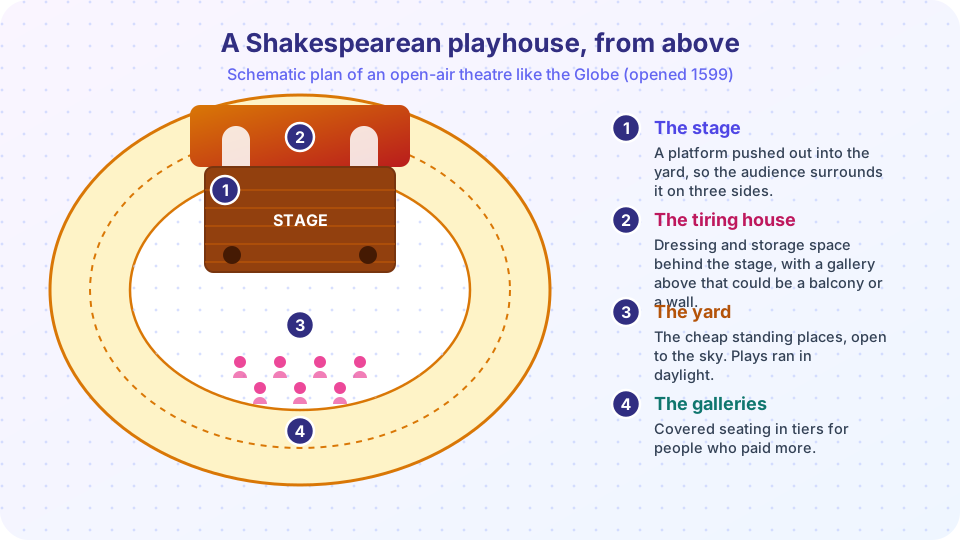
An open-air playhouse of this kind was roughly circular or polygonal. A large raised platform stage pushed forward into an open yard. Standing in the yard, for about a penny, were the groundlings. Around the walls were covered galleries with seats, which cost more. A building behind the stage, the tiring house (from "attire"), served as a dressing area and had doors for entrances and a gallery above that could serve as a balcony, a castle wall or a window. Capacity estimates run to several thousand people, so the actors had to speak powerfully and clearly.
Performances took place in the afternoon, by daylight, so there was no darkness to hide anything. Another venue, the indoor Blackfriars theatre, was used by Shakespeare's company from about 1608 and was lit by candles. Shakespeare's late plays, such as The Tempest, are often linked to the possibilities of that indoor stage.
Women did not perform on the public stage. Boys played the female roles, and in a play like Twelfth Night this produces a layered joke: a boy actor plays a woman, Viola, who disguises herself as a young man, Cesario. Critics still discuss how an audience that knew the convention reacted to such plays.
Words as scenery
There was little painted scenery. Props such as a throne, a bed, a tomb or a table could be carried on. Everything else, place, time of day, weather and mood, was supplied by language. Henry V's Chorus asks the audience to imagine armies inside "this wooden O", acknowledging the very building they sit in. This is not a weakness of the stage; it is a technique. Audiences listen actively, imagining what the words describe.
Think about the opening of Hamlet, which is set at night on a castle battlement. The first characters do not point to the cold. A guard says it is bitterly cold and that he is sick at heart, and the audience knows the place, the weather and the mood before anything has happened. In Macbeth the villain, before a murder, speaks of the light thickening and the crow making wing to the rooky wood. We learn it is dusk, and that the world itself seems to be turning sinister. Notice that no lighting designer is needed; the line is the lighting design.
When you read a Shakespeare speech, ask: what is this speech telling the audience that they cannot see? Place, time, an entrance, a feeling, a change of plan, a piece of backstory: it is often all in the words.
Verse and prose
Most of Shakespeare's serious and noble speech is in blank verse: unrhymed lines of iambic pentameter. An iamb is a weak syllable followed by a strong one (da-DUM). Five of them make ten syllables:
But SOFT, what LIGHT through YON-der WIN-dow BREAKS?
This rhythm is close to natural English speech, which is why it can sound both formal and conversational. Shakespeare often varies it. The line To BE, or NOT to BE, that IS the QUES-tion has eleven syllables, with an extra weak ending, and it is no less powerful for that. When the pattern breaks, listen for the reason: a character may be confused, angry, or breaking a rule.
Shakespeare also uses:
- Rhyming couplets, often to close a scene or give a speech a neat, final ring.
- Prose, typically for comic characters, ordinary people, letters, and sometimes for madness or intimacy. This is a tendency, not a rule: nobles speak prose and clowns sometimes speak verse. Switching between the two can mark a shift in tone or status, and sometimes the shift itself is the joke.
- Songs, from fools and spirits, in comedies and late plays.
Soliloquy and aside
The soliloquy is Shakespeare's tool for inwardness. When Hamlet asks whether to be or not to be, he is not talking to anybody on stage; he is thinking, and we hear him think. In a theatre with a thrust stage, the actor stands close to the audience, which creates unusual intimacy. By the end of a great soliloquy we know something that the other characters do not.
A soliloquy does not always mean honesty. Villains such as Iago in Othello or Richard in Richard III speak to the audience directly to boast about their plans, which makes us co-conspirators and uneasy about our own pleasure. An aside does the same thing more briefly: a sharp remark to the audience while others are talking.
Genres in the First Folio
The First Folio (1623), put together by Shakespeare's fellow actors seven years after his death, groups the plays as comedies, histories and tragedies. It is a useful rough map:
- Comedies, such as A Midsummer Night's Dream and Twelfth Night, move through confusion and disguise toward reconciliation.
- Histories, such as Henry V and Richard III, dramatize English kings and the cost of power.
- Tragedies, such as Hamlet, Othello, King Lear and Macbeth, follow a ruler or a person of high standing toward catastrophe, often with a strong link to the Aristotelian ideas you met in the previous lesson, but with much more freedom in time, place and tone.
Some plays escape the labels: The Winter's Tale, Cymbeline and The Tempest are often called romances or tragicomedies, and the famous stage direction "Exit, pursued by a bear" comes from the first of these.
"Shakespeare's language is too difficult for ordinary people." His first audiences included people who could not read. They understood the plays by ear, helped by action and context. Reading aloud and watching a performance are the best entry points.
"Everything is in verse." Many scenes, and roughly a third of some plays, are in prose.
"The plays are fixed texts." Several plays survive in more than one early version, such as the quarto and Folio texts of Hamlet and King Lear, and editors choose among them. Even the words of the plays have a history.
Try it
Check your understanding
Quick check · 5 questions
of 5 answered You scored / 5 · perfect!
-
1. Where did the groundlings stand at the Globe?
The groundlings stood in the open yard, the cheapest place, while the covered galleries had seats for those who paid more. -
2. Why did Shakespeare's language have to supply scenery?
With a thrust stage, daylight and minimal sets, words told the audience where and when the action took place. -
3. Which description fits iambic pentameter?
An iamb is a weak-strong pair, and a pentameter line has five of them, usually ten syllables. -
4. Which is a common use of prose in Shakespeare?
Prose is often used for comic characters and everyday speech, though it is a tendency and not a rule. -
5. What did boy actors do in Shakespeare's theatre?
Women did not perform on the public stage, so boys played the female roles.
Summary
- Shakespeare wrote for open-air playhouses, with a thrust stage, a standing yard, galleries and a tiring house.
- Boy actors played women, and plays ran in daylight, so words supplied time, place and mood.
- Blank verse (iambic pentameter) is the main line, with prose for comic and ordinary speech and rhyme for finishing touches.
- Soliloquy and aside open a character's mind to the audience, which can create sympathy or complicity.
- The First Folio groups the plays as comedies, histories and tragedies, with some late plays escaping the labels.
Next: Modern Drama
Track your progress
Create a free account to tick off lessons and pick up where you left off on any device.
of Introduction to Literature lessons completed