


















Lesson 14 of 47 · Poetry
Poetic forms: sonnet, ballad, haiku and more
Meet the major fixed forms of poetry, including the sonnet, ballad, haiku, limerick, villanelle and ode, and learn how to read a Shakespeare sonnet's rhyme scheme and turn.
A form is a pattern a poem agrees to follow: a number of lines, a rhyme scheme, a meter, a repeated line, a set of syllable counts. Why would a poet accept such rules? Because a pattern is like a game board. It creates expectations, and the tension between the pattern and the poet's meaning produces much of the pleasure. When a rhyme lands exactly as you hoped, you feel satisfaction; when it is withheld, you feel the surprise. This lesson introduces the most important forms and shows how to read what they do.
What you will learn
- How to read a rhyme scheme and label it with letters.
- The structure and the turn (volta) of the Shakespearean and Petrarchan sonnets.
- The ballad, the limerick, the villanelle, the ode and the elegy.
- What a haiku is, and how English haiku differ from Japanese ones.
- Why poets choose forms, and how to say what a form does.
Key terms
Rhyme scheme is the pattern of end rhymes, written with letters: ABAB means lines 1 and 3 rhyme, and lines 2 and 4 rhyme.
Sonnet is a fourteen-line poem, usually in iambic pentameter, with a set rhyme scheme and a turn.
Volta is the "turn" in a sonnet, where the argument or feeling changes direction.
Couplet is two consecutive lines that rhyme; quatrain is four lines; tercet is three; octave is eight; sestet is six.
Refrain is a repeated line or phrase.
Reading a rhyme scheme
To label a rhyme scheme, give the first end sound the letter A. Each new end sound gets the next letter, and a repeated sound reuses its letter. Take the four-line stanza "Twinkle, twinkle, little star, / How I wonder what you are! / Up above the world so high, / Like a diamond in the sky." The first two lines rhyme and the last two rhyme, so the scheme is AABB. If lines one and three rhyme and lines two and four rhyme, it is ABAB.
The sonnet
The sonnet is probably the most famous fixed form in Western poetry. It began in thirteenth-century Italy, and the fourteenth-century poet Petrarch made it famous. Sir Thomas Wyatt and Henry Howard, Earl of Surrey, brought it to English in the sixteenth century. It has fourteen lines, usually in iambic pentameter, and there are two main versions.
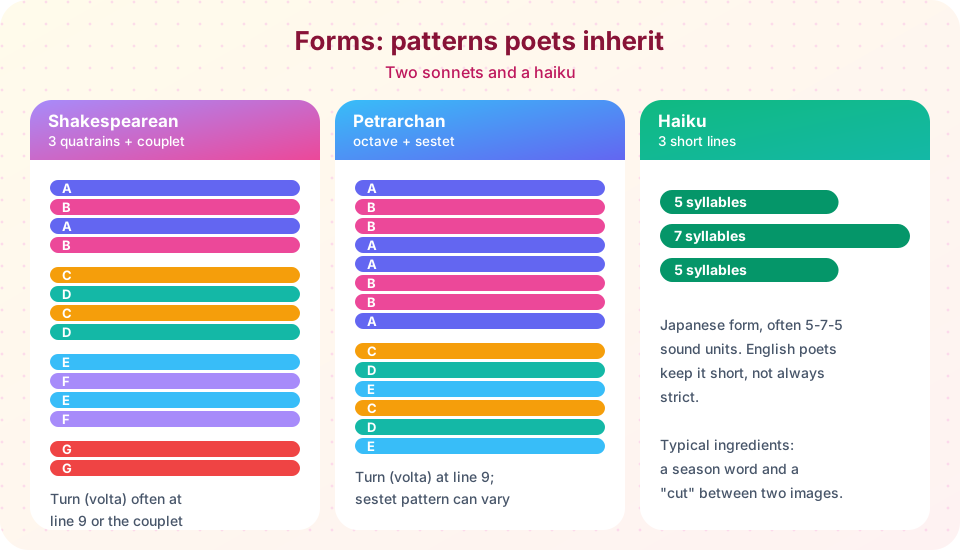
The Petrarchan (Italian) sonnet splits into an octave (eight lines rhymed ABBAABBA) and a sestet (six lines, often CDECDE or CDCDCD). The octave poses a problem or describes a situation; at line nine the volta turns, and the sestet answers or reflects.
The Shakespearean (English) sonnet has three quatrains and a couplet: ABAB CDCD EFEF GG. Each quatrain develops an idea, and the final couplet often delivers a punchy conclusion or a twist. The turn commonly falls at line nine, at the start of the third quatrain, or at the couplet.
Reading Sonnet 18
Here is Shakespeare's Sonnet 18, published in 1609 and in the public domain.
Shall I compare thee to a summer's day?
Thou art more lovely and more temperate:
Rough winds do shake the darling buds of May,
And summer's lease hath all too short a date;
Sometime too hot the eye of heaven shines,
And often is his gold complexion dimm'd;
And every fair from fair sometime declines,
By chance or nature's changing course untrimm'd;
But thy eternal summer shall not fade,
Nor lose possession of that fair thou ow'st;
Nor shall death brag thou wander'st in his shade,
When in eternal lines to time thou grow'st:
So long as men can breathe or eyes can see,
So long lives this, and this gives life to thee.
Rhyme scheme. The pattern is ABAB CDCD EFEF GG: day/May, temperate/date; shines/declines, dimm'd/untrimm'd; fade/shade, ow'st/grow'st; see/thee.
Structure. In the first quatrain, the speaker asks whether to compare his beloved to summer, and decides the beloved is "more lovely and more temperate." The second quatrain lists summer's flaws: too hot, too dim, too changeable. Then comes the volta at line nine: "But thy eternal summer shall not fade." The beloved, unlike summer, will not decline. The third quatrain explains why: not even death will take the beloved, because the poem itself preserves them "in eternal lines."
The couplet. "So long as men can breathe or eyes can see, / So long lives this, and this gives life to thee." This is the claim of the poem: as long as there are readers, the poem and its subject survive. The form carries the argument: question, complaints, turn, proof, conclusion. Notice that the poem boasts about itself as much as about its subject, a clever twist that readers still debate.
Other fixed forms
The ballad tells a story in four-line stanzas, usually alternating four-stress and three-stress lines with rhymes on lines two and four (ABCB). It began as an oral form, sung by traveling performers, and uses repetition and dramatic dialogue. Samuel Taylor Coleridge wrote a long literary ballad, "The Rime of the Ancient Mariner" (1798).
The limerick is a five-line comic verse with the rhyme scheme AABBA. Edward Lear popularized it in A Book of Nonsense (1846). One of his begins:
There was an Old Man with a beard,
Who said, 'It is just as I feared!—
Two Owls and a Hen,
Four Larks and a Wren,
Have all built their nests in my beard!'
The rhythm is bouncy, with long A-lines and short B-lines, and the punchline sits in the last line.
The villanelle has nineteen lines: five tercets and a final quatrain, with two refrain lines that alternate and come together at the end. The rhyme scheme is ABA ABA ABA ABA ABA ABAA. Its looping repetition suits obsession and grief; Dylan Thomas's "Do not go gentle into that good night" (1951) is a famous modern example (it is still in copyright, so look it up in a library or authorized anthology).
The ode is a long, serious poem addressed to a person or thing: John Keats's "Ode to a Nightingale" and "To Autumn" are classics. The elegy mourns the dead: Gray's "Elegy Written in a Country Churchyard" meditates on ordinary lives. The epic is a long narrative poem about heroes, such as the Odyssey or Milton's Paradise Lost.
Concrete (shape) poetry arranges words into a picture. George Herbert's "Easter Wings" (1633) is printed so that the lines widen and narrow like a pair of wings.
The haiku
The haiku is a Japanese form, traditionally three lines of five, seven and five sound units (called on, which are not exactly English syllables). Matsuo Bashō (1644 to 1694) made it a great art. Classic haiku usually include a kigo, a word that signals a season, and a kireji, a "cutting word" that creates a pause between two images. Bashō's most famous poem, in a plain English rendering, goes something like: an old pond; a frog jumps in; the sound of water. Notice the effect: a still scene, a sudden action, a ripple of sound and then silence.
English-language poets often write haiku with seventeen syllables, but many now prefer shorter, looser versions, saying that English syllables are longer than Japanese sound units. What matters is the heart of the form: a small, precise image, a moment of attention and a turn between two things.
Why choose a form?
When you read a form, ask three questions.
- What does the form promise? (a quick joke, a tightly argued thought, a looping obsession)
- Where does the poem follow the pattern, and where does it break it? Breaks matter.
- How does the form match or clash with the subject? A cheerful rhyme scheme used for a bleak subject creates irony. A rigid form can express control, or the effort to keep control.
Common misconceptions
"A sonnet must be about love." Most early sonnets were, but sonnets have been used for politics, religion, war and humor.
"A haiku is just 5-7-5." The syllable count is the surface. The deeper features are a seasonal reference, a cut and a focus on a concrete moment.
"Fixed forms are old-fashioned." Poets keep using and bending them. The pattern gives a place to push against.
Try it
Let code detect the rhyme scheme of Sonnet 18, then chart the length of its lines.
Press Run (or Ctrl + Enter) to see the console output here.
No output.
Press Run (or Ctrl + Enter) to see the result here.
Program input · what you'd type while the program runs
Type the answers before you press Run, one per line. Each time the program reads a line (with input()), it gets the next line from this box.
Check your understanding
Quick check · 5 questions
of 5 answered You scored / 5 · perfect!
-
1. What is the rhyme scheme of a Shakespearean sonnet?
Three quatrains plus a couplet: ABAB CDCD EFEF GG. -
2. What is the volta?
The volta is the turn, often at line nine or in the couplet. -
3. Which form has five lines and the scheme AABBA?
The limerick is a five-line comic form rhymed AABBA. -
4. What do traditional haiku usually include?
The kigo (season word) and kireji (cutting word) are core features. -
5. What does the final couplet of Sonnet 18 claim?
As long as people breathe and read, the poem lives and gives life to the subject.
Summary
- A form is a pattern of lines, rhyme, meter or repetition; rhyme schemes are labeled with letters.
- The Petrarchan sonnet has an octave and sestet; the Shakespearean has three quatrains and a couplet; both have a volta.
- Other forms include the ballad, limerick, villanelle, ode, elegy, epic and concrete poem.
- The haiku is built on a small image, a season word and a cut.
- Ask what a form promises, where the poem breaks it, and how it matches the subject.
Track your progress
Create a free account to tick off lessons and pick up where you left off on any device.
of Introduction to Literature lessons completed