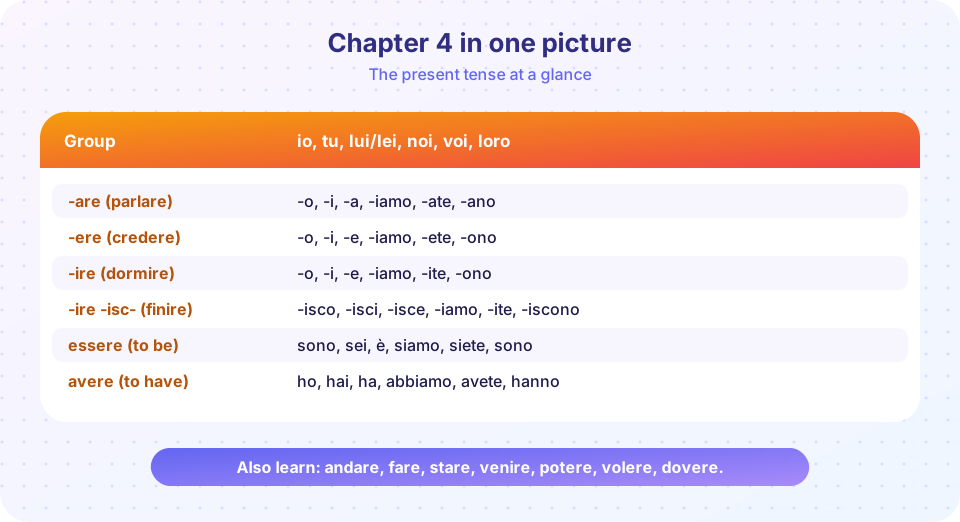
Review Chapter 4: the Italian present tense of regular verbs, essere and avere, and the main irregular verbs, with a recap table, reading text and ten-question test.
You have reached the end of the first half of the course. With the present tense you can now say what people are, have, do and want. This is the grammar that carries nearly every real conversation, so it is worth reviewing carefully before moving on to daily life in the next chapter.
This page gives you a one-picture summary, a recap table, a reading text to analyze, and a ten-question test.
Chapter 4 in one picture: the endings of the three families, the -isc- verbs, and the two key verbs.
-o, -i, -a, -iamo, -ate, -ano. Stress on the stem except noi and voi. Cercare → cerchi, pagare → paghiamo, mangiare → mangi. No preposition after ascoltare, guardare, cercare, aspettare.
Read this text aloud. Then find every verb, name its person and its family. The answer list follows.
Mi chiamo Marta e abito a Bologna. Ho due gatti e una casa piccola. Lavoro in una scuola: sono insegnante. Ogni giorno prendo il treno, leggo un libro e ascolto la musica. La sera cucino la pasta, guardo un film e finisco il lavoro. Il sabato esco con gli amici, ma la domenica resto a casa e dormo molto.
Translation: My name is Marta and I live in Bologna. I have two cats and a small house. I work in a school: I am a teacher. Every day I take the train, read a book and listen to music. In the evening I cook pasta, watch a film and finish my work. On Saturdays I go out with friends, but on Sundays I stay at home and sleep a lot.
All the verbs are in the first person singular (io):
abito (abitare, -are), lavoro (lavorare, -are), ascolto (ascoltare, -are), cucino (cucinare, -are), guardo (guardare, -are), resto (restare, -are).
prendo (prendere, -ere), leggo (leggere, -ere).
dormo (dormire, -ire, no -isc-), finisco (finire, -ire with -isc-).
ho (avere), sono (essere), esco (uscire, irregular).
The verb mi chiamo belongs to chiamarsi (to be called), a reflexive verb that you will meet properly in Chapter 5.
<style>*{box-sizing:border-box}body{margin:0;padding:14px;font-family:system-ui,'Segoe UI',Arial,sans-serif;background:linear-gradient(135deg,#faf5ff,#eff6ff);color:#1e1b4b}.wrap{max-width:640px;margin:0 auto}.card{background:#fff;border-radius:20px;box-shadow:0 10px 24px rgba(67,56,202,.15);padding:18px}.big{font-size:30px;font-weight:700;color:#312e81;text-align:center;min-height:44px;margin:14px 0 4px}.sub{font-size:16px;color:#64748b;text-align:center;min-height:22px}.row{display:flex;gap:8px;flex-wrap:wrap;justify-content:center;margin-top:14px}button{font:inherit;font-weight:600;border:0;border-radius:999px;padding:9px 16px;cursor:pointer;color:#fff;background:linear-gradient(135deg,#6366f1,#a78bfa)}button.alt{background:#eef2ff;color:#3730a3}button.ok{background:linear-gradient(135deg,#10b981,#14b8a6)}button:disabled{opacity:.5;cursor:default}.meta{font-size:14px;color:#6366f1;text-align:center;margin-bottom:4px}.opt{display:block;width:100%;text-align:left;margin:8px 0;background:#eef2ff;color:#1e1b4b;border-radius:14px;padding:11px 14px}.opt.good{background:#d1fae5;color:#064e3b}.opt.bad{background:#fee2e2;color:#7f1d1d}.fb{min-height:24px;margin-top:10px;font-weight:600;text-align:center}input[type=text]{font:inherit;width:100%;padding:11px 14px;border:2px solid #c7d2fe;border-radius:14px;margin-top:10px;background:#fff;color:#1e1b4b}table{border-collapse:collapse;width:100%;margin-top:10px}td,th{padding:8px 10px;text-align:left;border-bottom:1px solid #e0e7ff;font-size:16px}th{color:#4f46e5;font-size:14px;text-transform:uppercase;letter-spacing:.04em}.mt{margin-top:10px}</style><divclass="wrap"><divclass="card"><divclass="meta"id="meta">Click an Italian word, then its English meaning.</div><divstyle="display:flex;gap:14px"><divid="L"style="flex:1"></div><divid="R"style="flex:1"></div></div><divclass="fb"id="fb"></div><divclass="row"><buttonclass="alt"id="re">Shuffle again</button></div></div></div><script>constP=[["vado","I go"],["ho fame","I am hungry"],["capisco","I understand"],["possiamo","we can"],["dormono","they sleep"],["fai","you do"]];const$=id=>document.getElementById(id);let selL=null,matched=0;functionsh(a){a=a.slice();for(let i=a.length-1;i>0;i--){const k=Math.floor(Math.random()*(i+1));[a[i],a[k]]=[a[k],a[i]];}return a;}functionbuild(){$('L').innerHTML='';$('R').innerHTML='';selL=null;matched=0;$('fb').textContent='';sh(P.map((_,i)=>i)).forEach(i=>{const b=document.createElement('button');b.className='opt';b.textContent=P[i][0];b.dataset.i=i;b.onclick=()=>{if(b.disabled)return;[...$('L').children].forEach(x=>x.style.outline='');b.style.outline='3px solid #6366f1';selL=b;};$('L').appendChild(b);});sh(P.map((_,i)=>i)).forEach(i=>{const b=document.createElement('button');b.className='opt';b.textContent=P[i][1];b.dataset.i=i;b.onclick=()=>{if(b.disabled||!selL)return;if(selL.dataset.i===b.dataset.i){selL.classList.add('good');b.classList.add('good');selL.disabled=true;b.disabled=true;selL.style.outline='';selL=null;matched++;$('fb').style.color='#047857';$('fb').textContent=matched===P.length?'All matched. Bravo!':'Match!';}else{b.classList.add('bad');setTimeout(()=>b.classList.remove('bad'),500);$('fb').style.color='#b91c1c';$('fb').textContent='No, try another one.';}};$('R').appendChild(b);});}$('re').onclick=build;build();</script>
Second, translate full sentences.
Translate the sentences
<style>*{box-sizing:border-box}body{margin:0;padding:14px;font-family:system-ui,'Segoe UI',Arial,sans-serif;background:linear-gradient(135deg,#faf5ff,#eff6ff);color:#1e1b4b}.wrap{max-width:640px;margin:0 auto}.card{background:#fff;border-radius:20px;box-shadow:0 10px 24px rgba(67,56,202,.15);padding:18px}.big{font-size:30px;font-weight:700;color:#312e81;text-align:center;min-height:44px;margin:14px 0 4px}.sub{font-size:16px;color:#64748b;text-align:center;min-height:22px}.row{display:flex;gap:8px;flex-wrap:wrap;justify-content:center;margin-top:14px}button{font:inherit;font-weight:600;border:0;border-radius:999px;padding:9px 16px;cursor:pointer;color:#fff;background:linear-gradient(135deg,#6366f1,#a78bfa)}button.alt{background:#eef2ff;color:#3730a3}button.ok{background:linear-gradient(135deg,#10b981,#14b8a6)}button:disabled{opacity:.5;cursor:default}.meta{font-size:14px;color:#6366f1;text-align:center;margin-bottom:4px}.opt{display:block;width:100%;text-align:left;margin:8px 0;background:#eef2ff;color:#1e1b4b;border-radius:14px;padding:11px 14px}.opt.good{background:#d1fae5;color:#064e3b}.opt.bad{background:#fee2e2;color:#7f1d1d}.fb{min-height:24px;margin-top:10px;font-weight:600;text-align:center}input[type=text]{font:inherit;width:100%;padding:11px 14px;border:2px solid #c7d2fe;border-radius:14px;margin-top:10px;background:#fff;color:#1e1b4b}table{border-collapse:collapse;width:100%;margin-top:10px}td,th{padding:8px 10px;text-align:left;border-bottom:1px solid #e0e7ff;font-size:16px}th{color:#4f46e5;font-size:14px;text-transform:uppercase;letter-spacing:.04em}.mt{margin-top:10px}</style><divclass="wrap"><divclass="card"><divclass="meta"id="meta"></div><divclass="big"style="font-size:24px"id="p"></div><divclass="sub"id="h"></div><inputtype="text"id="in"autocomplete="off"autocapitalize="off"spellcheck="false"placeholder="Type your answer in Italian"><divclass="row"><buttonid="chk">Check</button><buttonclass="alt"id="nx">Next</button></div><divclass="fb"id="fb"></div></div></div><script>constITEMS=[["I speak Italian","parlo italiano"],["We eat pasta","mangiamo la pasta|mangiamo pasta"],["She reads a book","legge un libro"],["They understand","capiscono"],["I have a cat","ho un gatto"],["He is tired","è stanco"],["I would like a coffee","vorrei un caffè"],["We go to the cinema","andiamo al cinema"]];let i=0,score=0,tried=false;const$=id=>document.getElementById(id);conststrip=s=>s.normalize('NFD').replace(/[\u0300-\u036f]/g,'');constnorm=s=>s.trim().toLowerCase().replace(/\s+/g,' ');functionshow(){const it=ITEMS[i];$('meta').textContent='Item '+(i+1)+' of '+ITEMS.length+' | score: '+score;$('p').textContent=it[0];$('h').textContent=it[2]||'';$('in').value='';$('fb').textContent='';tried=false;$('in').focus();}functioncheck(){const it=ITEMS[i];const a=norm($('in').value);if(!a)return;const ok=norm(it[1]).split('|');if(ok.includes(a)){if(!tried)score++;$('fb').style.color='#047857';$('fb').textContent='Correct: '+it[1].split('|')[0];tried=true;}elseif(ok.map(strip).includes(strip(a))){$('fb').style.color='#b45309';$('fb').textContent='Right letters, but check the accent: '+it[1].split('|')[0];tried=true;}else{$('fb').style.color='#b91c1c';$('fb').textContent='Not yet. Try again, or press Next to see the answer.';tried=true;}$('meta').textContent='Item '+(i+1)+' of '+ITEMS.length+' | score: '+score;}$('chk').onclick=check;$('in').onkeydown=e=>{if(e.key==='Enter')check();};$('nx').onclick=()=>{if(!$('fb').textContent.startsWith('Correct')){$('fb').style.color='#475569';$('fb').textContent='Answer: '+ITEMS[i][1].split('|')[0]+' (press Next again to continue)';if(!$('nx').dataset.s){$('nx').dataset.s='1';return;}}$('nx').dataset.s='';i=(i+1)%ITEMS.length;show();};show();</script>
Third, test your knowledge of the rules.
Quick verb check
<style>*{box-sizing:border-box}body{margin:0;padding:14px;font-family:system-ui,'Segoe UI',Arial,sans-serif;background:linear-gradient(135deg,#faf5ff,#eff6ff);color:#1e1b4b}.wrap{max-width:640px;margin:0 auto}.card{background:#fff;border-radius:20px;box-shadow:0 10px 24px rgba(67,56,202,.15);padding:18px}.big{font-size:30px;font-weight:700;color:#312e81;text-align:center;min-height:44px;margin:14px 0 4px}.sub{font-size:16px;color:#64748b;text-align:center;min-height:22px}.row{display:flex;gap:8px;flex-wrap:wrap;justify-content:center;margin-top:14px}button{font:inherit;font-weight:600;border:0;border-radius:999px;padding:9px 16px;cursor:pointer;color:#fff;background:linear-gradient(135deg,#6366f1,#a78bfa)}button.alt{background:#eef2ff;color:#3730a3}button.ok{background:linear-gradient(135deg,#10b981,#14b8a6)}button:disabled{opacity:.5;cursor:default}.meta{font-size:14px;color:#6366f1;text-align:center;margin-bottom:4px}.opt{display:block;width:100%;text-align:left;margin:8px 0;background:#eef2ff;color:#1e1b4b;border-radius:14px;padding:11px 14px}.opt.good{background:#d1fae5;color:#064e3b}.opt.bad{background:#fee2e2;color:#7f1d1d}.fb{min-height:24px;margin-top:10px;font-weight:600;text-align:center}input[type=text]{font:inherit;width:100%;padding:11px 14px;border:2px solid #c7d2fe;border-radius:14px;margin-top:10px;background:#fff;color:#1e1b4b}table{border-collapse:collapse;width:100%;margin-top:10px}td,th{padding:8px 10px;text-align:left;border-bottom:1px solid #e0e7ff;font-size:16px}th{color:#4f46e5;font-size:14px;text-transform:uppercase;letter-spacing:.04em}.mt{margin-top:10px}</style><divclass="wrap"><divclass="card"><divclass="meta"id="meta"></div><divid="q"style="font-size:19px;font-weight:700;margin:8px 0"></div><divid="opts"></div><divclass="fb"id="fb"></div><divclass="row"><buttonid="next"disabled>Next question</button></div></div></div><script>constITEMS=[{"q":"Which verb adds -isc- in the present tense?","options":["partire","finire","dormire"],"a":1,"why":"Finire is an -isc- verb: finisco."},{"q":"What is the 'tu' form of 'pagare'?","options":["pagi","paghi","paghe"],"a":1,"why":"Before i, -gare adds h: tu paghi."},{"q":"Choose the right verb: '___ venti anni.' (I am twenty)","options":["Sono","Ho","Sto"],"a":1,"why":"Age uses avere: ho venti anni."},{"q":"Which form is the 'loro' form of 'andare'?","options":["vanno","andano","vano"],"a":0,"why":"Andare is irregular: vanno."}];let i=0,score=0,done=false;const$=id=>document.getElementById(id);functionshow(){const it=ITEMS[i];done=false;$('meta').textContent='Question '+(i+1)+' of '+ITEMS.length+' | score: '+score;$('q').textContent=it.q;$('opts').innerHTML='';$('fb').textContent='';$('next').disabled=true;
it.options.forEach((o,k)=>{const b=document.createElement('button');b.className='opt';b.textContent=o;b.onclick=()=>pick(k,b);$('opts').appendChild(b);});}functionpick(k,b){if(done)return;done=true;const it=ITEMS[i];const bs=$('opts').children;if(k===it.a){score++;b.classList.add('good');$('fb').textContent='Correct! '+it.why;}else{b.classList.add('bad');bs[it.a].classList.add('good');$('fb').textContent='Not quite. '+it.why;}$('meta').textContent='Question '+(i+1)+' of '+ITEMS.length+' | score: '+score;$('next').disabled=false;$('next').textContent=i===ITEMS.length-1?'See result':'Next question';}$('next').onclick=()=>{if(i===ITEMS.length-1){$('q').textContent='Finished: '+score+' out of '+ITEMS.length;$('opts').innerHTML='';$('fb').textContent=score===ITEMS.length?'Perfetto!':'Try again to improve your score.';$('next').textContent='Start again';i=-1;score=0;$('next').onclick=()=>{$('next').onclick=null;location.reload();};return;}i++;show();};show();</script>