Master Italian consonants: hard and soft c and g, ch and gh, gli, gn, sc, z, s, r, the silent h, and why double consonants change the meaning of words.
Most Italian consonants sound like the English ones you already know: b, d, f, l, m, n, p, t, v. A few need attention, but they follow strict rules. This lesson teaches the rules for the letters that cause the most trouble: the two sounds of c and g, the special groups gli, gn and sc, the letters z, s, r and h, and the double consonants that Italians cannot do without.
The good news is that, unlike English, Italian has no "exceptions on every page". With about ten spelling patterns you can read nearly every word correctly on the first try.
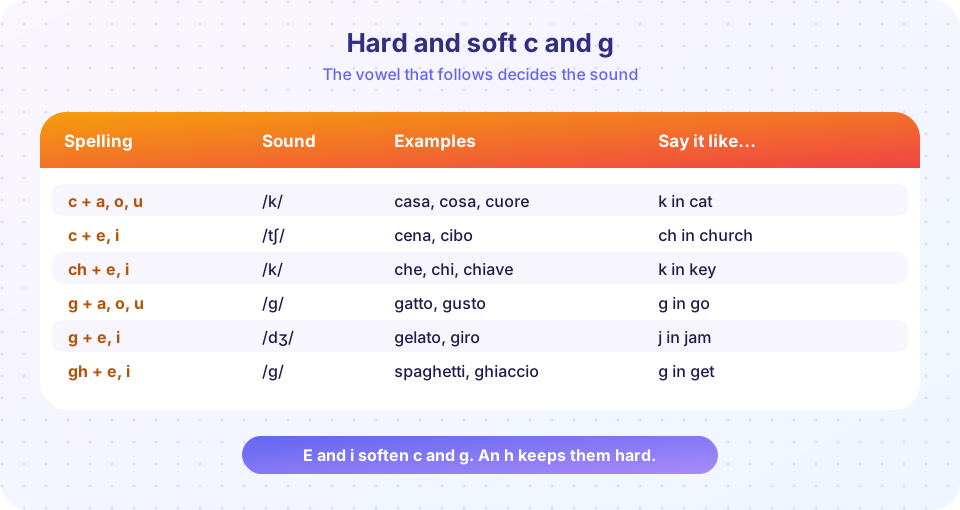
The vowel after c or g decides the sound: e and i soften it, and an h keeps it hard.
The letter c has two sounds, and the vowel that comes next chooses between them.
Before a, o, u (or a consonant), c is hard, /k/: casa (house), cosa (thing), cuore (heart), crema (cream).
Before e or i, c is soft, /tʃ/, like the ch in church: cena (dinner), cibo (food), cinema (cinema), amici (friends, masculine).
To keep the hard /k/ before e or i, Italian adds an h: che (what, that), chi (who), chiave (key), pochi (few), amiche (friends, feminine). The h is silent; it only changes the sound of the c.
And to get a soft sound before a, o, u, Italian adds a silent i: ciao (hi), cioccolato (chocolate), ciuccio (pacifier). The i in ci + vowel is usually not pronounced separately.
Before a, o, u: hard /g/, like g in go: gatto (cat), gonna (skirt), gusto (taste).
Before e, i: soft /dʒ/, like j in jam: gelato (ice cream), giro (tour), gentile (kind), pagina (page).
With an h, hard again before e, i: spaghetti, ghiaccio (ice), lunghe (long, feminine plural).
With a silent i, soft before a, o, u: giorno (day), giacca (jacket), giugno (June).
These patterns also explain a small spelling change in verbs and plurals, which you will meet later: amico → amici (the sound stays /k/ in the singular and becomes /tʃ/ in the plural), but amica → amiche (the h keeps the /k/ sound). Think of it as a rule to remember: the sound stays, the spelling adapts. The same happens with lungo → lunghi.
A memory hook: e and i are soft, h makes hard, i before a, o, u is just a helper. Say it out loud with ciao - che - gelato - spaghetti and the whole system is in your mouth.
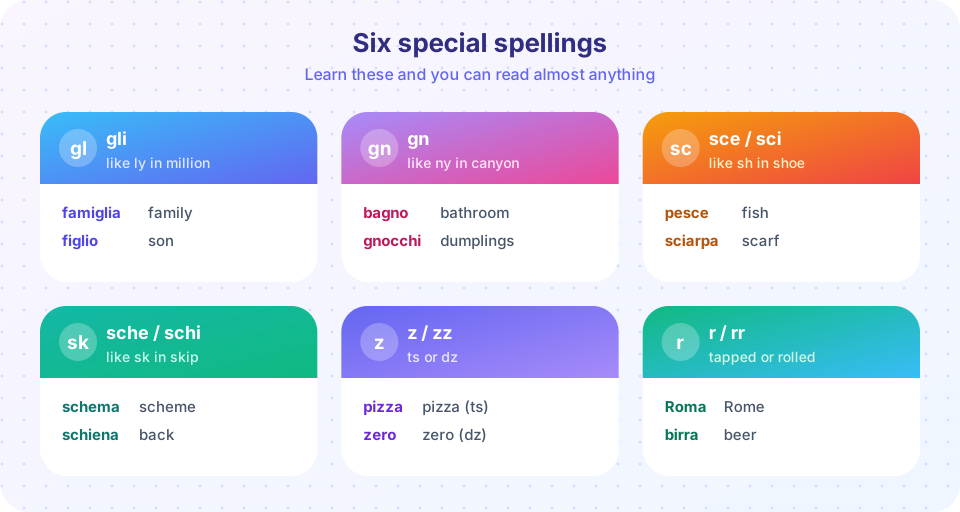
Six spellings that look odd at first and soon become automatic.
gli /ʎ/ sounds like the lli in million. Say famiglia (fa-MEE-lya), figlio (FEE-lyo), aglio (AH-lyo, garlic), meglio (MEH-lyo, better). In gli followed by a vowel, the i is part of the group and not heard separately. A few words, such as glicine (wisteria), keep a hard g + l. When gli stands alone, it is the article "the" for some plural nouns (gli amici).
gn /ɲ/ sounds like the ny in canyon or the Spanish ñ: bagno (BAH-nyo), gnocchi (NYOK-kee), lasagna, ogni (every).
sc has two sounds, by the same e/i rule: before e or i it is /ʃ/, like sh in shoe: pesce (PEH-sheh, fish), scena, sciare (to ski), sciarpa (scarf). Before a, o, u or h it is /sk/: scuola (school), scala (stairs), scusi (excuse me), and with the h before e/i, schema, schiena (back), scherzo (joke).
An important detail: between vowels, the sounds gli, gn and sc (as /ʃ/) are always long, as if they were doubled, even though only one group is written. Famiglia sounds like fa-MEE-llya, with a long ly, bagno like BAH-nnyo with the ny held, and pesce like PESH-she.
z is /ts/ or /dz/, and there is no simple rule for which one: pizza (PEET-tsa), grazie (GRAH-tsyeh), zio (TSEE-o, uncle) use /ts/; zero (DZEH-ro) and mezzo (MED-dzo, half) use /dz/. Dictionaries mark it. In speech both are acceptable to learners, and the difference will rarely cause a misunderstanding. Double zz is long.
s is /s/ at the start of a word, doubled, or next to a voiceless consonant (sole, rosso, sport). Between two vowels or before a voiced consonant, standard (northern-influenced) pronunciation uses /z/: casa /ˈkaza/, rosa /ˈroza/, sbagliato (wrong). In many parts of southern Italy people say /s/ in all those places, and that is fine.
r is never the English r. A single r is a quick tap of the tongue tip against the ridge behind the upper teeth, like the tt in American English butter or water. A double rr is a trill, a longer vibration. Caro (dear) has a tap, carro (cart) has a trill. Practice by saying "butter" fast several times and keeping only the flicking sound. Do not worry if the trill takes weeks; a tap everywhere is understood.
q is always followed by u, and the group is pronounced /kw/: quando (when), questo (this), quadro (picture). Double q is written cq: acqua (AHK-kwa, water). The group cu + vowel is also often /kw/: cuore (KWOH-reh).
h is silent in every Italian word. It appears in four forms of the verb avere (ho, hai, ha, hanno), in ch and gh, and in a few foreign words like hotel.
In Italian a double consonant is not a spelling decoration. It changes the length of the sound, and the length changes the word. Here are some pairs:
Single
Meaning
Double
Meaning
pala
shovel
palla
ball
caro
dear, expensive
carro
cart
sete
thirst
sette
seven
nono
ninth
nonno
grandfather
pena
pity, sorrow
penna
pen
casa
house
cassa
cash register, crate
How to say a double: hold the consonant for about twice as long, and shorten the vowel before it. For palla, say pal, pause the tongue on the roof of the mouth for a moment, and then release into la. For nonno, hold the n sound (non-no). For double b, g, d (and cc, gg before e or i), you make a tiny stop, then the release: faccia (face, FAT-cha), peggio (worse, PED-jo), ebbene.
Any consonant can be doubled except h and q (the double q is written cq). English speakers often forget this, and they also tend to double consonants where Italian has just one. Read carefully: anno (year) is not ano; mamma (mum) is not mama; tutto (everything) is not tuto.
First, run the sound splitter on tricky spellings. It prints the sounds of each word (in IPA and with an English-style respelling). The tool knows only spelling rules, so it does not show stress, and it displays z as "ts/dz". Add your own words and run it again.
JS
Sounds of tricky spellings
// Italian letters-to-sounds splitter (a teaching model, not a full phonetic engine)constVOWELS="aeiouàèéìòóù";constisV=c=> c !==undefined&& c !==""&&VOWELS.includes(c);constisFront=c=> c !==undefined&& c !==""&&"eiéèì".includes(c);constSAY={a:"ah",e:"eh",i:"ee",o:"oh",u:"oo","tʃ":"ch","dʒ":"j","ʃ":"sh","ʎ":"ly","ɲ":"ny","ttʃ":"tch","ddʒ":"dj","kw":"kw","ts/dz":"ts/dz"};constPLAIN={à:"a",è:"e",é:"e",ì:"i",ò:"o",ó:"o",ù:"u"};functionsounds(word){const w = word.toLowerCase().normalize("NFC");const out =[];let i =0;while(i < w.length){const c = w[i], n = w[i +1]||"", n2 = w[i +2]||"";if(isV(c)){ out.push(PLAIN[c]|| c); i++;continue;}let ipa =null, len =1;if(c ==="h"){ i++;continue;}if(c ==="c"&& n ==="q"&& n2 ==="u"){ ipa ="kkw"; len =3;}elseif(c ==="c"&& n ==="c"&& n2 ==="h"){ ipa ="kk"; len =3;}elseif(c ==="c"&& n ==="c"&&isFront(n2)){ ipa ="ttʃ"; len =2;}elseif(c ==="c"&& n ==="c"){ ipa ="kk"; len =2;}elseif(c ==="g"&& n ==="g"&& n2 ==="h"){ ipa ="gg"; len =3;}elseif(c ==="g"&& n ==="g"&&isFront(n2)){ ipa ="ddʒ"; len =2;}elseif(c ==="g"&& n ==="g"){ ipa ="gg"; len =2;}elseif(c ==="z"&& n ==="z"){ ipa ="ts/dz"; len =2;}elseif(c === n &&!isV(c)){ ipa = c + c; len =2;}elseif(c ==="c"&& n ==="h"){ ipa ="k"; len =2;}elseif(c ==="g"&& n ==="h"){ ipa ="g"; len =2;}elseif(c ==="s"&& n ==="c"&&isFront(n2)){ ipa ="ʃ"; len =2;}elseif(c ==="c"&&isFront(n)){ ipa ="tʃ"; len =1;}elseif(c ==="c"){ ipa ="k";}elseif(c ==="g"&& n ==="l"&& n2 ==="i"){ ipa ="ʎ"; len =2;}elseif(c ==="g"&& n ==="n"){ ipa ="ɲ"; len =2;}elseif(c ==="g"&&isFront(n)){ ipa ="dʒ";}elseif(c ==="g"){ ipa ="g";}elseif(c ==="q"&& n ==="u"){ ipa ="kw"; len =2;}elseif(c ==="z"){ ipa ="ts/dz";}else{ ipa = c;}
out.push(ipa);
i += len;// a silent i after a soft c, g, sc or gl when another vowel follows: ciao, giorno, sciare, figlioif(["tʃ","dʒ","ʃ","ʎ","ttʃ","ddʒ"].includes(ipa)&& w[i]==="i"&&isV(w[i +1])) i++;}return out;}functionshow(word){const s =sounds(word);
console.log(word.padEnd(12), s.join(" ").padEnd(22), s.map(x=>SAY[x]|| x).join("-"));}const words =["cena","chiave","gelato","ghiaccio","pesce","schiena","gnocchi","famiglia","bagno","quando","acqua","pizza"];for(const w of words)show(w);
Press Run (or Ctrl + Enter) to see the console output here.
No output.
Second, check your reading rules on common words.
Hard or soft?
<style>*{box-sizing:border-box}body{margin:0;padding:14px;font-family:system-ui,'Segoe UI',Arial,sans-serif;background:linear-gradient(135deg,#faf5ff,#eff6ff);color:#1e1b4b}.wrap{max-width:640px;margin:0 auto}.card{background:#fff;border-radius:20px;box-shadow:0 10px 24px rgba(67,56,202,.15);padding:18px}.big{font-size:30px;font-weight:700;color:#312e81;text-align:center;min-height:44px;margin:14px 0 4px}.sub{font-size:16px;color:#64748b;text-align:center;min-height:22px}.row{display:flex;gap:8px;flex-wrap:wrap;justify-content:center;margin-top:14px}button{font:inherit;font-weight:600;border:0;border-radius:999px;padding:9px 16px;cursor:pointer;color:#fff;background:linear-gradient(135deg,#6366f1,#a78bfa)}button.alt{background:#eef2ff;color:#3730a3}button.ok{background:linear-gradient(135deg,#10b981,#14b8a6)}button:disabled{opacity:.5;cursor:default}.meta{font-size:14px;color:#6366f1;text-align:center;margin-bottom:4px}.opt{display:block;width:100%;text-align:left;margin:8px 0;background:#eef2ff;color:#1e1b4b;border-radius:14px;padding:11px 14px}.opt.good{background:#d1fae5;color:#064e3b}.opt.bad{background:#fee2e2;color:#7f1d1d}.fb{min-height:24px;margin-top:10px;font-weight:600;text-align:center}input[type=text]{font:inherit;width:100%;padding:11px 14px;border:2px solid #c7d2fe;border-radius:14px;margin-top:10px;background:#fff;color:#1e1b4b}table{border-collapse:collapse;width:100%;margin-top:10px}td,th{padding:8px 10px;text-align:left;border-bottom:1px solid #e0e7ff;font-size:16px}th{color:#4f46e5;font-size:14px;text-transform:uppercase;letter-spacing:.04em}.mt{margin-top:10px}</style><divclass="wrap"><divclass="card"><divclass="meta"id="meta"></div><divid="q"style="font-size:19px;font-weight:700;margin:8px 0"></div><divid="opts"></div><divclass="fb"id="fb"></div><divclass="row"><buttonid="next"disabled>Next question</button></div></div></div><script>constITEMS=[{"q":"How is 'cinema' pronounced at the start?","options":["k-","ch-","s-"],"a":1,"why":"C before i is soft: /tʃ/, as in CHEE-neh-mah."},{"q":"How is 'chiave' (key) pronounced at the start?","options":["ch-","sh-","k-"],"a":2,"why":"The ch before i is hard /k/: KYAH-veh. The h keeps the c hard."},{"q":"What is the sound of 'gn' in 'bagno'?","options":["like ny in canyon","like n then g","like g in go"],"a":0,"why":"Gn is /ɲ/, as in BAH-nyo, a long ny sound."},{"q":"How do you pronounce 'sc' in 'pesce'?","options":["sk","sh","s-c"],"a":1,"why":"Sc before e or i is /ʃ/, like sh: PEH-sheh."},{"q":"Which word has a hard g?","options":["gelato","giro","spaghetti"],"a":2,"why":"In spaghetti, gh keeps the g hard. Gelato and giro have a soft g before e or i."},{"q":"'Palla' means ball. What does 'pala' mean?","options":["pen","shovel","thirst"],"a":1,"why":"Pala is a shovel. Single versus double l changes the word."}];let i=0,score=0,done=false;const$=id=>document.getElementById(id);functionshow(){const it=ITEMS[i];done=false;$('meta').textContent='Question '+(i+1)+' of '+ITEMS.length+' | score: '+score;$('q').textContent=it.q;$('opts').innerHTML='';$('fb').textContent='';$('next').disabled=true;
it.options.forEach((o,k)=>{const b=document.createElement('button');b.className='opt';b.textContent=o;b.onclick=()=>pick(k,b);$('opts').appendChild(b);});}functionpick(k,b){if(done)return;done=true;const it=ITEMS[i];const bs=$('opts').children;if(k===it.a){score++;b.classList.add('good');$('fb').textContent='Correct! '+it.why;}else{b.classList.add('bad');bs[it.a].classList.add('good');$('fb').textContent='Not quite. '+it.why;}$('meta').textContent='Question '+(i+1)+' of '+ITEMS.length+' | score: '+score;$('next').disabled=false;$('next').textContent=i===ITEMS.length-1?'See result':'Next question';}$('next').onclick=()=>{if(i===ITEMS.length-1){$('q').textContent='Finished: '+score+' out of '+ITEMS.length;$('opts').innerHTML='';$('fb').textContent=score===ITEMS.length?'Perfetto!':'Try again to improve your score.';$('next').textContent='Start again';i=-1;score=0;$('next').onclick=()=>{$('next').onclick=null;location.reload();};return;}i++;show();};show();</script>
Third, drill the minimal pairs. Say each Italian word aloud, holding the double consonants.
Single or double?
<style>*{box-sizing:border-box}body{margin:0;padding:14px;font-family:system-ui,'Segoe UI',Arial,sans-serif;background:linear-gradient(135deg,#faf5ff,#eff6ff);color:#1e1b4b}.wrap{max-width:640px;margin:0 auto}.card{background:#fff;border-radius:20px;box-shadow:0 10px 24px rgba(67,56,202,.15);padding:18px}.big{font-size:30px;font-weight:700;color:#312e81;text-align:center;min-height:44px;margin:14px 0 4px}.sub{font-size:16px;color:#64748b;text-align:center;min-height:22px}.row{display:flex;gap:8px;flex-wrap:wrap;justify-content:center;margin-top:14px}button{font:inherit;font-weight:600;border:0;border-radius:999px;padding:9px 16px;cursor:pointer;color:#fff;background:linear-gradient(135deg,#6366f1,#a78bfa)}button.alt{background:#eef2ff;color:#3730a3}button.ok{background:linear-gradient(135deg,#10b981,#14b8a6)}button:disabled{opacity:.5;cursor:default}.meta{font-size:14px;color:#6366f1;text-align:center;margin-bottom:4px}.opt{display:block;width:100%;text-align:left;margin:8px 0;background:#eef2ff;color:#1e1b4b;border-radius:14px;padding:11px 14px}.opt.good{background:#d1fae5;color:#064e3b}.opt.bad{background:#fee2e2;color:#7f1d1d}.fb{min-height:24px;margin-top:10px;font-weight:600;text-align:center}input[type=text]{font:inherit;width:100%;padding:11px 14px;border:2px solid #c7d2fe;border-radius:14px;margin-top:10px;background:#fff;color:#1e1b4b}table{border-collapse:collapse;width:100%;margin-top:10px}td,th{padding:8px 10px;text-align:left;border-bottom:1px solid #e0e7ff;font-size:16px}th{color:#4f46e5;font-size:14px;text-transform:uppercase;letter-spacing:.04em}.mt{margin-top:10px}</style><divclass="wrap"><divclass="card"><divclass="meta"id="meta"></div><divclass="big"id="front"></div><divclass="sub"id="back"></div><divclass="row"><buttonclass="alt"id="prev">Back</button><buttonid="flip">Show English</button><buttonid="next">Next</button></div><divclass="row"><buttonclass="alt"id="shuf">Shuffle</button><buttonclass="alt"id="say">Listen (if your browser can)</button><buttonclass="ok"id="got">I knew it</button></div><divclass="fb"id="fb"></div></div></div><script>constDATA=[["pala","shovel","PAH-lah"],["palla","ball","PAHL-lah"],["caro","dear, expensive","KAH-ro"],["carro","cart","KAR-ro"],["sete","thirst","SEH-teh"],["sette","seven","SET-teh"],["nono","ninth","NOH-no"],["nonno","grandfather","NON-no"],["pena","pity","PEH-nah"],["penna","pen","PEN-nah"],["casa","house","KAH-zah"],["cassa","cash register","KAHS-sah"]];let order=DATA.map((_,i)=>i),pos=0,shown=false,known=newSet();const$=id=>document.getElementById(id);functiondraw(){const c=DATA[order[pos]];$('meta').textContent='Card '+(pos+1)+' of '+DATA.length+' | known: '+known.size;$('front').textContent=c[0];$('back').textContent=shown?c[1]+(c[2]?' ('+c[2]+')':''):'';$('flip').textContent=shown?'Hide English':'Show English';}$('flip').onclick=()=>{shown=!shown;draw()};$('next').onclick=()=>{pos=(pos+1)%DATA.length;shown=false;$('fb').textContent='';draw()};$('prev').onclick=()=>{pos=(pos-1+DATA.length)%DATA.length;shown=false;$('fb').textContent='';draw()};$('shuf').onclick=()=>{for(let i=order.length-1;i>0;i--){const k=Math.floor(Math.random()*(i+1));[order[i],order[k]]=[order[k],order[i]];}pos=0;shown=false;draw()};$('got').onclick=()=>{known.add(order[pos]);$('fb').textContent=known.size===DATA.length?'You know them all. Bravo!':'Marked as known.';draw()};$('say').onclick=()=>{try{const u=newSpeechSynthesisUtterance(DATA[order[pos]][0]);u.lang='it-IT';speechSynthesis.cancel();speechSynthesis.speak(u);}catch(e){$('fb').textContent='Speech is not available in this preview.';}};draw();</script>