Review Italian travel phrases, directions, small talk about family and work, and customs such as tu and Lei, meals and holidays, with drills and a ten-question quiz.
You can now find your way, hold a short conversation about yourself and others, and avoid the most common cultural slips. This review puts the chapter's key phrases in one place and checks that they are ready for use. As always, speaking aloud with other people is the best practice; if you can arrange a conversation with an Italian speaker, use these dialogues as a script.
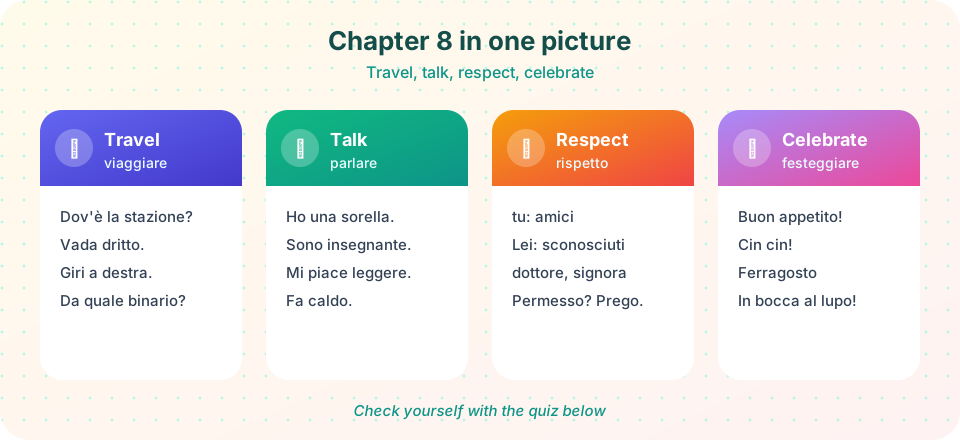
Chapter 8 in one picture: move (travel), talk (small talk), respect (formality) and celebrate (customs).
Anna: Scusi, sa dov'è il Museo Archeologico?
Passante: Sì, certo. Vada dritto fino alla piazza e poi giri a destra. È accanto alla biblioteca.
Anna: È lontano?
Passante: No, sono dieci minuti a piedi. È di qui?
Anna: No, sono americana, studio italiano da un anno.
Passante: Brava! Parla molto bene. Buona visita!
Anna: Grazie mille, arrivederci!
"Excuse me, do you know where the Archaeological Museum is?" "Yes, of course. Go straight to the square and then turn right. It is next to the library." "Is it far?" "No, it is ten minutes on foot. Are you from here?" "No, I am American, I have been studying Italian for a year." "Well done! You speak very well. Enjoy your visit!" "Thank you very much, goodbye!" Notice how Anna addresses a stranger with Scusi and Lei, and how the passer-by answers with formal imperatives (vada, giri).
Rehearse the three dialogues of the chapter: directions, a conversation with a new acquaintance and a meal. Say each one aloud twice, once as each speaker. Then change the details: a different destination, your own family and job, a different dish. If you can, record yourself and compare with the text. Finally, read the culture lesson again and note one custom that surprised you, and a phrase you could use in that situation. Combining language and culture in this way helps you remember both.
<metacharset="utf-8"><style>*{box-sizing:border-box}body{margin:0;padding:14px;font:16px system-ui,-apple-system,'Segoe UI',sans-serif;color:#1e1b4b;background:linear-gradient(135deg,#f0fdfa,#ecfeff)}.card{background:#fff;border-radius:18px;padding:18px;box-shadow:0 10px 26px rgba(13,148,136,.18)}.n{color:#0d9488;font-size:14px;font-weight:600}.q{font-size:20px;margin:10px 0;min-height:30px}.h{color:#64748b;font-size:14px;min-height:20px}input{font:inherit;padding:8px 12px;border:2px solid #99f6e4;border-radius:12px;width:min(100%,22em)}button{font:inherit;font-weight:600;border:0;border-radius:12px;padding:9px 15px;color:#fff;background:linear-gradient(135deg,#14b8a6,#6366f1);cursor:pointer;margin:4px 4px 0 0}button.alt{background:linear-gradient(135deg,#f59e0b,#ef4444)}button.ghost{background:#e0f2fe;color:#075985}.ok{color:#047857;font-weight:600}.bad{color:#b91c1c;font-weight:600}.face{min-height:120px;display:flex;align-items:center;justify-content:center;text-align:center;font-size:30px;font-weight:700;border-radius:16px;background:linear-gradient(135deg,#ccfbf1,#e0e7ff);padding:14px;cursor:pointer;margin:10px 0}.note{color:#475569;font-size:15px;min-height:22px}.cols{display:grid;grid-template-columns:1fr 1fr;gap:10px}.cols button{display:block;width:100%;margin:0 0 8px;background:#f1f5f9;color:#1e1b4b;border:2px solid #cbd5e1;text-align:left}.cols button.sel{border-color:#6366f1;background:#e0e7ff}.cols button.done{border-color:#10b981;background:#d1fae5;color:#065f46}.cols button.wrong{border-color:#ef4444;background:#fee2e2}</style><divclass="card"><divclass="n"id="n"></div><divclass="q"id="q"></div><divclass="h"id="h"></div><inputid="a"autocomplete="off"autocapitalize="off"spellcheck="false"aria-label="Your answer"><buttonid="b">Check</button><pid="m"class="note"></p></div><script>const items=[["Scusi, ___ la stazione? (where is)","dov'è",""],["___ a destra. (Lei, girare)","giri",""],["Un ___ per Napoli, per favore. (ticket)","biglietto",""],["Hai ___? (siblings)","fratelli",""],["___ fame. (I am hungry)","ho",""],["Mi ___ viaggiare. (like)","piace",""],["___ caldo oggi. (It is hot)","fa",""],["In bocca al lupo! - ___! (the reply)","crepi",""]];let i=0,score=0,checked=false;const$=id=>document.getElementById(id);constnorm=s=>s.toLowerCase().replace(/[.,;!?]/g,"").replace(/[\u2018\u2019]/g,"'").replace(/\s+/g," ").trim();conststrip=s=>norm(s).normalize("NFD").replace(/[\u0300-\u036f]/g,"");functionrender(){const it=items[i];$("n").textContent="Question "+(i+1)+" of "+items.length+" - score "+score;$("q").textContent=it[0];$("h").textContent=it[2]?"Hint: "+it[2]:"";$("a").style.display="";$("a").value="";$("m").textContent="";$("m").className="note";$("b").textContent="Check";checked=false;$("a").focus();}functionact(){if(i>=items.length){i=0;score=0;render();return}if(checked){
i++;if(i>=items.length){$("n").textContent="";$("h").textContent="";$("q").textContent="Finished! Score: "+score+" / "+items.length;$("a").style.display="none";$("m").textContent="";$("b").textContent="Try again";return}render();return;}const opts=items[i][1].split("|"),g=norm($("a").value);if(!g){return}if(opts.some(o=>norm(o)===g)){score++;$("m").className="ok";$("m").textContent="Corretto! "+opts[0]}elseif(opts.some(o=>strip(o)===strip(g))){$("m").className="bad";$("m").textContent="Almost - watch the accent: "+opts[0]}else{$("m").className="bad";$("m").textContent="Not quite. Answer: "+opts.join(" / ")}$("n").textContent="Question "+(i+1)+" of "+items.length+" - score "+score;
checked=true;$("b").textContent="Next";}$("b").onclick=act;$("a").addEventListener("keydown",e=>{if(e.key==="Enter")act()});render();</script>
A flashcard deck for the chapter.
Chapter 8 review cards
<metacharset="utf-8"><style>*{box-sizing:border-box}body{margin:0;padding:14px;font:16px system-ui,-apple-system,'Segoe UI',sans-serif;color:#1e1b4b;background:linear-gradient(135deg,#f0fdfa,#ecfeff)}.card{background:#fff;border-radius:18px;padding:18px;box-shadow:0 10px 26px rgba(13,148,136,.18)}.n{color:#0d9488;font-size:14px;font-weight:600}.q{font-size:20px;margin:10px 0;min-height:30px}.h{color:#64748b;font-size:14px;min-height:20px}input{font:inherit;padding:8px 12px;border:2px solid #99f6e4;border-radius:12px;width:min(100%,22em)}button{font:inherit;font-weight:600;border:0;border-radius:12px;padding:9px 15px;color:#fff;background:linear-gradient(135deg,#14b8a6,#6366f1);cursor:pointer;margin:4px 4px 0 0}button.alt{background:linear-gradient(135deg,#f59e0b,#ef4444)}button.ghost{background:#e0f2fe;color:#075985}.ok{color:#047857;font-weight:600}.bad{color:#b91c1c;font-weight:600}.face{min-height:120px;display:flex;align-items:center;justify-content:center;text-align:center;font-size:30px;font-weight:700;border-radius:16px;background:linear-gradient(135deg,#ccfbf1,#e0e7ff);padding:14px;cursor:pointer;margin:10px 0}.note{color:#475569;font-size:15px;min-height:22px}.cols{display:grid;grid-template-columns:1fr 1fr;gap:10px}.cols button{display:block;width:100%;margin:0 0 8px;background:#f1f5f9;color:#1e1b4b;border:2px solid #cbd5e1;text-align:left}.cols button.sel{border-color:#6366f1;background:#e0e7ff}.cols button.done{border-color:#10b981;background:#d1fae5;color:#065f46}.cols button.wrong{border-color:#ef4444;background:#fee2e2}</style><divclass="card"><divclass="n"id="n"></div><divclass="face"id="f"tabindex="0"role="button"aria-label="Flip card"></div><divclass="note"id="note"></div><buttonid="flip">Flip</button><buttonid="know"class="alt">I knew it</button><buttonid="again"class="ghost">Again later</button><buttonid="say"class="ghost">Listen</button><pclass="note"id="m"></p></div><script>const items=[["Dov'è la farmacia?","Where is the pharmacy?","Scusi, dov'è la farmacia?"],["Prenda la seconda a sinistra.","Take the second on the left.","formal imperative"],["Ho prenotato una camera.","I booked a room.","Ho prenotato una camera doppia."],["Faccio l'insegnante.","I am a teacher.","Sono insegnante also works"],["Pronto?","Hello? (phone)","answering the phone"],["Permesso?","May I?","entering, passing"],["Altrettanto!","The same to you!","reply to Buon appetito"],["Ferragosto","15 August","national holiday"]];let deck=items.map((_,k)=>k),flipped=false,known=0;const$=id=>document.getElementById(id);functionrender(){$("n").textContent="Known "+known+" of "+items.length+" - "+deck.length+" left";if(!deck.length){$("f").textContent="Tutto fatto! All cards known.";$("note").textContent="Press Again later to restart.";deck=items.map((_,k)=>k);known=0;flipped=false;return}const it=items[deck[0]];$("f").textContent=flipped?it[1]:it[0];$("note").textContent=flipped?(it[2]||""):"Tap the card to see the English.";}functionflip(){flipped=!flipped;render()}$("f").onclick=flip;$("flip").onclick=flip;$("know").onclick=()=>{deck.shift();known++;flipped=false;render()};$("again").onclick=()=>{deck.push(deck.shift());flipped=false;render()};$("say").onclick=()=>{try{if(!deck.length||!("speechSynthesis"in window)){$("m").textContent="Speech is not available in this preview.";return}const u=newSpeechSynthesisUtterance(items[deck[0]][0]);u.lang="it-IT";window.speechSynthesis.speak(u);$("m").textContent="";}catch(e){$("m").textContent="Speech is not available in this preview."}};render();</script>
A tiny phrase-picker for travel situations. It maps a need to a useful phrase; add your own entries and run it.
JS
Travel phrase picker
const phrases ={"ask the way":"Scusi, dov'è la stazione?","buy a ticket":"Un biglietto per Roma, per favore.","ask the platform":"Da quale binario parte il treno?","book a room":"Ho prenotato una camera doppia.","need help":"Mi sono perso. Può aiutarmi?","ask for the bill":"Il conto, per favore.",};for(const[need, phrase]of Object.entries(phrases)){
console.log(need.padEnd(18),"->", phrase);}
console.log("\nEmergency number in Italy and the EU: 112");
Press Run (or Ctrl + Enter) to see the console output here.