Lesson 39 of 50 · Future, Pronouns and Subjunctive Basics
Chapter 7 Review: Future, Pronouns and Subjunctive
Review the Italian future and conditional, object and reflexive pronouns and the present subjunctive with a recap table, practice drills and a ten-question quiz.
This chapter gave you four powerful tools: the future and conditional, object pronouns, reflexive verbs and the first steps of the subjunctive. Use this review to see them side by side, practice them in mixed drills and test yourself with a longer quiz. If an answer surprises you, follow the link back to the lesson that explains it.
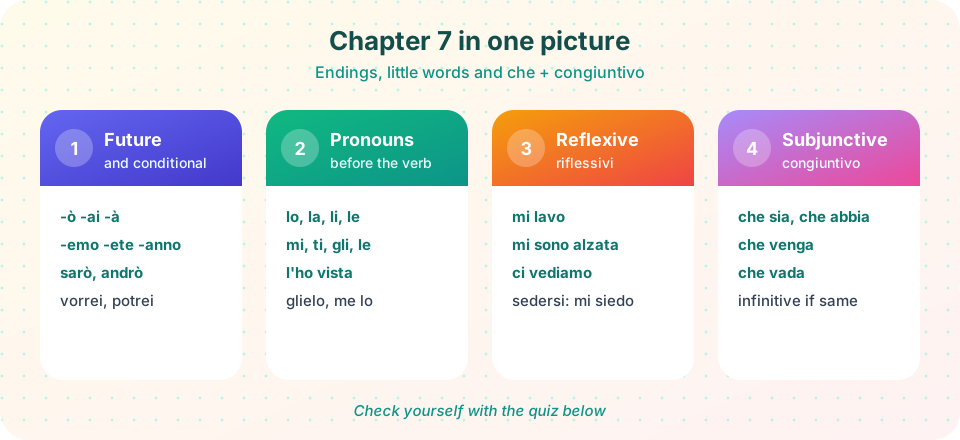
Chapter 7 in one picture: endings for the future, little words that go before the verb, and che + congiuntivo.
Domani mi alzerò presto e andrò in stazione. Vorrei comprare i biglietti per Firenze, ma non so se li troverò ancora. Penso che il treno parta alle otto. Se arrivo in tempo, te lo scrivo subito. Ci vediamo domani sera!
"Tomorrow I will get up early and go to the station. I would like to buy the tickets to Florence, but I do not know whether I will still find them. I think the train leaves at eight. If I arrive in time, I will write to you right away. See you tomorrow evening!" Count the tools: future (mi alzerò, andrò, troverò), conditional (vorrei), pronouns (li, te lo), a reflexive verb (mi alzerò), the subjunctive (parta).
Spend one day on each tool. Day one: write a plan for next week using five different future forms, including two irregular verbs. Day two: take ten sentences from earlier lessons and replace the objects with pronouns. Day three: describe your morning routine with reflexive verbs in the present and in the past. Day four: write five Penso che... and Spero che... sentences about people you know. Day five: mix everything in a short message to a friend, then take the quiz and review the answers.
A mixed drill: future, pronouns, reflexive verbs and the subjunctive.
Chapter 7 mixed drill
<metacharset="utf-8"><style>*{box-sizing:border-box}body{margin:0;padding:14px;font:16px system-ui,-apple-system,'Segoe UI',sans-serif;color:#1e1b4b;background:linear-gradient(135deg,#f0fdfa,#ecfeff)}.card{background:#fff;border-radius:18px;padding:18px;box-shadow:0 10px 26px rgba(13,148,136,.18)}.n{color:#0d9488;font-size:14px;font-weight:600}.q{font-size:20px;margin:10px 0;min-height:30px}.h{color:#64748b;font-size:14px;min-height:20px}input{font:inherit;padding:8px 12px;border:2px solid #99f6e4;border-radius:12px;width:min(100%,22em)}button{font:inherit;font-weight:600;border:0;border-radius:12px;padding:9px 15px;color:#fff;background:linear-gradient(135deg,#14b8a6,#6366f1);cursor:pointer;margin:4px 4px 0 0}button.alt{background:linear-gradient(135deg,#f59e0b,#ef4444)}button.ghost{background:#e0f2fe;color:#075985}.ok{color:#047857;font-weight:600}.bad{color:#b91c1c;font-weight:600}.face{min-height:120px;display:flex;align-items:center;justify-content:center;text-align:center;font-size:30px;font-weight:700;border-radius:16px;background:linear-gradient(135deg,#ccfbf1,#e0e7ff);padding:14px;cursor:pointer;margin:10px 0}.note{color:#475569;font-size:15px;min-height:22px}.cols{display:grid;grid-template-columns:1fr 1fr;gap:10px}.cols button{display:block;width:100%;margin:0 0 8px;background:#f1f5f9;color:#1e1b4b;border:2px solid #cbd5e1;text-align:left}.cols button.sel{border-color:#6366f1;background:#e0e7ff}.cols button.done{border-color:#10b981;background:#d1fae5;color:#065f46}.cols button.wrong{border-color:#ef4444;background:#fee2e2}</style><divclass="card"><divclass="n"id="n"></div><divclass="q"id="q"></div><divclass="h"id="h"></div><inputid="a"autocomplete="off"autocapitalize="off"spellcheck="false"aria-label="Your answer"><buttonid="b">Check</button><pid="m"class="note"></p></div><script>const items=[["Domani io ___ a Milano. (andare, future)","andrò",""],["___ un caffè, per favore. (volere, conditional, io)","vorrei",""],["Vedi Paolo? Sì, ___ vedo. (him)","lo",""],["Io ___ alzo alle sette. (reflexive pronoun)","mi",""],["Penso che lui ___ stanco. (essere, subjunctive)","sia",""],["Hai comprato le mele? Sì, ___ ho comprate. (them)","le",""],["Noi ___ vediamo domani. (each other)","ci",""],["Spero che tu ___ bene. (stare, subjunctive)","stia",""]];let i=0,score=0,checked=false;const$=id=>document.getElementById(id);constnorm=s=>s.toLowerCase().replace(/[.,;!?]/g,"").replace(/[\u2018\u2019]/g,"'").replace(/\s+/g," ").trim();conststrip=s=>norm(s).normalize("NFD").replace(/[\u0300-\u036f]/g,"");functionrender(){const it=items[i];$("n").textContent="Question "+(i+1)+" of "+items.length+" - score "+score;$("q").textContent=it[0];$("h").textContent=it[2]?"Hint: "+it[2]:"";$("a").style.display="";$("a").value="";$("m").textContent="";$("m").className="note";$("b").textContent="Check";checked=false;$("a").focus();}functionact(){if(i>=items.length){i=0;score=0;render();return}if(checked){
i++;if(i>=items.length){$("n").textContent="";$("h").textContent="";$("q").textContent="Finished! Score: "+score+" / "+items.length;$("a").style.display="none";$("m").textContent="";$("b").textContent="Try again";return}render();return;}const opts=items[i][1].split("|"),g=norm($("a").value);if(!g){return}if(opts.some(o=>norm(o)===g)){score++;$("m").className="ok";$("m").textContent="Corretto! "+opts[0]}elseif(opts.some(o=>strip(o)===strip(g))){$("m").className="bad";$("m").textContent="Almost - watch the accent: "+opts[0]}else{$("m").className="bad";$("m").textContent="Not quite. Answer: "+opts.join(" / ")}$("n").textContent="Question "+(i+1)+" of "+items.length+" - score "+score;
checked=true;$("b").textContent="Next";}$("b").onclick=act;$("a").addEventListener("keydown",e=>{if(e.key==="Enter")act()});render();</script>
A flashcard deck for the chapter's high-frequency forms.
Chapter 7 review cards
<metacharset="utf-8"><style>*{box-sizing:border-box}body{margin:0;padding:14px;font:16px system-ui,-apple-system,'Segoe UI',sans-serif;color:#1e1b4b;background:linear-gradient(135deg,#f0fdfa,#ecfeff)}.card{background:#fff;border-radius:18px;padding:18px;box-shadow:0 10px 26px rgba(13,148,136,.18)}.n{color:#0d9488;font-size:14px;font-weight:600}.q{font-size:20px;margin:10px 0;min-height:30px}.h{color:#64748b;font-size:14px;min-height:20px}input{font:inherit;padding:8px 12px;border:2px solid #99f6e4;border-radius:12px;width:min(100%,22em)}button{font:inherit;font-weight:600;border:0;border-radius:12px;padding:9px 15px;color:#fff;background:linear-gradient(135deg,#14b8a6,#6366f1);cursor:pointer;margin:4px 4px 0 0}button.alt{background:linear-gradient(135deg,#f59e0b,#ef4444)}button.ghost{background:#e0f2fe;color:#075985}.ok{color:#047857;font-weight:600}.bad{color:#b91c1c;font-weight:600}.face{min-height:120px;display:flex;align-items:center;justify-content:center;text-align:center;font-size:30px;font-weight:700;border-radius:16px;background:linear-gradient(135deg,#ccfbf1,#e0e7ff);padding:14px;cursor:pointer;margin:10px 0}.note{color:#475569;font-size:15px;min-height:22px}.cols{display:grid;grid-template-columns:1fr 1fr;gap:10px}.cols button{display:block;width:100%;margin:0 0 8px;background:#f1f5f9;color:#1e1b4b;border:2px solid #cbd5e1;text-align:left}.cols button.sel{border-color:#6366f1;background:#e0e7ff}.cols button.done{border-color:#10b981;background:#d1fae5;color:#065f46}.cols button.wrong{border-color:#ef4444;background:#fee2e2}</style><divclass="card"><divclass="n"id="n"></div><divclass="face"id="f"tabindex="0"role="button"aria-label="Flip card"></div><divclass="note"id="note"></div><buttonid="flip">Flip</button><buttonid="know"class="alt">I knew it</button><buttonid="again"class="ghost">Again later</button><buttonid="say"class="ghost">Listen</button><pclass="note"id="m"></p></div><script>const items=[["sarò","I will be","future of essere"],["andrò","I will go","future of andare"],["vorrei","I would like","conditional of volere"],["l'ho vista","I saw her","participle agrees with la"],["me lo dai?","will you give it to me?","mi + lo = me lo"],["mi sono svegliata","I woke up (female)","reflexive + essere"],["penso che sia","I think that it is","subjunctive of essere"],["voglio che tu venga","I want you to come","venga from venire"]];let deck=items.map((_,k)=>k),flipped=false,known=0;const$=id=>document.getElementById(id);functionrender(){$("n").textContent="Known "+known+" of "+items.length+" - "+deck.length+" left";if(!deck.length){$("f").textContent="Tutto fatto! All cards known.";$("note").textContent="Press Again later to restart.";deck=items.map((_,k)=>k);known=0;flipped=false;return}const it=items[deck[0]];$("f").textContent=flipped?it[1]:it[0];$("note").textContent=flipped?(it[2]||""):"Tap the card to see the English.";}functionflip(){flipped=!flipped;render()}$("f").onclick=flip;$("flip").onclick=flip;$("know").onclick=()=>{deck.shift();known++;flipped=false;render()};$("again").onclick=()=>{deck.push(deck.shift());flipped=false;render()};$("say").onclick=()=>{try{if(!deck.length||!("speechSynthesis"in window)){$("m").textContent="Speech is not available in this preview.";return}const u=newSpeechSynthesisUtterance(items[deck[0]][0]);u.lang="it-IT";window.speechSynthesis.speak(u);$("m").textContent="";}catch(e){$("m").textContent="Speech is not available in this preview."}};render();</script>
And a sentence transformer: replace a noun with a pronoun, using the forms from lesson 2. This is a rule-based demonstration, not a parser.
JS
Noun to pronoun transformer
const map ={m:{s:"lo",p:"li"},f:{s:"la",p:"le"}};const pairs =[["Vedo il film.","m","s"],["Compro le mele.","f","p"],["Leggo la lettera.","f","s"],["Mangio i biscotti.","m","p"],];for(const[sentence, g, n]of pairs){const[verb]= sentence.split(" ");
console.log(sentence.padEnd(22),"->",`${map[g][n]}${verb.toLowerCase()}.`);}
Press Run (or Ctrl + Enter) to see the console output here.